Saffron milk.

Saffron milk

My friend Seti says that to “activate” saffron, you grind a little bit of it with a pinch of sugar, then steep it in hot water until the colour deepens. Then you can use the liquid whenever you make rice, or whatever you want to make taste like saffron. She brought me saffron back home with her from Iran, and this is the first saffron that has gone instantly yellow for me, like tiny droplets of yellow food colouring but fragrant. The Trader Joe’s stuff now seems like orange sawdust in a little jar, six dollars for nothing and I’ve got eighteen US dollars’ worth.

It seemed like it was worth a lot more before I knew how well saffron could bloom, and how little of it you’d have to use if you used the good stuff. Everything is fine until you learn there’s something better. Maybe I should have ground the Trader Joe’s stuff down with a bit of sugar. I didn’t know how well that could work.

We’ve finished our first full week of Kindergarten even though I am pretty sure this just happened, but what do I know? On the first day, that just-recently-a-baby and I stopped at Starbucks for hot chocolate on the way in, both of us chattering all the way about the things we’re looking forward to: reading books, writing books, fighting bad guys, flying on planes, and getting big enough for bigger adventures.

I took this week off of work, partly because I wanted to concentrate on a bit of writing in a quiet apartment for once, but mostly because we have yet to sort out the details around Kindergarten drop-off and pick-up, and because the teachers ease the kids into school, gradually increasing the number of hours they’re in the classroom until they get to a full day, even the daycare kids for whom “full days” have always meant days longer than our work-days. “Gradual entry should be optional!” I exclaim to everyone but also no one in particular. I am talking to myself.

So I’ve been walking two little boys to Kindergarten, mine and his friend who are a month apart in age and who is like a cousin or brother because they’ve been together, always for long days, since they were barely sentient. We cut through a park and on the way we stop at a pond and look at the ducks, and then they pick things up off the ground that I ask them not to, and then I shout at them for throwing things at the ducks.

I listen to the other moms with their sweet, calm voices around their children who are surely as infuriating as mine is, as I think most children can be, and I practice their tones but when I do it, it always comes off a little condescending. In the yellow light that tints these fall mornings, both kids sort of glow, their fair hair almost ginger, the bright colours of their little boy clothes somehow over-saturated. I try not to talk too much.

“Stop throwing crap at the ducks!” I have already come down with a cold.

To make saffron milk, take a pinch of saffron, just what you can grab with the tips of your thumb and forefinger, and grind it into your palm with the thumb of your other hand until the strands crumble into little pieces. Good saffron has a smell a little bit like sweet pepper, and reminds me a bit of anise, not because of its fragrance but because of the way both are sweet and bitter at the same time.

Saffron milk is an old-fashioned Dutch cold remedy, though the Dutch had trading posts in India for over 200 years so it’s likely that merchants there were influenced by Ayurveda and the medicinal use of saffron milk to improve sleep, reduce inflammation, and to strengthen the baby’s heart during pregnancy.

Dutch mothers are said to be patient people. I like the idea that someone has figured out parenting and is doing it right, somewhere. It makes me feel like anyone could do it.

Add your bits of saffron to a saucepan with a cup and a half or so of milk, and about a teaspoon of honey. Natural health proponents suggest drinking warm milk and honey as a sleep aid, as both are sources of tryptophan. What science says about this is kind of a downer, of course, but there is something soothing about a warm mug in your hands nevertheless.

Bring the milk to a boil over medium heat, whisking quickly for maximum frothiness. Remove the pot from the heat, and pour the whole thing into a mug or two teacups. It makes about twelve ounces, or the amount of a tall Starbucks latte. This is enough for one or two people.

When you sip your saffron milk, do so with your eyes closed. Think about little golden boys, and the way they shine now, the way they are like sunflowers stretching toward the yellow morning light. Do not think about those blue shadows stretching out behind them, where you stand, fretting, worrying about the time. They call out to the ducks, and the ducks swim away faster as their voices rise to be heard.

“Come on, boys. We have to go,” you say. And you hurry them along.

saffron_milk


General Tso’s Chicken + Cookbook Giveaway

I have been kind of obsessed with General Tso’s Chicken since last spring, when I sat in my dark living room and watched The Search for General Tso on Netflix, and on an empty stomach. I think General Tso’s is the kind of thing that is a phenomenon in the US; in Canada we have our own interpretation of “Chinese food” – did you know that Ginger Beef was invented in Calgary, Alberta? Anyway, it looked delicious and I needed to get into it right away. I wish I could see people doing yoga and react with the same sense of urgency.

General Tso’s Chicken is not served at dim sum, which is how we most often enjoy Chinese cuisine, and though it appears on the occasional take-out menu, it’s never in the combos (we’re a Dinner for 2 B family, with its chicken chow mein and red saucy sweet-and-sour pork). For too long, there was no opportune time to get to know the General. No time, that is, until this past Saturday.

Thanks to Food Bloggers of Canada and Clarkson Potter, I was offered the opportunity to review a copy of food writer Kian Lam Kho‘s cookbook, Phoenix Claws and Jade TreesIn order to fulfill my part of the deal, I was tasked with preparing a dinner with a few of the dishes from the book. To get a sense of the variety of recipes, I read the whole thing in a single evening, shouting excitedly at Nick about all the wonderful things we would get to have once he cleaned the kitchen and figured out how to get me eight pounds of nontoxic pottery clay (Beggar’s Chicken, page 314).

This book is beautiful. The writing is clear and well-paced; the photos are stunning and often demonstrate multiple steps in a single collage. Everything about it says “cooking Chinese cuisine unlike anything you’ve seen on a North American take-away menu is easy and fun and you should do it right now. Right now!” And while I can’t speak to the ease of obtaining the ingredients just anywhere, in Vancouver it was only as challenging as deciding which T&T to go to (Renfrew & 1st Avenue won out – free parking).

Within an hour, I had gathered all of the ingredients to prepare six recipes from the book for a Mid-Autumn Festival feast for three friends. The ingredients were very affordable. I think I spent $53 on the entire meal (including a very cheap and sort of embarrassing rosé), and we had leftovers for two days.

We had:

  • General Tso’s Chicken (page 174, recipe below)
  • Red Cooked Lion’s Head, a braised pork meatball with water chestnuts and greens (page 198)
  • Mapo Tofu,  a mix of beef and tofu with chili paste and fermented beans (page 211)
  • Black vinegar and garlic vinaigrette (page 327 served over steamed yu choy that I had chilled before serving)
  • Cucumber salad with garlic (page 336)
  • Spicy lotus root salad with Szechuan pepper, chilies and cilantro (page 338)

There were so many intriguing dishes in this book, and a good mix of challenging dishes to prepare when you’ve got the time and quick, straightforward recipes you could make on a weeknight or for company.

The best thing about this book, at least for me, is that most of the recipes are designed to make two servings: this way, I can make enough for Nick and I for a weekend lunch or weeknight dinner, or make a dinner party of multiple dishes without going overboard on quantity. I also love that so many of the dishes are so inexpensive to make; the Mapo Tofu, for example, called for a quarter-pound of ground beef and two dollars’ worth of tofu.

Once you build a pantry of some of the book’s more frequently used ingredients, you can make the recipes quickly and cheaply. I’ve already used the Szechuan chili paste from the Mapo Tofu twice more since Saturday. It brings boring old steamed broccoli or scrambled eggs to LIFE.

My dinner guests were split on their favourites – one liked the Red Cooked Lion’s Head: “I’ve never had this dish before,” she said, “but the flavour reminds me of something similar I might have eaten as a child.” Another was quite keen on the black vinegar and garlic dressing, which I’ll agree is incredible, especially for how simple it is.

I fell in love with the Mapo Tofu, a dish I have been fond of for my whole life in Vancouver – this version was so simple, but so perfectly spicy and salty and balanced. And General Tso’s Chicken? It’s not too sweet, with a lot of garlic and a little bit of vinegar and heat: in short, it’s everything I hoped it would be.

General Tso’s Chicken

Makes two servings.

Marinade

  • 2 tbsp. Shaoxing cooking wine
  • 1 large egg white
  • 1/2 tsp. salt
  • 1/4 tsp. ground white pepper
  • 1 lb. boneless, skinless chicken thighs, cut into 3/4-inch cubes

Sauce

  • 3/4 cup chicken stock or water
  • 1/4 cup Shaoxing cooking wine
  • 2 tbsp. Chinkiang black vinegar
  • 1 tbsp. soy sauce
  • 1 tsp. hoisin sauce
  • 2 tbsp. tapioca starch
  • 1 tbsp. sugar
  • 4 cups vegetable oil
  • 3/4 cup tapioca starch
  • 3 tbsp. minced garlic
  • 1 tbsp. minced fresh ginger
  • 1/4 cup dried red chilies
  • 1 tbsp. roasted sesame oil
  • 1 tsp. sesame seeds, toasted
  • 2 tbsp. thinly sliced scallion greens

In a medium bowl, whisk together marinade ingredients. Add the chicken cubes, and, using your hands, work the marinade into the meat so that all pieces are well-coated. Set aside for 20 minutes.

Meanwhile, mix sauce ingredients together in another bowl. Set this aside too.

Put the tapioca starch into a bowl.

In a wok or Dutch oven, heat the vegetable oil to 375°F, or until it shimmers. Dredge the chicken pieces through the tapioca starch until well-coated. Working in batches, fry chicken pieces in the hot oil until golden brown, four to five minutes. Remove chicken with a slotted spoon to a plate lined with paper towels.

Pour off all but two tablespoons of the cooking oil, then return your wok or pot to the stove and add the garlic and ginger, cooking for about 30 seconds; do not let these burn. Add the chilies and cook for another 30 seconds. Give the sauce mixture a quick stir, then add this to the wok or pot and cook for about a minute, until the sauce has thickened. Return the chicken to the wok or pot and toss the pieces in the sauce. Add the sesame oil, then toss again.

Garnish with sesame seeds and scallions. Serve with rice and a cold salad.

The giveaway

To win a copy of Phoenix Claws and Jade Trees from Clarkson Potter, leave a comment below describing your favourite Chinese dish. You can leave comments until 11:59 PST on October 2; on October 3, I’ll put all the names in a hat and draw a winner. The winner will be notified by email on October 3.

Please note that this giveaway is for Canadian readers only; watch redcook.net after September 14 for information on giveaways for American readers.

Disclosure: I received a copy of this book for free. However, I really like the book and would buy it for myself if it wasn’t offered to me first. No one pays me money for my opinions, which is probably for the best.

Tempeh with tomatoes and eggplant.

tempeh with tomatoes and eggplant

If you like ratatouille, I think you’ll be into this. It’s got all that deep tomato flavour, but with a touch of smoke and a bit more texture, thanks to the tempeh, and the flavours are sweet and sour and spicy all at once. It also comes together in about half an hour, so it is in many ways a perfect cloudy summer day dish, nourishing and flavourful but not a huge pain in the ass to pull together on a weeknight.

Tempeh is a fermented soy product that originated in Indonesia, where it’s very popular in Bali – the soybeans are bound together by a mold that sort of resembles the white rind on a wheel of brie. It’s a living food that’s very high in protein and fibre, and it’s got a mild flavour and firm texture that has allowed me to pass it off as chicken nuggets to some of our less discerning family members. Tempeh is often found near the tofu in the market; if you can’t find it, you can use extra firm tofu.

If you’re in Vancouver, check out Tempea Foods tempeh, which is made locally and often available at the Vancouver Farmer’s Markets. I am in love with this product (I don’t get paid to say that, so it’s earnest).

For the recipe that follows, if you’re not able to find tamarind paste, use cooking molasses. If you’re not able to find lime leaves, use the zest and juice of an additional lime. Look for fresh lime leaves in Asian grocery stores or in the Asian ingredients section of your market’s produce section; you can often find dried or frozen lime leaves in Asian markets as well.

An aside: Why The Name ‘Kaffir Lime’ Is Wildly Offensive To Many.

IMG_6540Tempeh with tomatoes and eggplant

(Makes four servings.)

  • 3 tbsp. canola or vegetable oil, divided
  • 2 shallots, roughly chopped
  • 6 garlic gloves
  • 1″ (2.5 cm) piece ginger, peeled and sliced
  • 1 stalk lemongrass
  • 3 tbsp. brown sugar
  • 2 tbsp. sambal oelek
  • 1 tbsp. tamarind paste
  • 1 tbsp. fish sauce
  • 1 tsp. ground turmeric
  • 1 lime leaf
  • Zest and juice one one lime
  • 7 oz. (200 g) block tempeh, cut into inch-wide squares
  • 1/2 lb. (225 g) Japanese eggplant, halved lengthwise and cut into inch-wide pieces
  • 1 1/2 lbs. (680 g)  tomatoes, quartered lengthwise and then widthwise into 8 pieces
  • 1 tsp. coarse salt
  • 1/2 tsp. ground black pepper
  • 1/2 cup toasted cashews
  • Finely chopped scallions, for garnish

Heat one tablespoon of oil in a large pan over medium-high heat. Add the shallots, garlic, ginger, and lemongrass, and cook – stirring occasionally – until browned and slightly charred in places, about three minutes. Pour this mixture into a blender.

To the blender, add brown sugar, sambal oelek, tamarind paste or molasses, fish sauce, ground turmeric, lime leaf (if using), and lime zest and juice. Blend until pureed. Set aside.

Add the pan back to medium-high heat and add another tablespoon of oil.

Cook the tempeh for about two minutes per side, until browned and charred in places. Remove tempeh to a plate lined with paper towel.

Add the final tablespoon of oil to the pan. Cook the eggplant in a manner similar to the tempeh – until browned and charred in bits. Another two minutes.

Add the tomatoes to the pan, and add the tempeh back. Reduce heat to medium. Add the reserved blender mixture. Add salt and pepper. Stir the mixture together and cook – stirring occasionally – until the tomatoes and eggplant have expressed most of their liquid and the sauce has thickened, another 10 to 12 minutes. The mixture should resemble a chunky tomato sauce.

Stir cashews into the pan, and then sprinkle with scallions. Serve over rice.


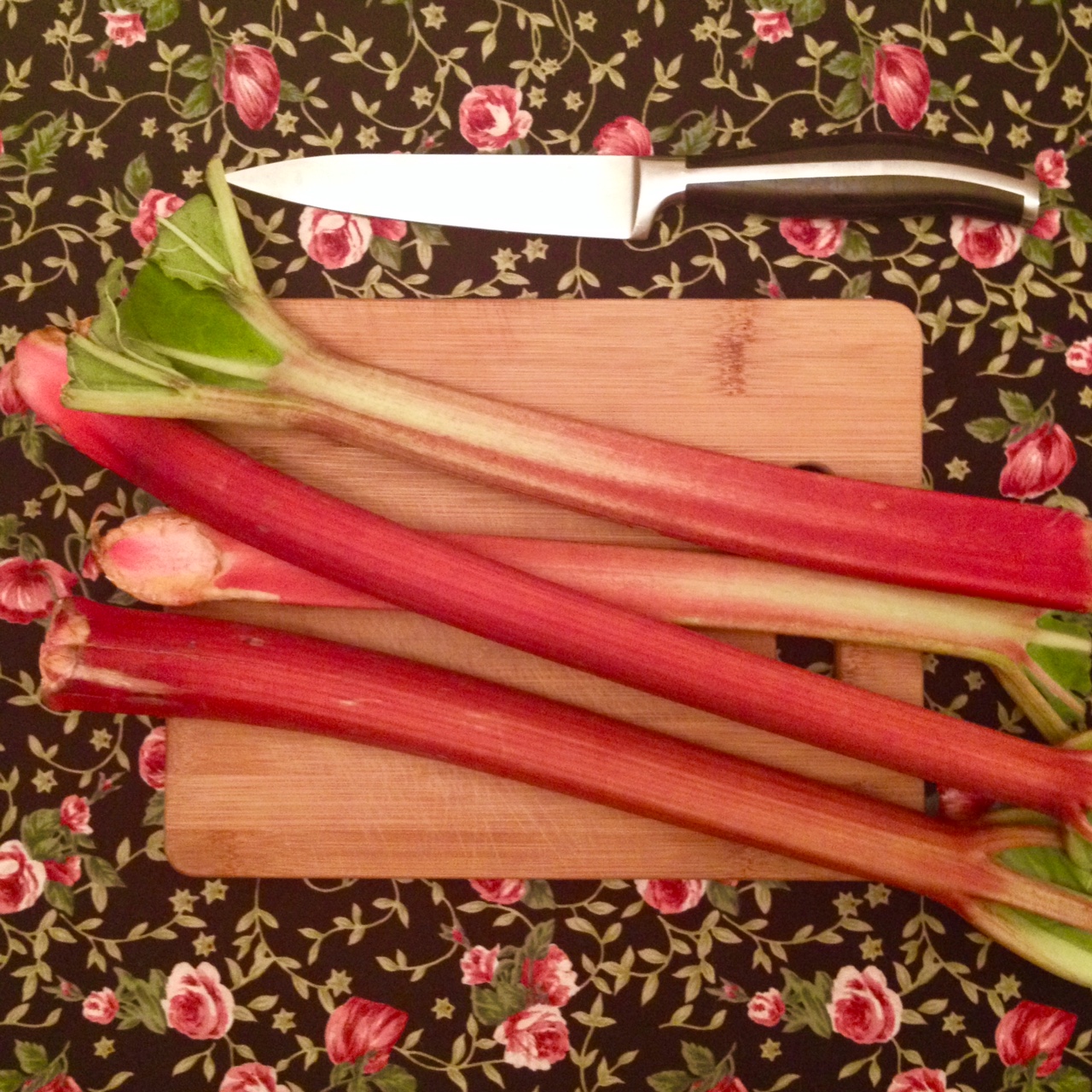
Rhubarb sauce with rosemary.

My parents have always had a rhubarb plant in the backyard; I think the plant originated with my grandparents, but I can’t be sure. I like the idea that it might have, but it could just as easily have come from Art Knapp’s Plantland, a nursery we’d sometimes go to where you could ride in golf carts to pick up infant cherry trees and the stubby shrubs that divided every suburban home from the one beside it.

We always had rhubarb pie, rhubarb crisp, rhubarb and dumplings, and, if we were lucky, rhubarb sauce, which was best over vanilla ice cream, but also worked pretty well as a pancake topping.

I don’t know why we had rhubarb; it’s not an easy fruit to feed to kids, and yet I recall eating it from the beginning, or as close to the beginning as I’m able to remember. It’s sour and stringy, and some years are worse than others, but every spring it turned up in my mom’s pots and pie plates, sweetened with white sugar and apples, and sometimes with strawberries. It didn’t matter if the rhubarb wasn’t good that year – Mom just added more sugar. Maybe that’s what I saw in it?

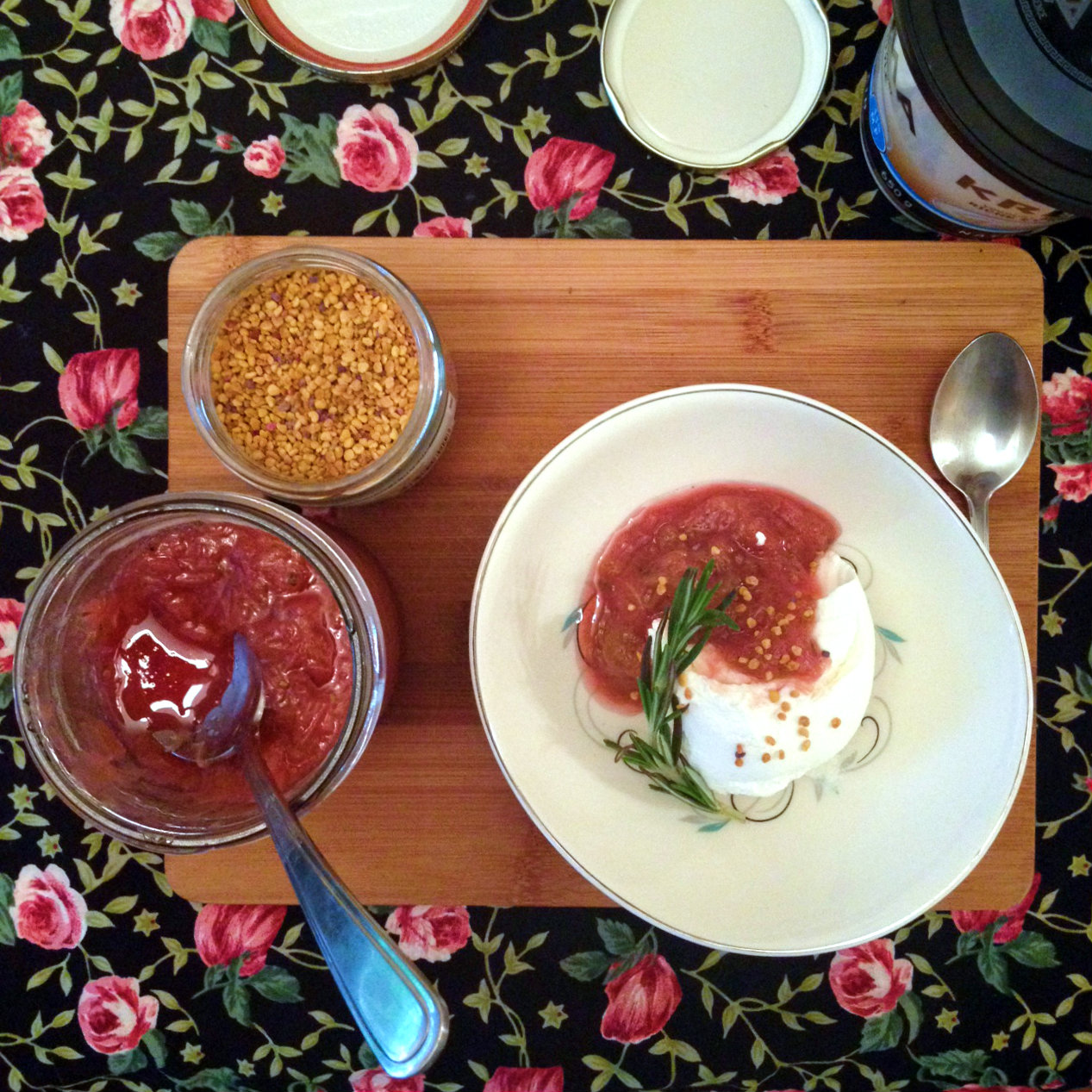
There’s less rhubarb in my life now, as I can’t just pop into the back yard and pull a few stalks out of the garden as I need them, though I did scope out my mother-in-law’s plant on the weekend with moochy intent – it wasn’t ready. Now if I want rhubarb, I need to pay for it. Fortunately, they had it at the farmer’s market this past weekend. I didn’t buy quite enough for pie or cobbler or crisp, but I did grab enough to stew into sauce; this one is a little sweet, a little savoury, and great with rich, fatty Greek yogurt and a few flecks of black pepper and bee pollen, if you’re into that sort of thing.

The rosemary is what makes this; a little goes a long way, and the end result tastes the way spring feels, especially those first few warm rays of morning sunlight through your kitchen window after it’s rained for weeks and weeks.

Rhubarb sauce

(Makes about 2 cups.)

  • 1 lb. rhubarb, trimmed and cut into 1/4-inch-thick slices
  • 1/2 cup honey*
  • 1/2 tsp. chopped fresh rosemary
  • 1/4 tsp. ground black pepper

In a covered pot over medium-low heat, simmer rhubarb and honey for ten minutes, or until rhubarb has expelled most of its liquid.

Remove lid, and simmer for 15 to 20 minutes, until sauce has thickened to the consistency you desire; I like a slightly chunky sauce.

Add rosemary and pepper, and simmer for a minute or two, and then spoon it into a jar and use as needed. Keeps for about a week in the fridge; if you end up making extra, it’s wonderful baked into muffins instead of applesauce.

*You may have to sweeten this to taste, depending on the rhubarb you get. Taste as you go, but keep in mind you may need up to 2/3 cup of sweetener per pound of rhubarb and this will vary from plant to plant and year to year. 


Maggi meatball soup.

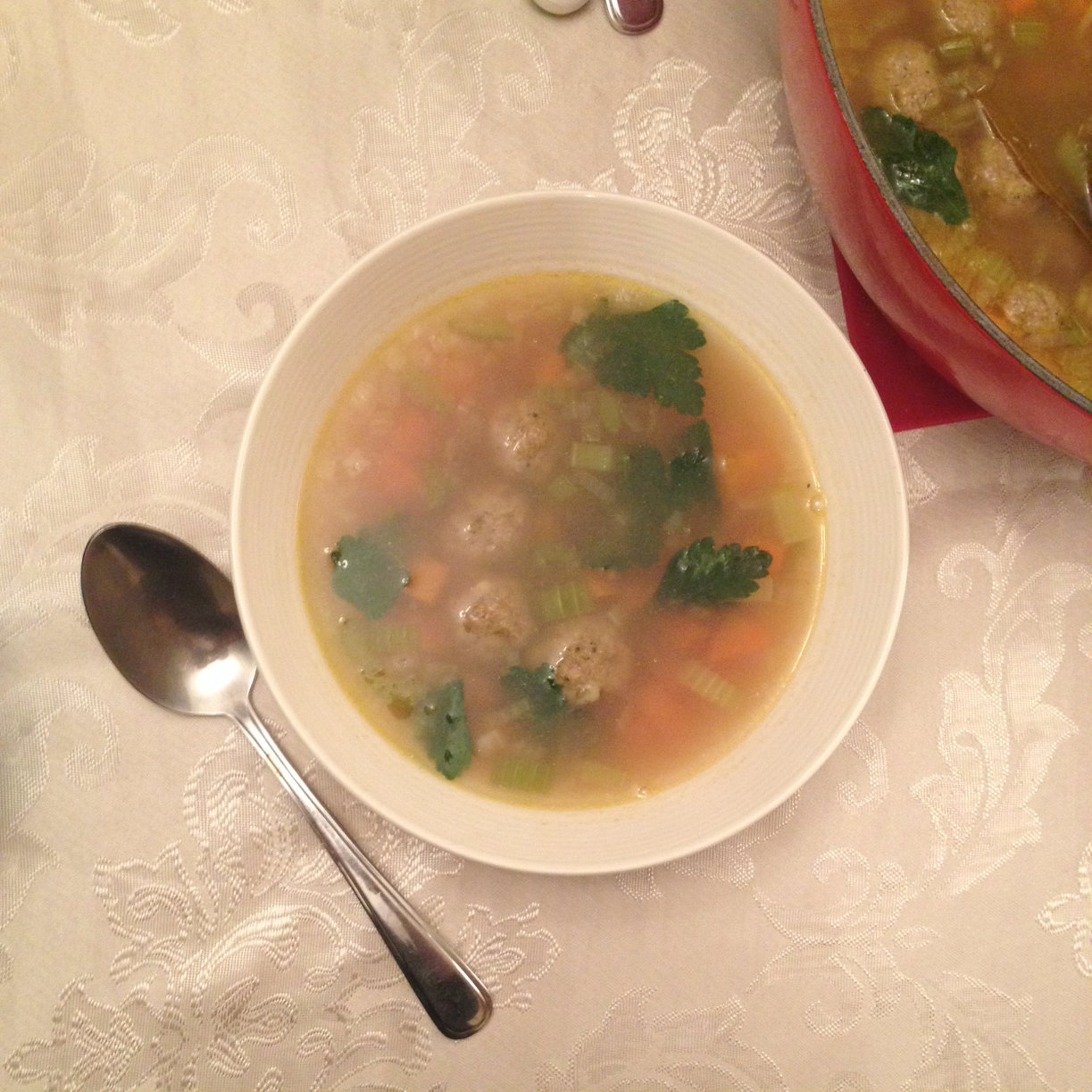
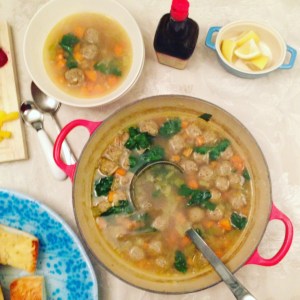
Maggi meatball soup started out as “groentesoep met balletjes,” or Dutch vegetable soup with meatballs, which I guess it still kind of is? It kind of is. Maggi, the shorthand name for Maggi-Würze, is a sweet, soy-based seasoning sauce Dutch people (and not just Nick) use in abundance, whether a dish needs it or not. It’s actually a rather international thing – Maggi sauce spans continents, and is used everywhere from the Netherlands to the Philippines, from Germany to Pakistan. It’s sweet, very salty, and keeps forever without needing to be refrigerated, and it’s great for seasoning meatballs.

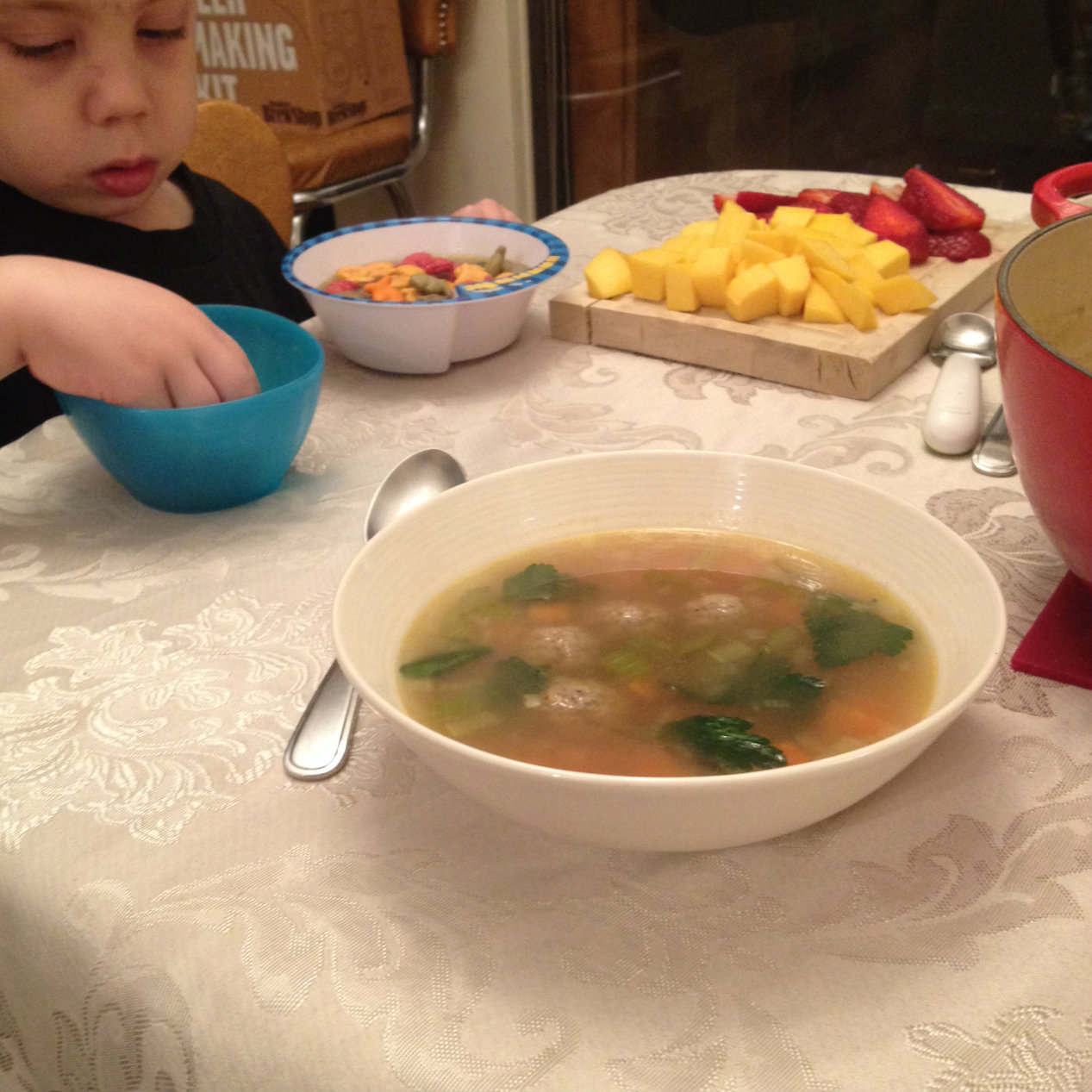
This soup is somewhere between Italian Wedding and plain old chicken soup, with soft, tender meatballs, noodles and veggies in a clear chicken broth. If you are like my mother-in-law, you would serve this with soft, buttered buns and thin slices of deli ham and Gouda; if you are like me, you will retrieve half a loaf of grocery store garlic bread from the depths of your freezer and then burn it under your broiler while you eat half a bag of pre-dinner chips and lose 15 minutes Googling Maggi’s origin story. If you are like my four-year-old, you will drown three handfuls of goldfish crackers in the broth and claim it is too hot to eat long after your small bowl of soup has gone cold.

Anyway, this is good with whatever you want to serve it with, but it’s best with soft white bread in some fashion.

IMG_1872Maggi meatball soup

Meatballs:

  • 1/2 lb. extra lean ground beef
  • 1/2 cup breadcrumbs
  • 1 egg
  • 1 tbsp. Maggi seasoning sauce
  • 1/2 tsp. ground nutmeg
  • 1/2 tsp. ground black pepper
  • 1 garlic clove, finely chopped

Soup:

  • 2 tbsp. olive oil
  • 2 carrots, quartered lengthwise and then chopped
  • 2 celery stalks, quartered lengthwise and then chopped
  • 1 shallot, chopped
  • 1 garlic clove, minced
  • 2 tsp. coarse salt
  • 2 tsp. yellow curry powder
  • 1 bay leaf
  • 6 cups low-sodium or homemade chicken stock
  • 1/2 cup fine egg noodles
  • 1 tbsp. fresh lemon juice
  • 1/2 cup fresh parsley leaves, roughly chopped

In a large bowl and using your hands, mush together meatball ingredients until well mixed. Form meatballs about half an inch (1.25 cm) in diameter; you should end up with about 40. Set these aside.

In a large pot over medium-high heat, add oil, carrots, celery, shallot, and garlic, and cook for about two minutes, until colours have brightened and everything’s coated in oil. Add salt, curry powder, and the bay leaf, and cook for another minute or two, until the curry is fragrant and starting to stick a little bit to the bottom of the pot. Add stock.

Bring the pot of soup to a boil, then reduce heat to medium. Drop the meatballs into the pot, stirring gently, and let these simmer for 10 minutes.

Add egg noodles,. and cook for another five minutes or until noodles are al denté.

Taste the soup. Adjust salt to taste. Add lemon juice, and parsley, remove the bay leaf, and then serve.

Hete Bliksem.

Dutch food is often comfort food, and as such, much of it is boiled to mush and then mashed and occasionally sugared in some way. Mush and sausages features heavily in the Dutch cookbooks I’ve acquired over the past year, and while that approach to cooking is not without its merits, there’s only so much mushy stuff I can pass off as dinner around here.

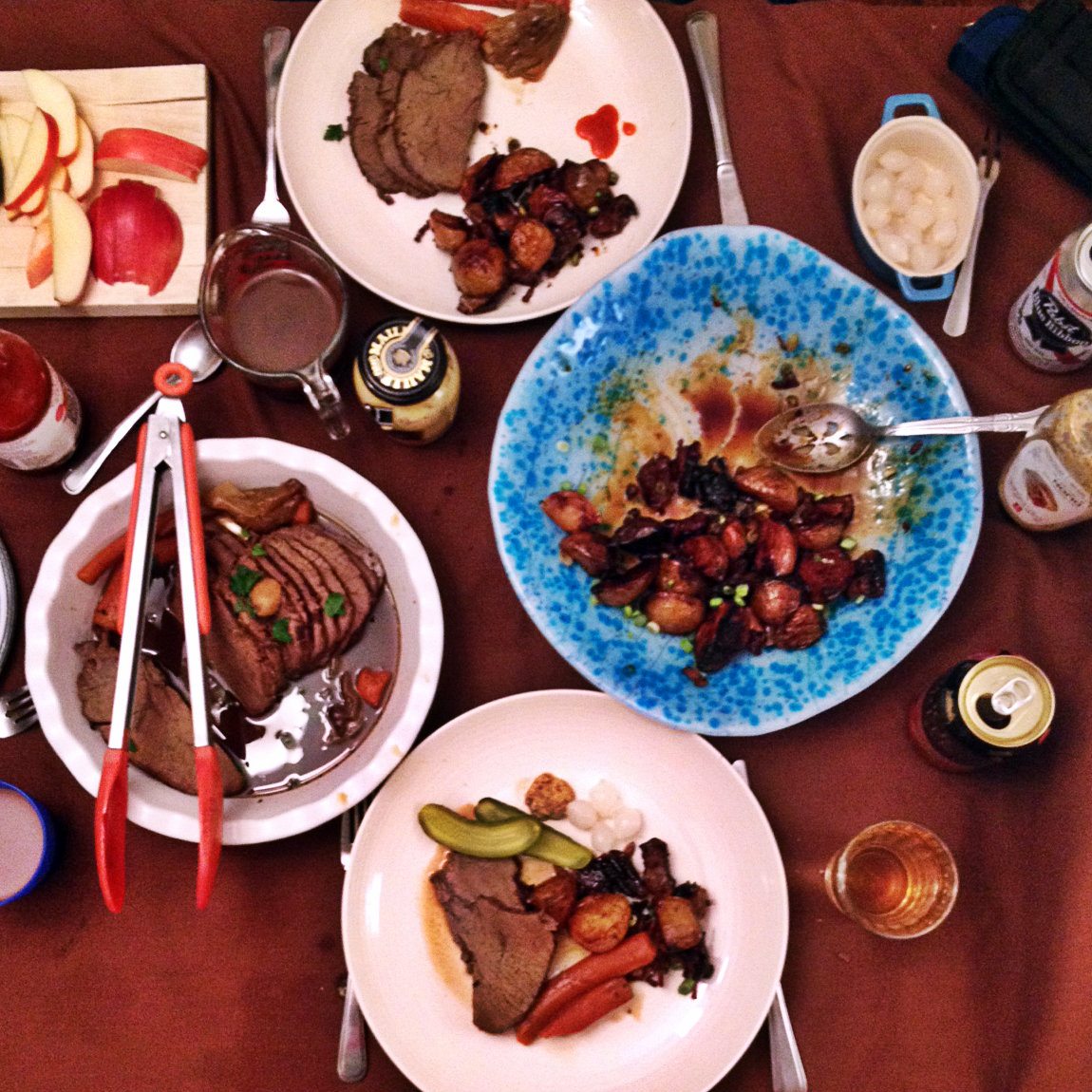
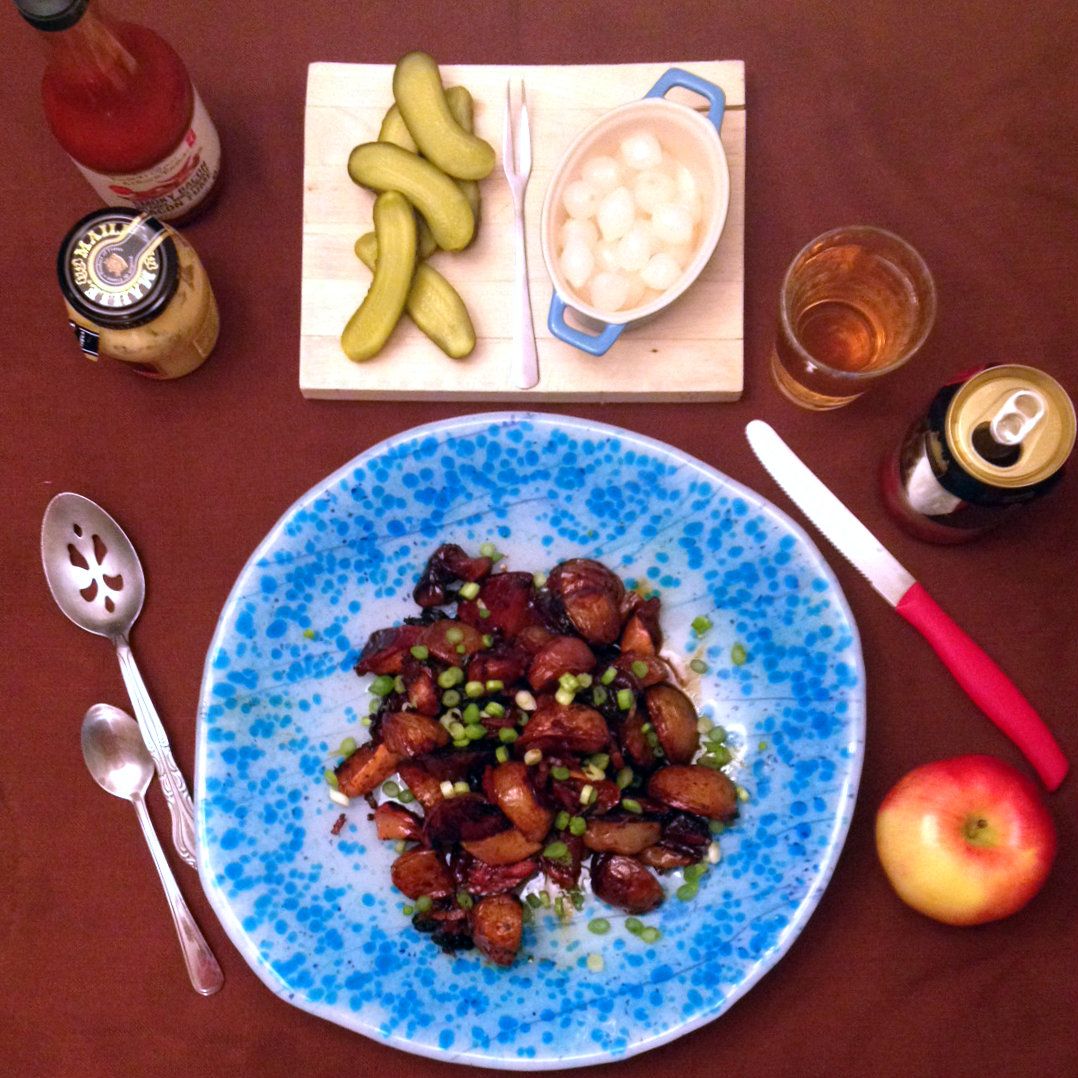
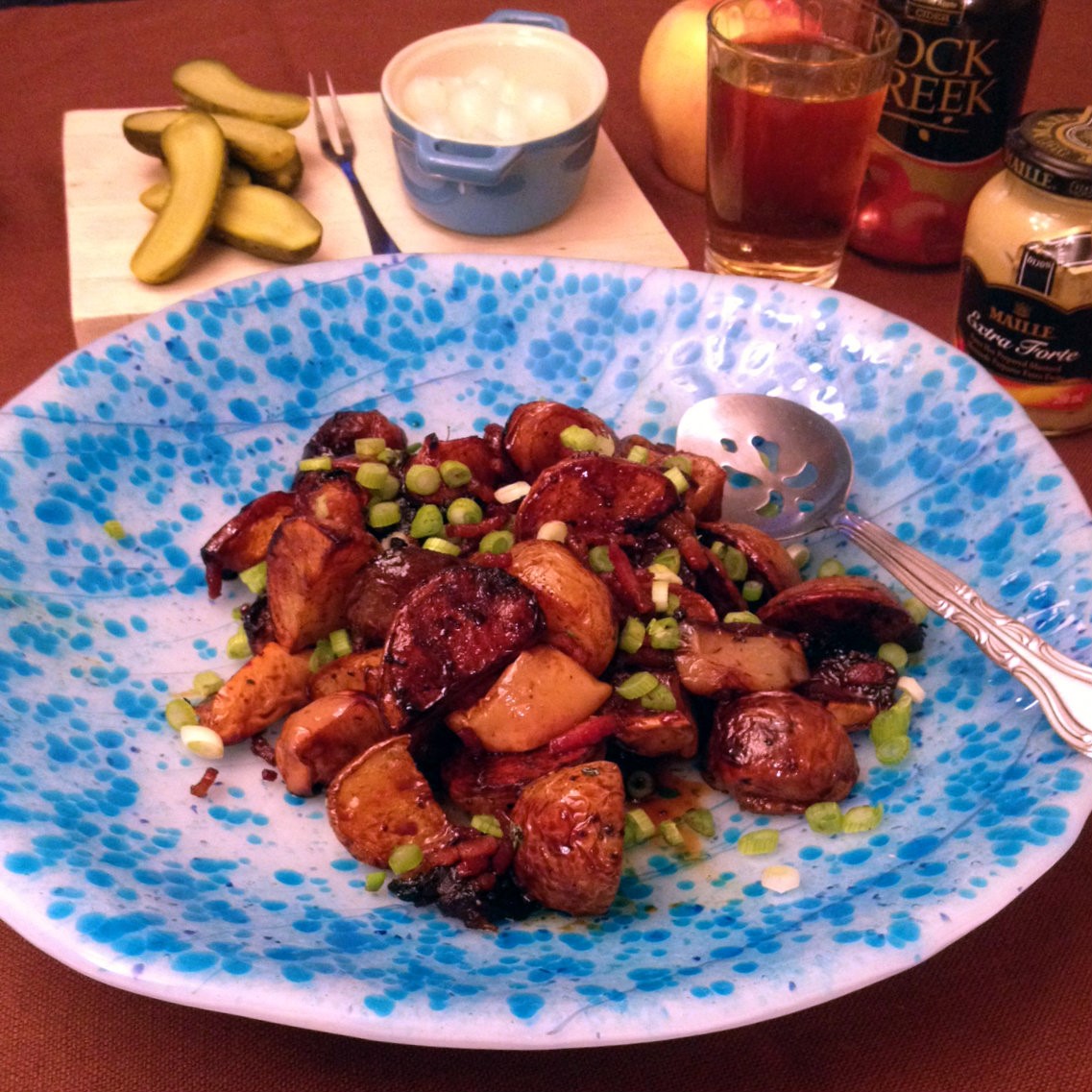
And so, Hete Bliksem. Typically, this dish is a mash of potatoes and apples with bacon or ham, and sometimes pears or onions, and it’s sometimes served with stroop, a kind of Dutch syrup. There are an infinite number of variations on this, from the very high end to the very simple. My variation falls somewhere in the middle, with an updated approach to the cooking so that the dish will stand alone as well as it would alongside a plate of sausages or roast meats.

It makes thrifty use of bacon fat and stuff you’ve probably already got in your fridge and pantry; I’d like to think the Dutch, or at least the less stubborn among them, would be pleased.

Hete Bliksem

(Makes four servings.)

  • 1/4 lb. bacon, finely chopped
  • 1 lb. crisp, sweet apples, such as Braeburn, Honeycrisp, or Ambrosia, cored and quartered, each quarter then halved again lengthwise, and then halved again cross-wise
  • 1 lb. new or nugget potatoes, scrubbed and cut into quarters
  • 1/2 tsp. coarse salt
  • 1/2 cup apple cider or unsweetened apple juice
  • 2 tbsp. fancy molasses
  • 1/4 tsp. allspice
  • 1/4 tsp. ground black pepper
  • 1 tsp. apple cider vinegar
  • 1/2 tsp. grainy mustard
  • 1 tsp. chopped fresh thyme
  • 2 scallions, finely chopped

Preheat your oven to 375°F.

In a 12-inch cast iron or other oven-transferable pan over medium high heat, cook bacon until it is very crispy and all the fat has rendered, about six minutes. Scoop the bacon from the pan and onto a plate lined with paper towel, and set aside.

You will need about three tablespoons of fat in the pan; if you don’t have another, add up to another tablespoon of fat, either bacon fat or olive oil. Add potatoes and apples to the pan, sprinkle with salt, and toss to coat.

Roast apple and potato mixture for 60 minutes, flipping midway through the cooking process.

About 10 minutes before these are done, add apple juice, molasses, allspice and pepper to a small saucepan. Bring to a simmer and cook, stirring frequently, until reduced by about half  – it should be about the consistency of maple syrup.

Add cider vinegar and mustard, and set aside.

Remove the potato and apple mixture from the oven. Sprinkle with thyme and reserved bacon, then pour apple juice reduction over top, stirring to coat. Serve in the pan, or spooned onto a serving plate, and garnish with chopped scallions.

No-recipe tacos*.

Think about the meal you want to make. Do you have everything you need? Check the fridge. You are probably out of tortillas, or perhaps you didn’t have them in the first place. Put on your boots, find your shopping bag and debit card, and walk three blocks to the corner store for corn tortillas, preferably small ones because the tacos will be held by small hands. Grab limes, cilantro, and a package of Reese peanut butter cups to eat alone later.


Grab coffee at the hipster café up the road and check your phone. Listen to the ambient rhythm of quiet chatter, and bask in the sweet sound of no one calling your name from a bathroom. Lose yourself on Instagram for 37 minutes.

Think about an alternative taco, because the chorizo might be spicy and the child, aged four years, is sensitive to anything hotter than a bell pepper, despite your best efforts to expand his palate. He likes corn. Doesn’t he? You think he likes corn, and if you caramelize the corn it will start to taste like sugar. You know he likes sugar.

Return home. Kick your boots off at the door. Notice the laundry, and how no one else has noticed the laundry. Do a load of laundry.

Do another load of laundry, and then another. Do three more loads after that. It’s possible that you are some kind of wizard and the washing machine only works for you.

The dinner hour is approaching. Answer “what’s for dinner, mum?” with “tacos” and hear “I like tacos,” which you know to be a lie because the only way he’d like tacos is if tacos were chocolate chip granola bars. Believe in yourself, and in your child, who is learning and growing and becoming a whole person who will one day genuinely appreciate and enjoy tacos. Everyone likes tacos, right? Worry that he’ll grow up to be the one person who doesn’t like tacos. Practice saying things like “he’s just really sensitive” and “I’m not disappointed.”

Mince one onion. Set two pans over medium-high heat. Into one, place a pat of butter; into the other, a glug of oil. Into the butter pan, place a quarter of the minced onion; place the rest into the oil pan. Cook the onions until they are translucent and someone wanders into the kitchen to ask for a granola bar, and to say something accusatory about the smell of onions. “Why are you cooking onions?” “I’m not.” Shoo him away.

Smash and mince one garlic clove and throw it into the butter pan. Mince one jalapeño pepper and throw it into the oil pot. Cook until the onions in both pans have turned brownish. Answer three weirdly specific questions about the male anatomy as it relates to Iron Man, the Hulk, and daddy. Pour yourself a glass of wine.

Drain a can of corn, and throw the kernels into the butter pan. Stir occasionally, until the corn smells sweet and has browned in places.

Crumble a pound or so of chorizo into the oil pan, breaking it up with the backside of a wooden spoon. Cook until charred in spots, but not burned. You’ll know it when you see it. Move the granola bars to the top shelf of the pantry, as they’re becoming a point of contention.

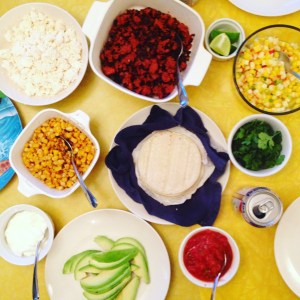
Snip cilantro leaves into a ramekin. Cut a lime into quarters. Make salsa out of mango and apple. Spoon sour cream into a small dish. Open a jar of tomato salsa. Crumble queso fresco into a bowl. Explain that Black Widow is different from Hawkeye in some ways, but similar in others, and we should celebrate those differences and not keep bugging mum about them right now. Explain that granola bars are for lunches. Explain that you don’t care what Grandma would let him have or eat or do. Shoo him away.

Soften your tortillas. Years ago, you would have prepared these individually, and lovingly, but now you use the microwave. Something about wet paper towels and stacks of six and dish cloths and 30 seconds or so on high.

Slice an avocado. Discard overripe avocado. Slice another avocado.

Call your family to the table.

“I was hoping to have … not this,” he says.

“You told me you like tacos,” you say.

“But not this kind of tacos,” he says.

“Just taste them.”

Prepare your tacos. Start with a slice of avocado, then add a little bit of chorizo, some queso fresco, and a few cilantro leaves. Squeeze a few drops of lime juice over each one.

Watch a small hand knead a soft tortilla into a wad. Watch the wad explode into crumbs as he opens his small fist. Hand him another tortilla, and tell him he must eat it. Show him how it works. Watch his small hand knead the tortilla into a wad. Pour yourself another glass of wine.

“Eat some corn,” you say.

“Eat some corn,” you say.

“Eat some corn,” you say.

Shove a spoonful of corn into his mouth.

He is crying. You are mean.

“Drink some milk, and then take another bite,” you say.

He glares at you. “You keep this up and you’re going to bed,” you say.

He will chew his first bite of corn for 20 minutes, during which your partner will eat eight tacos and you will drink another glass and a half of wine.

Send him to bed. “Can I have a granola bar?”

Wine.

Finish your tacos. Bring him back to the table.

“Are you going to eat now?” and then, “good.”

Supervise six further bites of taco and sixty minutes of chewing. Wonder if any part of this constitutes a victory. Think about your friend Grace, with her clean apartment, and about how she probably ate a beautiful meal in appreciative company just six blocks away while you were here saying stern things about corn and avocado and respectful behaviour.

Clear the table. Load the dishwasher. Fold the laundry. Listen to him tell his father a distorted version of what you told him about Black Widow. Listen to his father tell him he doesn’t think she is sad she’s not more like Hawkeye. Listen to them read a story about Black Widow. Wonder what Mexico is like, and how long you could reasonably go for and how many tacos you could eat while you’re there.

Get settled on the couch with the same or maybe another glass of wine and your secret peanut butter cups, and last month’s Bon Appétit. Loud footsteps approach, and you imagine it must sound like thunder to the people in the apartment below.

“I’m still hungry,” he says.

“You should have eaten your dinner,” you say.

“How about I have a granola bar?”

*Individual results may vary.

Saoto.

CAT.I sat on the couch all day with my cat and season two of Brooklyn Nine-Nine, sick in the belly and the head, the latest victim of the illness that’s decimated my office this past week. I ate buttered saltines because we were out of bread for toast, and I was too lazy to put on pants and boots and go outside. I ate oranges, because I thought they’d make me feel better, but then I ate too many of them.

I’ve been tinkering with a version of a soup particular to two countries colonized by the Dutch, which happened to be the perfect soup for today, and for days like these when the rain is relentless and your playlist is just one feeling-sorry-for-self song after another and even Andy Samberg can’t break through the fog of flu season in your head. It’s from Suriname, though there’s something very similar (soto ayam) in Indonesia. It is often served with a bowl of rice on the side; if you’re serving more than four, a side of rice would stretch the dish to serve more people.

The simmering broth is fragrant and soothing, all ginger and citrus, with a floral touch from the coriander. The flavours reveal themselves in moments, like waves rolling in and then back, every bite a little bit different from the last but comforting all the same; it’s salty and briny and just a little bit sweet. It will fog up your windows and you will sweat when you eat it and you will feel better, but not heavy. It’s somewhere between a bowl of laksa and bowl of chicken noodle soup, and all the work is in the beginning, so you can spend the rest of the afternoon with your cat and Jake Peralta and your sad playlists.

Lemongrass and lime leaves freeze well, so when you find them, grab a whole bunch and keep them in your freezer for days like these.

Saoto soup from Suriname.Saoto

(Makes four servings.)

  • 1 large sweet onion, such as Walla Walla, halved
  • 1 head garlic, halved cross-wise
  • 3-inch knob of ginger, peeled and sliced
  • 3 tbsp. peanut or canola oil
  • 3 lbs. bone-in skin-on chicken thighs
  • 1 tbsp. coarse salt
  • 1 tbsp. coriander seeds
  • 2 tsp. cumin seeds
  • 1 tsp. black peppercorns
  • 6 fresh or frozen lime leaves
  • 2 stalks lemongrass, trimmed and halved lengthwise
  • 1 stalk celery, cut into three pieces
  • 3 tbsp. fish sauce
  • 14 oz. (398 mL) can coconut milk
  • 2 cups finely chopped green cabbage
  • 1/4 cup chopped fresh cilantro
  • 1 lime, zest and juice
  • 1 tsp. ground turmeric
  • 4 thai bird or other hot chilies, finely chopped
  • 4 handfuls fresh bean sprouts
  • 2 scallions, finely chopped
  • 8 oz. rice vermicelli (about 1/2 package)
  • 4 hard-boiled eggs, peeled and halved
  • Celery leaves
  • Sambal oelek or other chili paste

Heat your oven to broil. Place the onion, garlic, and ginger on a sheet pan, and place under the broiler until blackened in parts, about five minutes.

Meanwhile, salt chicken thighs. Heat oil in a Dutch oven or other large, heavy pot over medium-high heat. When oil shimmers, brown the thighs a few at a time. Drain the oil from the pot.

Heat a second burner. Over high heat, in a cast iron or other heavy pan, toast coriander seeds, cumin seeds, and peppercorns until browned and fragrant, tossing regularly, about three minutes. Set aside.

Cut a large square of two layers of cheesecloth, at least eight inches by eight inches. Onto this, place your lime leaves, lemongrass, celery pieces, charred onion, garlic and ginger, and toasted coriander, cumin and pepper. Fold the ends of the cheesecloth over, then roll the bundle tightly and secure with kitchen string.

Place the Dutch oven or heavy pot back on the heat, and add eight cups of cold water. Place the chicken thighs and spice bundle in the pot, add fish sauce, then partly cover. Reduce heat to medium-low, and simmer gently for two-and-a-half to three hours, occasionally skimming the top with a spoon. If it boils, remove the lid and reduce the heat; you want the broth to remain as clear as possible.

Remove chicken and spice bundle. Shred the chicken, discarding the skin and bones (you can make another stock out of the bones, if you’re feeling thrifty). Return the chicken to the pot with the coconut milk and cabbage. Bring heat up to medium, and simmer for up to five minutes, until cabbage is tender. Add lime juice and zest, and turmeric. Taste, adjusting the seasonings to your preference. Add cilantro.

Prepare vermicelli according to package instructions, then divide evenly between four large soup bowls. Add handfuls of bean sprouts and a sprinkle each of chilies and scallions. Ladle chicken and broth into bowls, then nestle two egg halves into each bowl of soup. Top with celery leaves and sambal oelek or other chili paste, and serve with quartered fresh lime and additional fish sauce.

Gezellig, and a spot of mustard.

Mosterdsoep (Dutch mustard soup)

January is always a month of catch-up, a chilly, cloudy month when all of a sudden the bills are bigger than you thought they’d be and the deadlines you ignored in December are here, now, with projects not as straightforward as you assumed they’d be when you hastily agreed to them during the holiday season’s drinky haze. January is uncomfortable, a time for confronting excesses of every kind, including enthusiasm. Which is why we need gezelligheid.

Gezellig” is a Dutch word that doesn’t really have an English translation. Similar, in ways, to the more well-known Danish concept of “hygge,” what it means, sort of, is something along the lines of warm coziness or comfortable happiness. Pouring yourself into a pair of fleece pajamas and slumping into a heap of blankets and pillows with a cup of milky tea and a book? Gezellig. The way your favourite café or bookstore or brewery glows warm and golden against the black dampness of a January evening? Gezellig. Thick socks and Wes Anderson movies and knit scarves and slow dancing and Rufus Wainwright and the way that vanilla sugar cookies make your kitchen smell as they bake? Gezellig.

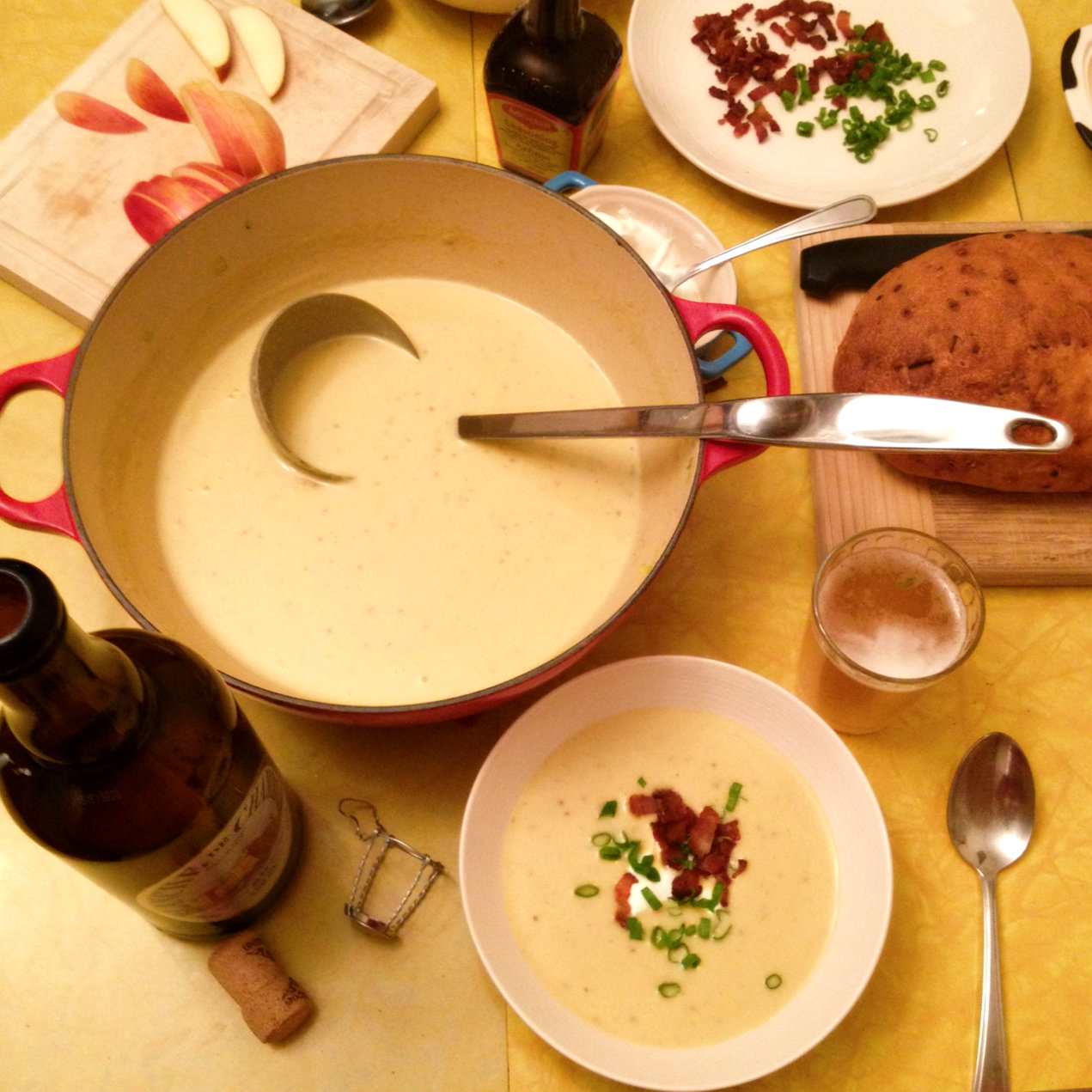
A bowl of homemade soup in the yellow light of your dining room with a small person whose hands dimple when his fingers flex to tear a hunk of bread apart, and who pauses after every third bite to get up from his seat and hug you? Gezellig.

It’s the little things that, when taken in sum, are everything. It’s that feeling where you can’t imagine going anywhere, because why would you leave? Gezelligheid is the exact right thing to embrace when it’s January and you just can’t even with any of this other stuff.

The recipe that follows is for Dutch mustard soup, a thing that is wonderful in the way that Polish dill pickle soup is – until you try it, you won’t understand why it should even exist. Traditionally this is thickened with both flour or cornstarch and egg yolks. To make it just slightly healthier, I’ve replaced the flour with a potato and added a couple of extra yolks; the result is something between vichyssoise and avgolemono, but with mustard, and it’s delicious.

Mosterdsoep (Dutch mustard soup)

(Makes 4 servings.)

  • 2 slices bacon, sliced into lardons
  • 2 cups sliced thinly sliced leek (from about two leeks, white and light green parts only)
  • 1/2 pound starchy potato, (such as Russet) peeled and diced
  • 1 garlic clove, smashed
  • 4 cups chicken stock
  • 1 tsp. coarse salt
  • 1/2 cup sour cream
  • 2 tbsp. grainy Dijon mustard*
  • 4 egg yolks
  • 1/2 tsp. yellow curry powder

In a Dutch oven or other heavy pot over medium-high heat, brown bacon until crispy, about four minutes. Scoop the bacon from the pot and onto a plate lined with paper towel. Pour off all but two tablespoons of the rendered bacon fat; if less than two tablespoons remain, make up the difference with a bit of butter.

Add leeks and quickly stir to coat in the fat. Add the potato and garlic, and then the chicken stock, scraping the bottom of the pot with a wooden spoon as you do. Add salt, and bring the liquid in the pot to a boil; reduce to medium, and simmer until potatoes are tender, about ten minutes.

Meanwhile, whisk together sour cream, egg yolks, mustard, curry powder, and two tablespoons of cold water. Set aside.

Remove the pot from the heat and purée using an immersion blender. If you don’t have an immersion blender, let this cool for about ten minutes, and, working in batches, blend until smooth in a regular blender.

Return the mixture to the heat and bring it all back up to a boil.

Remove the mixture from the heat, and, working quickly, pour the sour cream mixture into the pot in a thin stream while whisking constantly, so as not to allow the eggs to scramble. Taste, adjusting seasonings as needed; you may not need to add additional salt, as mustard is generally salty enough on its own.

Serve topped with reserved bacon, a dollop of additional sour cream, Maggi seasoning (if you’ve got it), and chopped fresh chives or scallions. Crusty bread for sopping is essential.

*If you can find it, use Zaanse Molen Dutch mustard; if not, Maille’s Thick Country Mustard (or something like it) is a good substitution. In Canada, get President’s Choice Old Fashioned Dijon mustard at any Superstore or Loblaw’s – it’ll run you about two dollars. Can’t find any of these? Mix one tablespoon of grainy Dijon with one tablespoon of regular Dijon. 

Swarni’s tofu bhurji.

Between right now and the last time I posted here, I wrote 32 drafts of posts I either forgot about or decided were terrible and then sort of thought “whatever, I give up, I AM TERRIBLE,” and then ate my way into a new pants size. The timing of the new Adele record was ideal because it hit me right at peak-wallow, and let me tell you, you do not want to read the Hello-inspired blog post I considered somewhere around the third week of December.

(For your and Nick’s benefit, I ate every last one of those feelings, many of them on crackers and with glasses of very cold white wine.)

But things are looking up. I’ve reignited my relationship with MyFitnessPal, which means I – once again – have a handy, non-human place to direct my contempt. I haven’t eaten cheese in four days, which has been hard but necessary. And I got a few work-appropriate sweater-dress/leggings outfits for Christmas and they’re making the bloat a lot easier to hide in this lumpy post-holiday interim.

And I have a few new recipes, including this one from my lovely, wonderful friend Swarni whom I bother every day at work. Swarni is an essential member of the office potluck team, and a harsh critic of any Indian food brought into the office that isn’t up to her exacting standards. She brought a big dish of her tofu bhurji in for a holiday potluck in mid-December and it was so good that I spent the rest of last month haranguing her for the recipe.

I ended up adapting the recipe a little bit, as Swarni gets her spices ground fresh when she’s in India and so they’re more potent than mine; I also use a bit of turmeric for more of an eggy colour. It’s a very mild dish and good for children (even mine, praise Swarni!), but if you like things spicy, a little (or a lot of) hot sauce works well here.

Tofu bhurji is perfect for weeknights, and January when we have no money and pretty much just fridge scraps with which to feed ourselves. I’ve used butter here, but you could easily turn this vegan by simply replacing the butter with a bit of oil. It’s a bit like scrambled eggs, in the end, but with none of the fart taste that so often accompanies a poorly scrambled egg. It’s magic, and it’s not cheese which, just this once, is a very good thing.

Swarni’s Tofu Bhurji

(Makes two to four servings.)

  • 2 tbsp. butter
  • 1/2 medium onion, finely chopped
  • 1 jalapeño pepper, seeded and finely chopped
  • 1 tsp. minced fresh ginger
  • 1 small tomato, seeded and chopped
  • 1 garlic clove, finely chopped
  • 1 1/2 tsp. Madras or other yellow curry powder
  • 1 tsp. coarse salt
  • 1/2 tsp. garam masala
  • 1/2 tsp. ground cumin
  • 1/2 tsp. ground turmeric
  • 1 cup frozen peas
  • 1 lb. (454 g) medium-firm tofu, drained and patted dry
  • Cilantro

In a large pan over medium-high heat, melt butter and stir together onion, jalapeño pepper, and ginger. Cook for about a minute, until the pepper brightens in colour, then reduce heat to medium-low. Stirring regularly, cook for seven to 10 minutes, until veggies have softened and turned golden.

Meanwhile, mash tofu with a potato masher, or use your hands to crumble it until it resembles curds of scrambled egg. Set aside.

Add tomato, garlic, curry powder, salt, garam masala, cumin, and turmeric to the pan and cook for another three to five minutes, until the liquid from the tomatoes has mostly disappeared and the contents of the pan resemble a soft paste.

Add frozen peas, and cook for another three to five minutes, until the water from the peas has mostly disappeared.

Add the tofu to the pan, and mix well. Partially cover the pan and cook for another five to seven minutes, stirring occasionally. The pan should be mostly dry on the bottom, and the tofu should be evenly coated in spices.

Taste, adjusting seasonings as needed. Stir in chopped fresh cilantro, and serve with a blurp of your favourite hot sauce and rice or warm roti bread. Would even be good on toast, come to think of it.

And Happy New Year! I hope your 2016 is delicious and everything you hope and want and need it to be.