Hunger Awareness Week: Slow cooker borscht.

Food bank use in Canada is 25 per cent higher now than it was before the first recession hit in 2008. One of the reasons for this is that many typically reliable or well-paid jobs, especially blue-collar jobs, have disappeared. Another is that wages, especially for what blue-collar jobs or less skilled labour roles remain, have not increased with the cost of living. Particularly vulnerable populations, such as the elderly or those on disability, have also been affected by inflation and corresponding lack of increase in benefits. In addition to providing emergency food hampers, many food banks provide additional services.

People who turn to food banks often need other types of assistance. Food banks have responded and many now provide advocacy and supports such as:

  • providing skills training such as food preparation skills,
    helping people to search for jobs and transition into employment,
  • raising community awareness about hunger and poverty,
  • assisting with the search for safe, affordable housing,
  • helping people find good quality, affordable child care,
  • providing referrals to other social agencies and support services.
    (Source: Food Banking in Canada)

One of the major barriers to cooking healthy meals at home is time. The logistics of poverty are often time-consuming, particularly as the cost of living in urban centres increases; to afford housing, people often live a long way from where they work or from the services they need to access. Many people rely on public transportation which, particularly in Vancouver, is only reliable in urban centres; the farther you get from the city, the bigger a hassle it can be to get to where you need to go on public transit.

Spending all day in transit can sap the enthusiasm for dinner-making from even the most devoted home-cook. The allure of convenience foods is strongest in those moments when even a pantry meal feels impossible, particularly when you need to feed other people (especially small children, who are not known for their patience or empathy).

For people who are pressed for time, crock pot recipes can be a life-saver. You can purchase an inexpensive, good quality slow cooker at department stores, but you can also find gently used slow-cookers online for pretty reasonable prices on sites like Craigslist or Kijiji. Mine holds about six quarts, which I find handy as it makes enough for dinner and for leftovers, which I can freeze or take to work for lunch.

The following recipe for a slow-cooker borscht is ideal for people for whom time is in short supply. I like to brown the meat and assemble the ingredients the night before, then put everything in the cooker in the morning before I head out the door.

It’s warming and hearty, and it makes generous use of inexpensive but nutrient-dense vegetables like beets, carrots and cabbage. And it makes a lot of it, so you can pack it into containers and reheat it whenever you need a bowl of something warm. Use cheap cuts of beef, like chuck, shank, or brisket, or omit the meat entirely (in that case, just add the butter straight to the Crock Pot).

Slow-cooker borscht

(Makes six servings.)

  • 3 tbsp. butter
  • 1 lb. cubed stewing beef (such as chuck or brisket) or beef shank
  • 1 onion, sliced
  • 2 lbs. beets, peeled, trimmed and diced
  • 1 lb. waxy potatoes, such as red or Yukon Gold, diced
  • 4 carrots, peeled and cut into one-inch pieces
  • 1/2 small head of red cabbage, cored and thinly sliced
  • 7 garlic cloves, divided
  • 1 bay leaf
  • 5.5-oz. (128 mL) can tomato paste
  • 2 tbsp. apple cider vinegar, divided
  • 1 tbsp. coarse salt
  • 1 tsp. ground black pepper
  • Sour cream and fresh or dried dill, to garnish

Melt butter over medium-high heat and add beef. Brown on all sides, and then pour into the slow cooker.scraping the pan as you do so as not to waste any of those good flavours.

Add onions, beets, potatoes, carrots, cabbage, and six smashed garlic cloves to the cooker. Add the bay leaf.

In a large bowl, whisk together the tomato paste, one tablespoon of apple cider vinegar, salt, pepper, and six cups of water. Pour this mixture over beef-and-veggie mixture.

Cook for eight to 10 hours over low heat.

Before serving, mince remaining clove of garlic and add the remaining tablespoon of apple cider vinegar. If using beef shank, remove meat from pot and shred it off the bone using the tines of a fork, then return meat to the pot and discard bones. Taste, adjusting seasonings as needed.

Serve with toasted bread and a dollop of sour cream and a sprinkle of dill.

Hunger Awareness Week: Whole grain pasta with chickpeas and caramelized tomato sauce.

http://www.youtube.com/watch?v=X0GB_YDamjQ

A well-stocked pantry has saved my butt on more occasions than I can count. Being able to open a cupboard and see a few simple things that could equal dinner is something I don’t take for granted – it’s a reassuring thing, and a luxury for many. Whether it’s because payday is too far away or I’m just too lazy to get to the market over the weekend, pantry meals warm my home and filled my belly most weeks, and have for my whole life.

When choosing non-perishable items to donate to the food bank, try to select nutritious items to fill the pantries of those with diverse dietary needs.

  • Fifty per cent of food bank users are families, including children; consider donating kid-friendly items like granola bars, breakfast items like oatmeal or other hot cereals, sugar-free applesauce, or peanut- or gluten-free items for school lunches.
  • If 20 per cent of people who use the food bank are seniors, consider seniors’ health issues (diabetes, heart disease, hypertension): select low-sodium canned goods, low-sugar or sugar-free canned or pureed fruits, lean proteins including peanut butter and legumes, whole grain and gluten-free pastas, and high-fibre grains and cereals.
  • For families with babies and young children, consider donating baby food, infant formula, or diapers in a range of sizes (not just newborn). Nursing mums need nutrition too – fortified cereals, canned fish (especially sardines, salmon, herring and mackerel), low-sodium canned soups and stews, and parboiled grains can be beneficial, especially for parents who are pressed for time.

Pasta with caramelized tomato sauce and garlic.A pantry with a few staples you’ll use again and again can go a long way to making you feel secure. Today’s recipe is an easy one – it’s comprised of stuff you probably already have, and it’s hearty enough to feed a family of four to a comfortable degree of fullness. It’s kid-friendly, at least at my table. It’s also suitable for people with diabetes, and it reheats well for lunch at work the next day.

Whole wheat pasta with chickpeas and caramelized tomato sauce

(Makes four servings.)

  • 1 lb. whole-wheat or other whole-grain pasta, such as penne or rotini
  • 19-oz. (540 mL) can of chickpeas, drained and rinsed
  • 1/4 cup butter
  • 1/2 medium onion, finely chopped
  • 4 garlic cloves, sliced
  • 1/2 tsp. red chili flakes (optional)
  • 5.5-oz. (128 mL) can low-sodium tomato paste
  • Salt and pepper to taste
  • Parsley to garnish

Bring a large pot of salted water to a boil, and add pasta. Cook according to package instructions, about 11 minutes.

Meanwhile, melt butter in a large pan over medium heat. Add onion, and cook for two minutes, until just translucent. Add chili flakes (if using) and garlic. Cook until onions and garlic have just turned golden, another three minutes. Add tomato paste. Stir constantly to keep the paste moving around the pan and cook until colour deepens and butter seems to have disappeared, four to six minutes.

Before draining the pasta, reserve about two cups of cooking water. Drain pasta, and add pasta and chickpeas to the pan. Stir, then add water half a cup at a time until sauce has loosened and coats the noodles thoroughly. Taste, adjusting seasonings as desired. Sprinkle with parsley and serve.

Hunger Awareness Week: Rice and lentil pilaf.

https://youtu.be/ru3AFJD1LxU

It’s funny how we think about poverty, and how we distance ourselves from it in reassuring ways. It’s a thing that happens to other people, and it is complicated. Maybe it’s because of their choices, we reason. As if we have made the right choices. (I, personally, am an expert in making questionable choices.) It’s a thing that happens to other people, not to us.

Not to us. But a third of us are still living paycheque-to-paycheque, at least in Canada; in the US, the numbers are even higher. According to Food Banks Canada, one in six people who access the food bank are currently employed, or have been recently. Sixty-four per cent of people who need the food bank are paying market rent. In Vancouver, nearly 20 per cent of those who need the food bank in a given week are seniors.

It could totally happen to us, to quite a few of us.

September 21 to 25 is Hunger Awareness Week in Canada. According to Food Banks Canada, “Hunger Awareness Week is about raising awareness of the solvable problem of hunger in Canada.”

Hunger in Canada exists because deep and persistent poverty continues in the country. For more than a decade, diverse and inter-related factors have sustained this situation: a labour market that fails to provide enough jobs with stable, livable wages; a rise in precarious and non-standard employment; a fraying income security system that does not provide sufficient financial support for those in need; a lack of affordable, social housing; and accessible and affordable child care. (Source: hungerawarenessweek.ca)

During Hunger Awareness Week, organizations across Canada have come together to raise awareness about the realities of poverty and the people who need food banks most. One of the major goals of this campaign is to dispel some of the myths around who accesses food banks and why. This is essential, because we’re never going to truly tackle hunger and poverty and inequality if we don’t see ourselves as part of it.

It’s not a stretch to see yourself moving from broke to poor. I can see it from here, just on the other side of some accident or emergency.

Food security is an issue that’s important to me, and so I’m spending the week highlighting a few simple, nutritious recipes a person could make to feed a family using some typical food bank staples. I’ll use the platform I have here to support the campaign, share my tips for stretching your budget and making donations anytime of year, and hopefully you’ll get a few budget-friendly recipes you can enjoy anytime, whether you need them or not.

What follows is a recipe for rice and lentil pilaf, a weeknight-friendly gluten-free vegetarian dish that’s easily made vegan. It’s good (and filling) on its own, or as a side for roasted veggies or sausages or pork chops, or as an alternative to stuffing for those who don’t do gluten. It tastes a bit like stuffing, because it’s meant to be comfort food. I serve this with beet pickles.

Rice and lentil pilaf with apple and mushrooms

(Makes four servings.)

  • 3 tbsp. butter
  • 1 medium onion, diced
  • 1 medium apple, cored and diced
  • 3 stalks celery, diced
  • 4 cloves garlic, minced
  • 1/2 lb. mushrooms, roughly chopped
  • 2 tsp. coarse salt
  • 1 tsp. dried sage
  • 1 tsp. dried thyme
  • 1 tsp. ground black pepper
  • 1 cup basmati rice, rinsed
  • 1 cup green or brown lentils, rinsed
  • Celery leaves, for garnish

In a large, heavy pot with a tight-fitting lid, such as a Dutch oven, melt butter over medium-high heat. Add onion, apple, and celery, and saute until fragrant and until onions are translucent, about three minutes.

Add garlic and mushrooms. Cook for another three to five minutes, until the mushrooms have given up most of their liquid. Add salt, sage, thyme, and pepper, and cook for one more minute, stirring to coat the veggies in the herbs.

Add rice and lentils. Add four cups of water (use chicken or vegetable stock if you prefer), and bring to a boil. Cover, then reduce heat to medium, and cook for 20 minutes.

Let rest, covered, for five minutes before serving. Garnish with celery leaves.

Crock pot membrillo (quince paste).

Country road, quince standMy friend Eileen bought a cute little house on a country road and planted quince trees. Perhaps not anticipating how prolific the trees would be, or how heavy the fruit, she planted four of them, four different varieties, and then recently took to Facebook to advertise the couple of hundred pounds of fruit she was looking to get rid of. For CHEAP.

Quince is a very dense apple-pear-type thing, and you have to cook it – it’s inedible raw. It’s got a musky, almost floral taste – a little rosy, a little appley, a little bit something else. It has a firm core that’s hard to cut through, and fuzz on its skin you have to wash off. If you’re in North America, you’re mostly relegated to getting it through friends, from abandoned orchards, or some Farmer’s Markets (if you are very lucky). It is very high in pectin.

Years ago, I got my hands on a few pounds of quince for something like $7 per pound. The market only had maybe ten pounds of them for the whole season, and because scarcity makes me irrational I bought as many as I could afford and then hoarded the jam I made out of them until a bunch of jars of it went bad in the back of my fridge when someone else opened and forgot about them.

The worst thing about marriage is when the other person lets your jam go bad without telling you. Just lets it happen. It’s still so hard to believe.

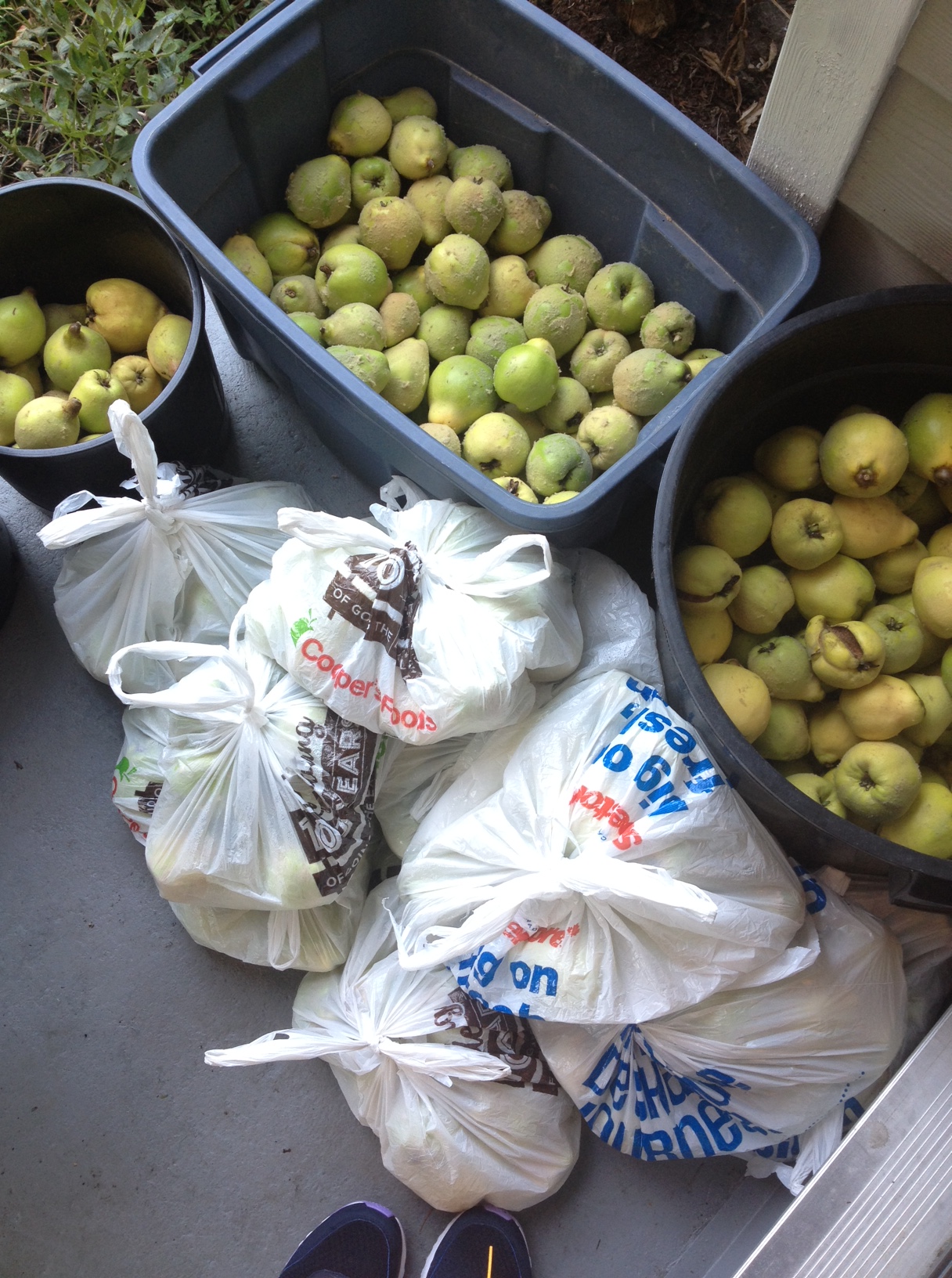
Quince haulThis time, with Eileen’s quinces, I was no less greedy but the price was much better and I was better prepared. Also, many of them were still green, and so they’ve been ripening in batches, four or five pounds at a time, and so I’ve been processing them at a leisurely pace, putting up a few here and a few there and barely breaking a sweat.

This is, in part, thanks to my trusty old Crock Pot.

The very best use for quince is a jammy paste the Spanish serve with cheese at breakfast and at tapas. It’s called membrillo, and it’s thick and sticky and garnet-red, and the process for making it is pretty straightforward but also quite time-consuming. I don’t have one million hours to peel and core and stir and stir and stir. Even if I did, I am profoundly lazy and as such, am always looking for the easier way of doing something.

The standard membrillo recipe calls for, at minimum, a ratio of two pounds quince to one pound sugar. You can add spices like cinnamon or vanilla, or strips of lemon peel, but you don’t have to.

If you were to make this on the stove, you would peel and core the quinces, add water, and cook until quinces are tender. Then you would puree them. Then you would cook them and their liquid down until a thick paste formed. Hours upon hours would pass, and this might satisfy a younger version of yourself but not this version, with her arthritic hands and arms and ill temper.

Shortcuts. Let’s take the easy way out. For this particular shortcut,  your best bet is a slow-cooker and a food mill fitted with your finest grinding disk. No food mill? A fine-mesh sieve will also work, but it will be a lot more work.

First, wash and halve your quince. For whatever weight of quince you prepare, add half the amount of sugar by weight. So, if you have five pounds of quince, use two and one-half pounds of sugar. Pour this over, and toss to coat fruit.

Slam your slow cooker lid down on the thing, set the cooker to low, and let ten hours pass. Overnight is nice. Your place will smell so good in the morning.

Get your canning stuff ready, if you plan to can. You can also freeze it.

The quince will start out yellow-peeled and white-fleshed, and by morning will have turned a winy kind of red. Working a couple of pieces at a time, process your quince halves through the food mill into a large non-reactive pot, such as a Dutch oven. Strain any remaining liquid into the pot as well, and turn your burner on to medium.

Cook until the paste has thickened and the mush appears to pull away from the the sides of the pot as you stir; the texture and consistency will be somewhat like apple butter; same idea, really. How long this takes depends on how much liquid remains in your slow-cooker; you will likely cook the paste down on the stove, stirring occasionally, for an additional 20 to 60 minutes. Some varieties of quince, like pineapple quince, may release more liquid and take longer to cook down. The colour will be a very dark red you might have a hard time believing at first.

Spoon quince paste into sterilized jars, run a knife around the edges to remove any large air pockets, and process for 20 minutes.

I started with about five pounds of quince, and ended up with just over two quarts of finished paste.

Serve on bits of bread with creamy goat’s cheese, or with an aged, nutty cheese like Manchego. Definitely have wine with it. The good stuff, the kind that comes in a bottle. And definitely invite a friend to share it, maybe one you don’t see very often, like your friend Eileen.

Gnocchi with kielbasa and caramelized corn.

gnocchi

There is so much choice when it comes to ingredients, and such a range of qualities and price points that it can be hard to know where to save your dollars and where to splurge. I sometimes get asked about this, but my answer is always pretty wishy-washy, as it’s one of those personal preference issues I can’t really call one way or the other. What matters to you? What do you notice when it’s not there? I buy both good and crappy vanilla, because the good stuff has its place but the crappy stuff can pass unnoticed, which makes the good stuff last longer.

You don’t need fancy ingredients to make good food. Most people can’t tell the difference between The Best and Good Enough anyway, the way most people will taste a wine and only know for certain whether it is white or red. They might think they can, and the truly gauche might say it out loud, but the reality is that a thoughtful meal comprised of modest ingredients is more than the sum of its sale-priced parts.

For the experienced cook, this is not news. But the novice cook, the young person who is just starting out and is perhaps swayed by pretty pictures in magazines or on Pinterest might be led to believe that there is no sense in doing something half-assed.

This is important: the only thing culinary you ever have to use your full ass for is eating. This is home-cooking; we are not cheffing around. The people you’re serving are already impressed that they didn’t have to make dinner. You can haul out the big guns, the good stuff, the meticulous technique and gourmet ingredients for special occasions – fancy company or holiday dinners or desserts – but when it comes to getting dinner on the table on a weeknight, half your ass will do.

The secret to good home-cooking is knowing where to take shortcuts, and where to spend your time.

If it’s corn season, highlight corn by gently caramelizing it with a finely chopped onion until your kitchen smells like butter and brown sugar; this is one of those gratifying things you can do while your small person tears around, suddenly naked, shouting the Rescue Bots theme song. If a package of gnocchi was on sale for a dollar, don’t bother hand-rolling fresh gnocchi; no one wants to do that on a weeknight anyway and you’re, like, what? Not supposed to ever have gnocchi? No. The shortcuts you take will emphasize the ingredients you lingered over, and everyone will love you for your efforts.

What follows is a recipe that takes full advantage of leisurely caramelizing and store-bought potato dumplings and the seasoning effects of Polish sausage. The great thing about this dish is that it kind of seems like something fancy, but if your people are like my people they won’t quite know why and you’ll somehow manage extra credit which you can use to excuse yourself from unsavoury tasks like scrubbing the cast iron or trying to wrestle a big-for-his-age three-year-old into the pajamas he would prefer not to wear.

Gnocchi with kielbasa and caramelized corn

(Makes 4 servings.)

  • 3 tbsp. grapeseed or other neutral-tasting oil, divided
  • 1/2 lb. kielbasa or farmer’s sausage, diced
  • 1 medium onion, finely chopped
  • 2 cups corn kernels, fresh or frozen (from two or three cobs if using fresh)
  • 3 tbsp. garlic cloves, minced
  • 1/2 tsp. Kosher salt
  • 1/2 tsp. ground black pepper
  • 1 lb. store-bought gnocchi
  • Smoked cheese, such as cheddar

Vinaigrette:

  • 2 tbsp. grapeseed or other neutral-tasting oil
  • 1 tbsp. red wine vinegar
  • 1 tbsp. minced fresh parsley
  • 1 tsp. grainy Dijon mustard
  • 1 garlic clove, minced
  • 1/4 tsp. Kosher salt
  • 1/2 tsp. ground black pepper

Heat one tablespoon of oil in a large pan over medium heat. Cook kielbasa for about two minutes, until lightly browned, then scoop from pan onto a plate lined with paper towel and set aside.

Depending on how fatty your kielbasa is, you may or may not have to add additional oil at this point. If the pan is looking dry, add additional oil as needed. Reduce heat to medium-low, and add onion. Cook, stirring often, until browned, about five minutes. Add corn, and stir often until the colour has deepened and the kernels have browned in places, about fifteen minutes. Add a small amount of water as needed to dissolve the layer forming on the bottom of the pan. Add garlic, salt and pepper, and cook until garlic has softened.

Make the vinaigrette by combining oil, vinegar, fresh parsley, mustard, garlic, salt and pepper in a small bowl or jar and stirring or shaking to combine. Set aside.

Meanwhile, bring a large pot of salted water to a boil. When the corn has turned colour and smells buttery and sweet, add gnocchi to the pot and cook according to package directions. Gnocchi will cook for about two minutes, most likely.

Reserve half a cup of the gnocchi cooking water, then drain. Add gnocchi to the pan with the corn. Add the sausage back. Deglaze the pan with the water, scraping the bottom of the pan and stirring to coat the gnocchi in the sauce that forms.

To serve, spoon vinaigrette over gnocchi and corn, and top with shaved or shredded smoked cheese. If you are not able to find smoked cheese, use an aged white cheddar.

http://www.youtube.com/watch?v=OvctVdoMgTQ

(This is the soundtrack to my life right now. Just FYI.)

Velvet that meat.

Stir-fried asparagus with velvet porkLet’s talk about velvet. As a verb.

IMG_1175If you’ve ever paused mid Beef & Broccoli to wonder how Chinese restaurants get their stir-fried meats so silky and tender, you may be intrigued by the concept velveting and its implications in your kitchen. This is something I’ve been playing with for a while, as I’ve got one of these small people who finds the texture of meat challenging.

Velveting meat is a gentle approach to meat cookery, and one that prevents the fibres of the meat from tightening and toughening.

Have you ever sat beside someone while they chewed a single bite of hot dog or chicken for 45 minutes? It’s just a marathon of wet mouth noises. There’s no bouncing back from that, and a little piece of you will die as your exhortations to “please, please swallow that right now” become increasingly frantic. Misophonia is a thing, and toddlers are known to aggravate it. And so the resourceful home cook will find that velveting becomes more than just a neat kitchen trick, but a matter of life and spiritual death as well.

IMG_1176Velveting is not terribly complicated. At its most basic, it’s a bit of raw lean meat that’s thinly sliced, marinated in a mix of egg white, salt, acid and cornstarch. This mixture serves to tenderize the meat, create a barrier between the meat and the heat, and to create a coating that will improve sauce adhesion.

It is then gently poached in oil or water (I prefer water poaching for cost and clean-up reasons) before being added to a stir fry, and the effect is meltingly soft. I’ve seen variations on this idea that don’t include egg white; if you’re dealing with egg allergies, you could certainly skip it. But I like the sort of slick layer the egg white leaves on the meat – it adds an extra element for your sauce to cling to, and the result is a lot of flavor with not a lot of effort.

Once you get into the habit, I mean.

If velveting meat is something you want to try at dinner, be prepared that there are multiple steps and though they are not difficult, they may add up to an additional 45 minutes or so to your dinner prep. This is annoying. Fortunately, you can do it ahead of time.

IMG_1179Because the steps are simple, I’ve found that if I time things correctly, I can prepare the meat for tomorrow’s dinner tonight. The advantage to this little bit of forethought is that you can have dinner prepared in about ten minutes, depending on how fast you chop your veggies. You can also deep-fry velvet meat.

(You can deep fry anything.)

Velveting meat is a Chinese technique and therefore suited to Chinese cooking, but it’s also something you can do in quick stews or pasta dishes. My favourite application of this is to add a few pieces of velvet chicken to a briny puttanesca sauce – the coating gets clingy with the olive oil and capers and tomato juices, and the chicken remains tender and does not compete texturally with the other elements. I bet it would lend something extra special to chicken piccata.

So, how do you do it? The following is a general set of ingredients, and you can substitute what’s listed for whatever you have or flavours you’d prefer. To make this more Mediterranean, for example, one might replace the rice vinegar with lemon juice or wine vinegar, and the soy sauce for coarse salt. You could replace the sesame oil with olive or grapeseed oil.

Velvet pork or chicken

  • 1 lb. lean meat, such as pork tenderloin or chicken
  • 4 tsp. cornstarch
  • 1 tbsp. soy sauce
  • 1 tbsp. rice vinegar
  • 1 egg white
  • 1 tbsp. coarse salt
  • 1 tbsp. sesame oil

Pat the meat dry using clean paper towels. Slice your meat as thinly as you can while still keeping each slice intact.

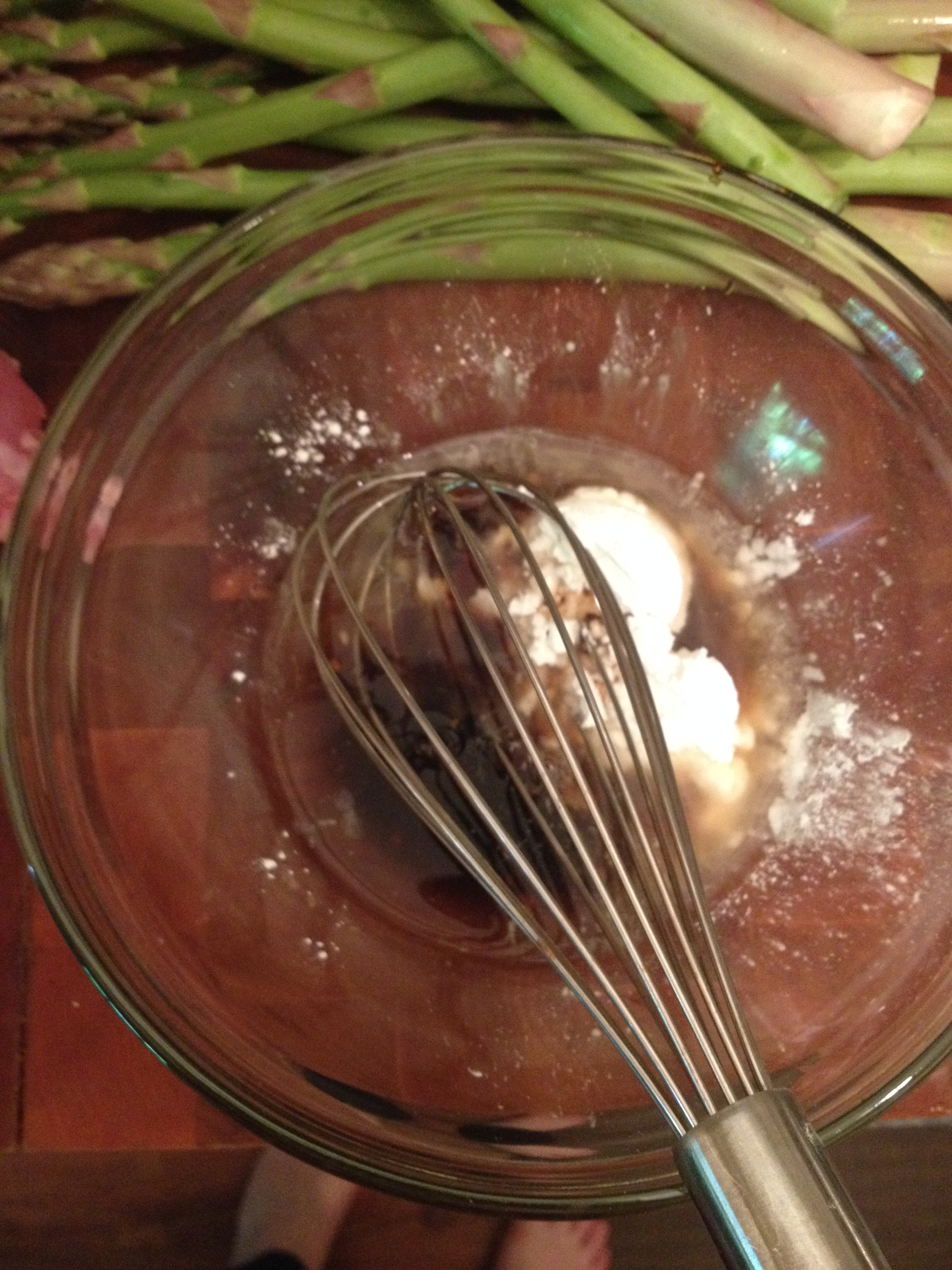
Whisk together cornstarch, soy sauce, and rice vinegar until no lumps remain. Add egg white, and whisk until thoroughly combined but not frothy.

Pour the egg white mixture over the meat. Squish the mixture together with your hands so that the meat is coated well. Cover, and refrigerate for at least 30 minutes, up to one hour.

Bring four cups of water, salt and sesame oil to a boil in a sauce pan. Working in batches, poach pieces of the meat for about 30 seconds each, removing these from the pot with a slotted spoon into a colander. Let the water come back to a boil between batches.

From here, you would either refrigerate the meat for another use, or add it straight to your current dinner preparation. To brown the meat, fry it quickly before adding your veggies to the pan. For best results, toss the meat in the pan and coat it in the sauce before adding veggies.

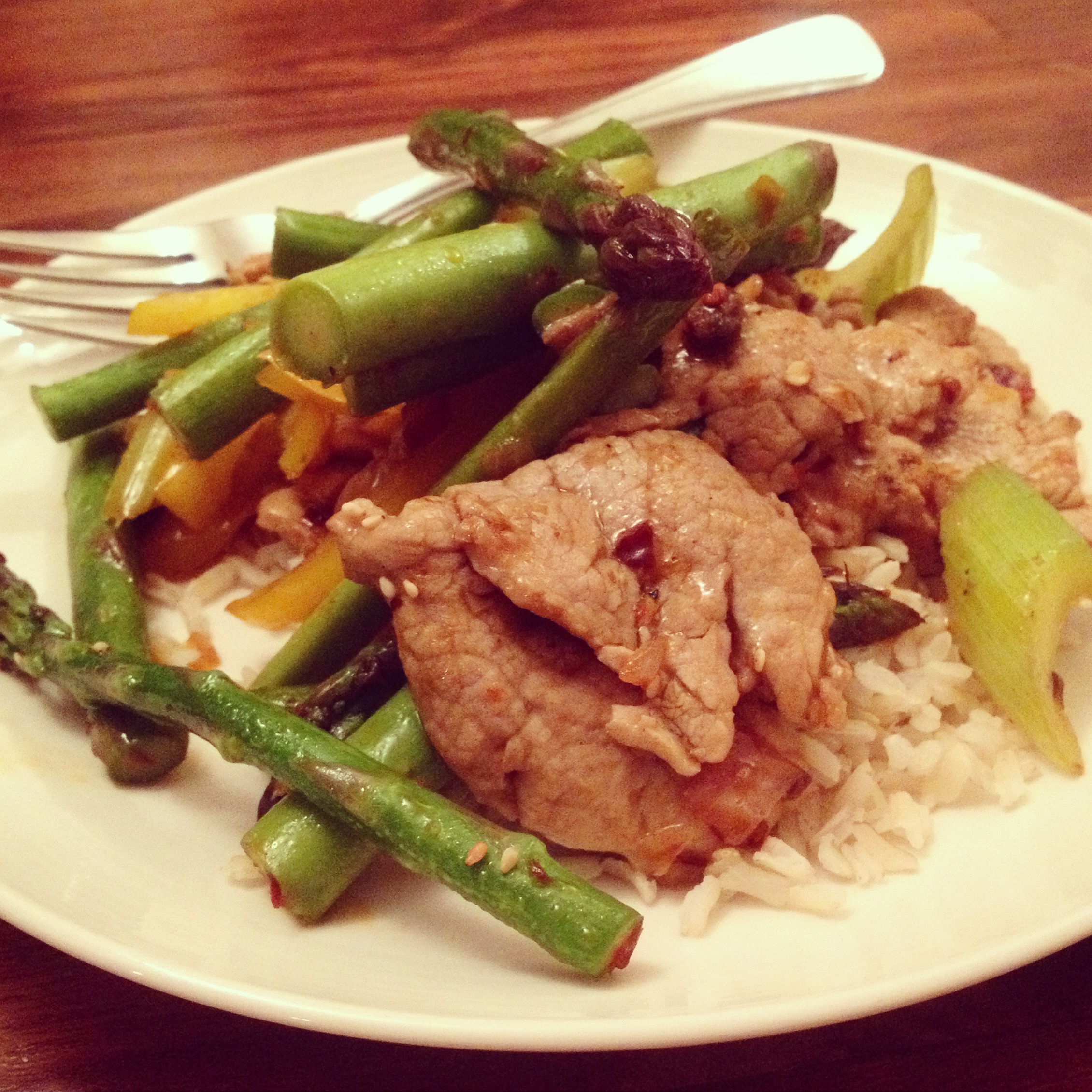
Plated asparagus and velvet pork


One-dish baked chicken and rice.

chicken and rice

If December was about coming undone, January is about putting ourselves back together (and lying to MyFitnessPal). We stole a whole day to ourselves yesterday, turned our ringers off and did laundry and made messes and ate Alphagetti on the couch in our pajamas and it was exactly what we needed. Today life returned to normal, and work was work and not an unending candy buffet. Everything is as it was, only now nothing really fits right and we’ve got to somehow pay all those bills we put off until after Christmas.

Part of putting ourselves back together is eating simply. After a month of rushing and driving and spending and feasting and drinking, all I want is to not feel like I am dying after eating a meal. At least for now. Simple, single-dish dinners that mostly prepare themselves are what will get us through this rainy post-holiday decompression phase (and, with any luck, back into our pre-Christmas dress sizes).

Happy New Year. I hope you’re easing into 2015, cozy, and eating something nice.

One-dish baked chicken and rice

(Makes 4 to 6 servings.)

  • 4 tbsp. olive oil, divided
  • 8 chicken thighs
  • 2 carrots, peeled and finely chopped
  • 2 celery stalks, finely chopped
  • 1 onion, finely chopped
  • 3 garlic cloves, finely chopped
  • 3 tsp. fresh thyme, chopped and divided
  • 2 cups basmati or other long-grain white rice
  • 2 1/2 tsp. coarse salt, divided
  • 1 1/2 tsp. ground black pepper
  • 1 lemon, zest and juice
  • 4 cups low-sodium or homemade chicken stock

Preheat your oven to 375°F. If you have a large pan or Dutch oven, use this. If not, a deep 9″x13″ pan will work just fine.

Rub chicken thighs with oil, and season with 1 teaspoon each of salt and pepper. Set aside.

Over medium-high heat, sauté your carrots, celery, and onion in olive oil for two to three minutes, until the veggies just begin to soften and their colours turn bright.

Add the garlic and 2 teaspoons of thyme, cook another minute, then add the rice. Stir to coat the rice in the oil mixture. Add remaining salt and pepper. Stir again.

Add lemon zest and juice and stock to the pan. Taste, and adjust your seasonings as needed.

Nestle the chicken thighs into the rice mixture, sprinkle with remaining thyme, and bake, uncovered, for  50 to 60 minutes, until chicken is cooked to a minimum internal temperature of 165°F, or until you find the juices run clear when you cut into a piece of chicken with a sharp knife.

Let rest for ten minutes before serving.

Coconut caramel pound cake.

pound cake

This was one of those weeks that really makes one appreciate the simple things; the kind of week where at the end of it, my salvation came from the basics – eggs and butter and sugar and flour, a bit of pasta, a bag of onions, and a few frozen sausages. The week started with some debit card fraud that cost me most of what was in my bank account, and an unavoidable trip to the local mechanic that threatened to eat up the rest.

It is also December, as you might have noticed – on top of everything, I’ve got places to go and potlucks to participate in and when you’ve got a cookbook pending, it is poor form to show up at these things with a two-liter bottle of store-brand pop and a bag of Cool Ranch Doritos. If you’re not going to bother washing your hair or dressing like an adult, you should at least show up with a salad, I guess.

But I haven’t been to a grocery store all week, which is silly because there’s one half a block away and I’ve managed to hit up the liquor store in the same vicinity twice. I am a caricature of a woman unraveling. Imagine a lot of leggings and cat hair.

December is reason enough to unravel and as a good a time as any. ‘Tis the season for demands on top of demands and far more debits than credits. And it’s so easy to fall into an exasperated funk and find yourself yelling at everyone; this is not what the season is all about, I’m told. I know it’s hard advice to take sometimes, but we need to go easy on ourselves. Take breaks. Take shortcuts. Make pound cake.

Pound cake will solve a great many of your December problems. It’s cheap – at its most basic it is literally just butter, sugar, flour and eggs – and it benefits from sitting around a while, so it’s best to make it a day ahead. It’s cake, so people will think that you tried. It’s cake, so everyone will like it.

This is grandma-level stuff right here, the kind of thing that will stand the test of time. A glazed pound cake recipe in your back pocket will get you through all kinds of things, and up to 98 per cent of what December can throw at you.

This is not one of those Bundt-pan pound cakes; make this in a loaf pan. Make it the night before you want to serve it, and then plop it out onto a plate or into a container and take it wherever you need to go. This is not fancy. Let someone else handle fancy – your job is to get through the holidays, deliciously.

Coconut caramel pound cake

Cake:

  • 1 cup butter, at room temperature
  • 1 cup brown sugar, packed
  • 4 eggs
  • 1 cup all-purpose flour
  • 1/2 tsp. coarse salt
  • 1/2 tsp. vanilla extract

Sauce:

  • 1 14-oz. (398 mL) can coconut milk
  • 1/2 cup brown sugar
  • 1/2 tsp. vanilla extract
  • Pinch salt

Preheat your oven to 350°F. Grease a 9″x5″ loaf pan, then line it with parchment paper so that the paper peeks over the sides by a couple of inches.

Using either a stand mixer or an electric mixer, cream butter and sugar together until fluffy and pale. Pause occasionally to scrape down the sides of the bowl.

Add the eggs one at a time while continuing to beat the mixture. Once you’ve added your last egg, add the vanilla and salt, and continue to beat until thoroughly mixed.

Using a spatula, fold the flour into the butter-sugar-egg mixture, a third of a cup at a time until just moistened. Pour the batter into your loaf pan, and bake for 40 to 50 minutes, until a toothpick inserted in the centre comes out clean.

Meanwhile, simmer coconut milk over medium heat with brown sugar until the mixture reduces by half. Add the vanilla and the salt, and set aside.

Using a toothpick, poke many holes into the top of the still-hot cake. Pour the coconut milk mixture over top, and let sit until cool. Cover, and let rest at room temperature for at least eight (up to 24) hours before serving.

To serve, reheat in a 350°F oven for 10 minutes. Invert onto a plate, peel away the parchment, and cut into slices. Serve as is, or with a scoop of vanilla ice cream.

Peanut butter marshmallow bars.

Sploosh.

Last week, or maybe the week before, it rained and rained and rained one night (I can’t remember which night because that sort of thing happens a lot here), and it was dark out and nearly bedtime, and I had a lot to do, book-wise, and I was dead tired after work and we all could have just endured a few more episodes of Octonauts, but there were big puddles outside. In Vancouver, if you don’t look at a puddle as an opportunity, the time between summers can be pretty bleak. So I had Nick shove Toddler’s feet into his boots and button his raincoat while I shoved my own feet into my own boots, and we clomped outside to splash around in the water under the orange glow of our street lamps. We rounded the block twice, and on the second go-round, Toddler announced that he’d like hot chocolate, “with march-mellos.” Who am I to refuse such a request? I can never say no to a marshmallow.

So we splashed our way to the grocery store just down the street, and we marched to the back of the store where the marshmallows are kept beside the ice cream freezers and sundae toppings, bought a big bag of white mini marshmallows, then came home to make hot chocolate. By the time Toddler was in his jammies, I had his hot chocolate in his dinosaur mug, heaping with marshmallows. We drank our drinks and read some books and we all went to bed pretty pleased with ourselves and our sound decision-making.

Fast forward a few days or weeks, and I still have a huge bag of mini marshmallows. And Nick, with his diabetes, has gone off to the woods outside of Princeton to shoot our year’s supply of meat. So Toddler and I are alone, free to raise our blood sugar and rot our teeth unencumbered. I’m using up the marshmallows. Toddler’s pretty pumped.

This is a spin on a bake-sale classic, improved by substituting white chocolate chips for butterscotch chips. The result is kind of like tiger butter, only with marshmallows. I used the microwave for this because it somehow felt wrong not to. Toddler and I are going to spend our weekend together eating these in a blanket fort while watching the whale shark episode of Octonauts over and over and over until the sugar knocks us out. You should definitely lick the spoon.

peanutbutterbars

Peanut butter marshmallow bars

  • 1/2 cup butter, cut into about eight equal pieces
  • 12 oz. white chocolate chips
  • 1 cup smooth peanut butter
  • 1/2 tsp. salt
  • 1/2 tsp. vanilla extract
  • 3 cups white mini marshmallows

Put the butter and the chocolate chips in a large glass bowl. Microwave the whole thing for 30 seconds. Remove the bowl from the microwave, stirring the mixture well, then return it to the microwave and repeat this process.

Add the peanut butter, stirring well. Microwave for another 30 seconds, before removing the bowl stirring well, and repeating the process once more.

When the chocolate chips have melted and the mixture is smooth and creamy, add the salt and vanilla, stir again, then set the bowl aside and let it rest for a minute.

Lightly grease a 9″x9″ baking dish and line it with parchment paper.

Stir the marshmallows into the peanut butter mixture, and then pour the whole thing into your prepared pan. Refrigerate the mixture until it’s firm enough to slice, at least two hours.

Cut into small squares and serve. This is great for bake-sales, treat tables at holiday events, and on plastic Buzz Lightyear plates under a fort made of blankets.


Sleepy tea.

sleepy tea

“You need my help,” he shouts, sans pants and full of fury as his purple marker is out of ink and he needs a “very big whale” drawn right now, please. Where any of this comes from, I hardly know. As Toddler’s language develops, his phrases are increasingly amusing – he’s an accidental and illiterate riddler. “You need my help,” he says, because he mixes up his subjects and his objects, and because he will not stand to be corrected, not by me, because what do I know.

Despite the fact that I’m now very near my manuscript deadline (October 1! It looms!), Toddler continues to insist that he be the centre of attention at all times. He is two, nearly three, and frankly doesn’t give a shit about my timelines. YOU NEED MY HELP. So, despite the pile of work I still have to do, I’m still spending an inordinate amount of time pushing Thomas and his railway friends off “bumpy” bridges to their deaths, and reading books about “very scary” animals (and mimicking their sounds, because of course I know what sound a sloth makes?), and drawing whales and rainbows and whole families of monsters (this way, not that way, not blue, not green).

CONSTANT MOTION.

If this is having it all, then out of necessity I am doing it on very little sleep. I think that is the secret to having it all: you just have it all all the time, with no breaks.

I’ve never been much of a sleeper anyway, but I have heard about rest and think I might like to try it someday. I wonder what I could achieve if I had a full night’s sleep? Maybe I’d remember to turn on the dishwasher before the smell of old food and dirty dishes takes over the apartment; maybe I’d stop buying so many cans of red kidney beans – I needed one can to test a recipe one last time and somehow, over the course of a week, I ended up with five. I hope I remember to use them.

But still, we’re getting there, if “there” is a finished book and a happy toddler and dinner on the table eventually; I’m still going to work every day, and functioning as an adult most of the time. We have not yet run out of toilet paper. I did finally remember to pay the hydro bill.

Most of my work gets done after dark, and so I approach bedtime with eyes stinging from the glare of a back-lit screen. Sleep experts advise that this is not a great way to ease into bedtime, but sleep experts are probably not much fun. You are supposed to avoid screens for at least an hour before bedtime, I’ve read, or else the light tricks your brain into believing it is daytime. I like to think my brain is smarter than that; in truth, it’s probably much dumber, because it’s never not tired and if it was really clever, it would knock me out from time to time to catch itself up on some rest. YOU NEED MY HELP, Brain.

So, to sort of limp towards unconsciousness, I’ve devised a beverage that calms me down the way my morning latte picks me up. Tea lattes have become bookends to my day, and it’s kind of nice. It’s soothing, and sweet, and if you drink it in bed while you read a few pages of whatever David Sedaris book you have on your bedside table, you’ll drift happily off to sleep, with little to no fretting about all the things you still have to do before dawn.

tea and honey

Chamomile latte

  • 1 mug full of milk
  • 1/2 tsp. honey
  • 1 chamomile tea bag

Measure a full mug of milk, then dump it into a small sauce pan. Add the honey, and whisk to mix the honey into the milk. Add the teabag.

Gently warm the milk to the point where it just begins to bubble, somewhere between 170°F and 180°F. When it reaches this point, remove the pot from the heat and set your timer for five minutes.

After five minutes, pour the milk back into your mug, discard the teabag, and go to bed.