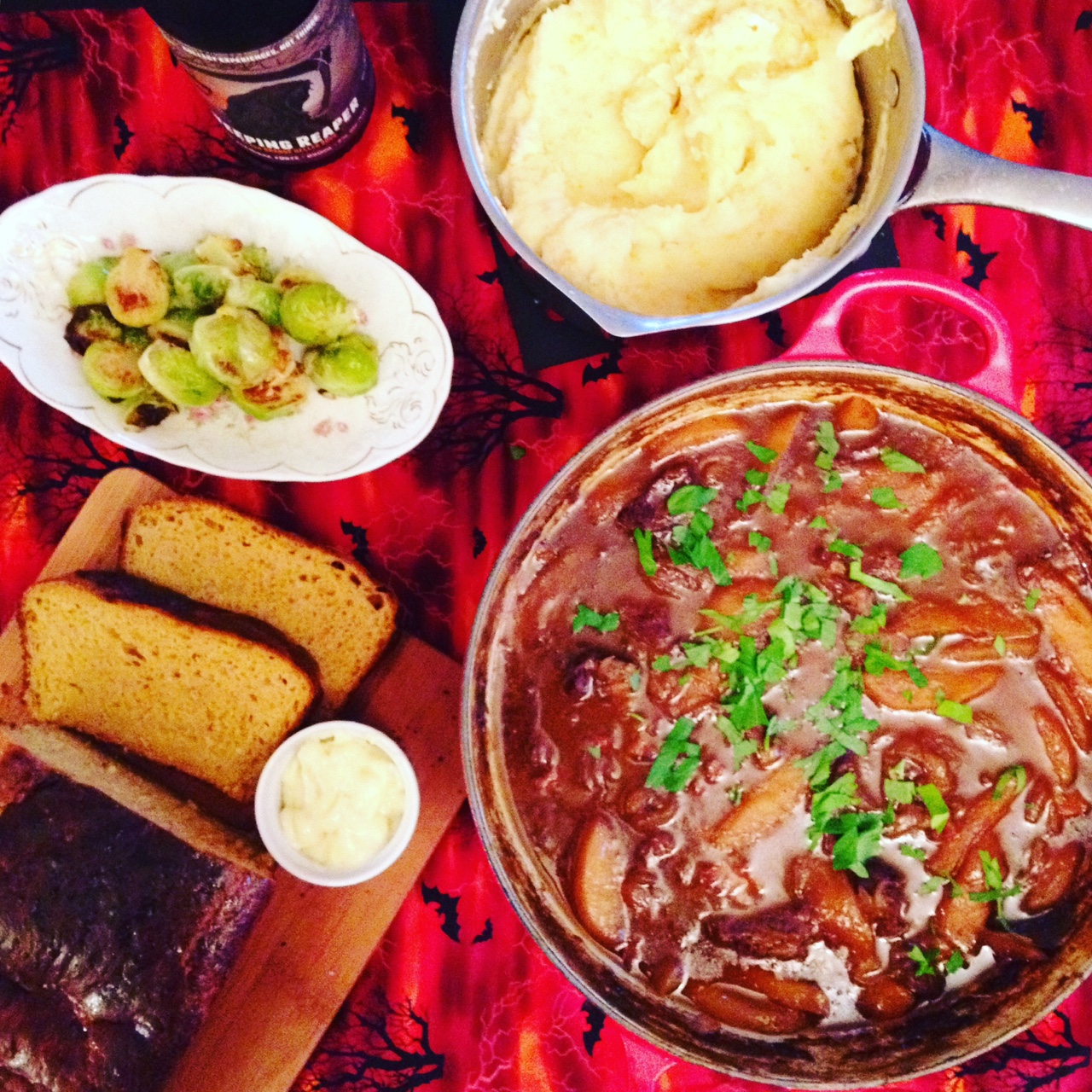
Hachee with beer and apples.

Hachee with potatoes and bread.Oh, the Dutch. My grandmother had a few ideas about the Dutch, and she mostly wasn’t right. But she wasn’t entirely wrong, either, and despite marrying into a bunch of them the mysteries of the Dutch didn’t begin to become apparent until recently, until this past summer when I started trying to really understand Dutch culture. Let’s just say that I’m starting to wonder how many of Nick’s quirks are the result of nature and not nurture.

One of these quirks is an inability, or perhaps unwillingness, to give a straight answer. I ask a question, I get a short story the answer isn’t even hidden within. It is literally beside the point: the point is over here, and I am now meant to do something with this other thing, these twelve oral paragraphs about something seemingly unrelated. I thought it was just Nick, who is prone to rambling and finding ways to bother me, but this might be cultural. You see, my next project is Dutch cookery and Google help you if you want to try to understand the origin or fundamentals of any Dutch recipe.

Every Dutch recipe is unlike every other Dutch recipe because everyone’s Dutch grandmother made everything different and better than everyone else’s Dutch grandmother and no one’s really written any of it down, not precisely.

(Maybe it’s not the Dutch who are at fault, here; maybe my issue is with grandmothers?)

Fortunately, I am a stubborn jackass and if something seems impossible, that’s my cue to jump in and shout SEE? I TOLD YOU I WAS ON TO SOMETHING. (Maybe I need to re-evaluate my life a little bit. This current approach is often more exhausting than it is satisfying.)
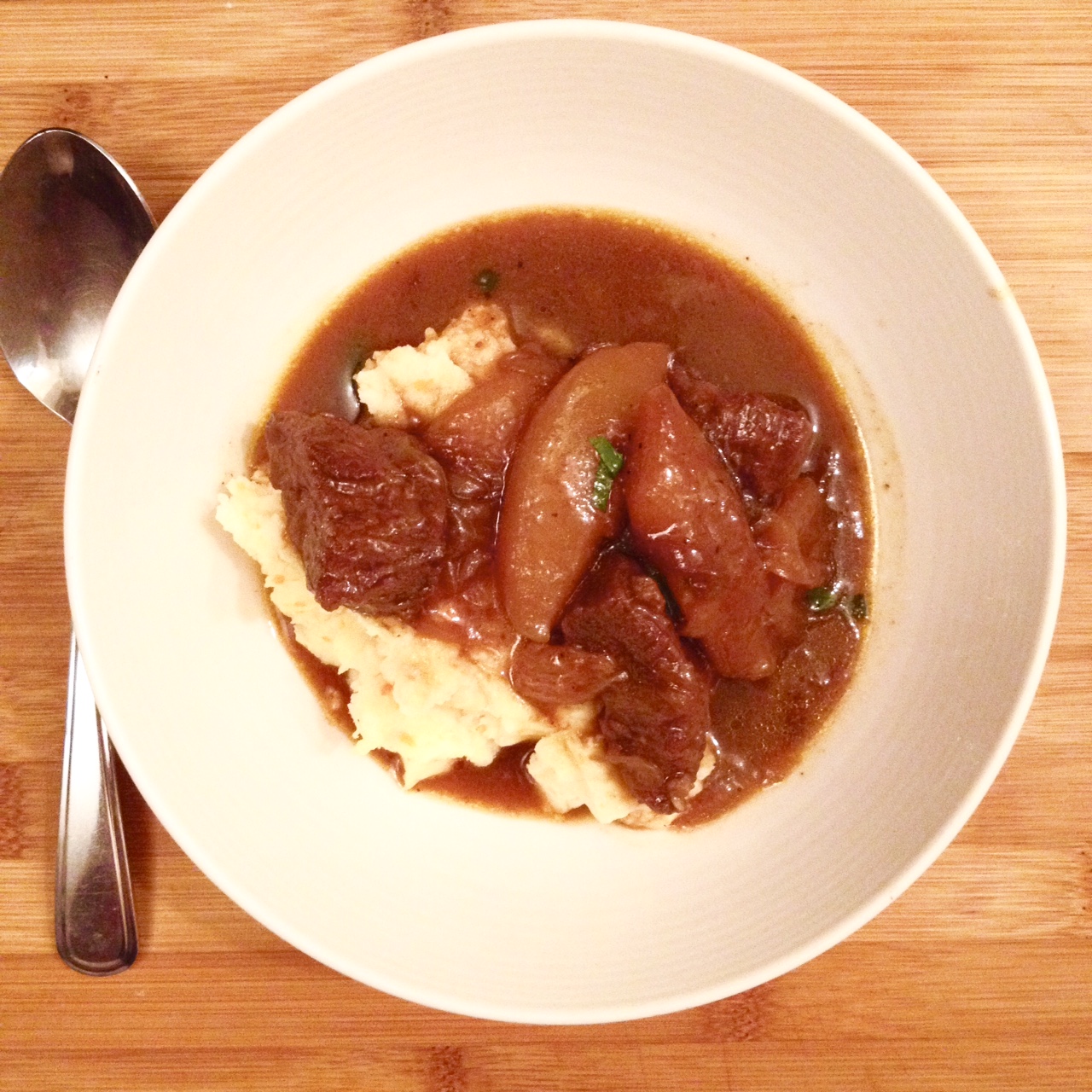
Hachee with potatoesSo in the meantime, it has taken a little longer than I’d planned to begin posting Dutch recipes, because there is a lot of learning, and a lot of trying to understand the whys of a dish before sorting out the hows. What follows is one I’m really happy with; it’s a recipe for hachee, which is a stew of beef and browned onions with apple for sweetness and acidity and very simple spices. The result is a slightly sweet, deeply savoury dish I’m certain you’ll want to make all winter.

Do you have Dutch recipes, and do you want to share them? I’d love to see (and make) them, so please email me!

A few notes:

  • Dutch bacon is not like North American bacon, in that it is not smoked. If you can find salt pork, use that; it’s inexpensive, and you can often get away with buying just a small piece at a time. If you can’t find it, bacon is fine and the stew will still be delicious.
  • I recommend using chicken stock instead of beef stock, as chicken stock is milder and doesn’t get in the way of the other ingredients – I found the beef stock was too much, and sort of did away with the subtler notes the apples brought to the pot; low-sodium or homemade chicken stock is best.
  • For apples, I chose a slightly sweet, slightly tart, firm-fleshed variety of apple – use the kind of apple you’d bake into a pie.
  • Serve hachee over mashed or boiled potatoes, buttered egg noodles, or steamed or boiled and buttered red cabbage. A heel of crusty brown bread on the side will make a good sop.

Hachee (Dutch beef stew)

  • 1/4 lb. bacon or salt pork, finely chopped
  • 1 tbsp. butter
  • 2 lbs. beef chuck, cubed
  • 2 lbs. onions, halved lengthwise and thinly sliced
  • 3 tbsp. all-purpose flour
  • 2 tbsp. molasses
  • 2 tsp. coarse salt
  • 1 tsp. ground black pepper
  • 1/2 tsp. ground nutmeg
  • 1 bay leaf
  • 12 oz. / 355 mL amber or brown ale (nothing hoppy)
  • 2 lbs. firm-fleshed apples, peeled, cored and cut into wedges approximately 1/2-inch thick
  • 4 cups low-sodium or homemade chicken stock
  • 2 tsp. apple cider vinegar

In a Dutch oven or other heavy pot, brown bacon over medium-high heat, stirring frequently, until fat has rendered and the bacon is crispy, about four minutes.

Scoop the bacon out and reserve. Working in batches, brown the beef in the accumulated bacon fat. As your beef browns, scoop it out and set it aside.

Once you have browned all of your beef, add the butter. Once the butter has melted, add the onions and reduce your heat to medium. Brown the onions until mostly caramelized and reduced in volume by about two-thirds; this should take between 15 and 20 minutes, and you should stir them regularly.

When onions are brown, add beef and bacon back to the pot. Add flour, and stir to coat pot contents thoroughly. Add molasses, salt, pepper, and nutmeg, and stir again. Add the bay leaf.

Add the beer to the pot, scraping the bottom of the pot as you do to scrape up any browned bits. There will be browned bits, and they will make this stew what it is. Add the apples, and then the chicken stock.

Reduce heat to medium low, and simmer, uncovered, for two and a half to three hours, until sauce is has thickened and meat is tender.

Before serving, add apple cider vinegar and stir. Taste, adjusting seasonings as needed. I serve this sprinkled with a bit of fresh parsley, for colour.
Taco fried rice.

The first time I ever heard about taco rice I didn’t have much information to go on other than “yeah, duh, that sounds amazing. I would like to have that now, please.”

As usual, I wasn’t entirely paying attention and when it came time to try making it for the first time, I missed a few essential details.

Taco rice is one of those magical, confusing dishes that results from a bunch of ideas all jumbled up and served on one plate. It’s origin is Japanese – Okinawan, specifically – with influence from a bunch of taco-craving American GIs based on the island. It came up in the most recent episode of Anthony Bourdain’s Parts Unknown, and it was only then that I understood. Says Bourdain: “This unholy, greasy, starchy, probably really unhealthy delight, a booze-mop-turned-classic, caught on big time.”

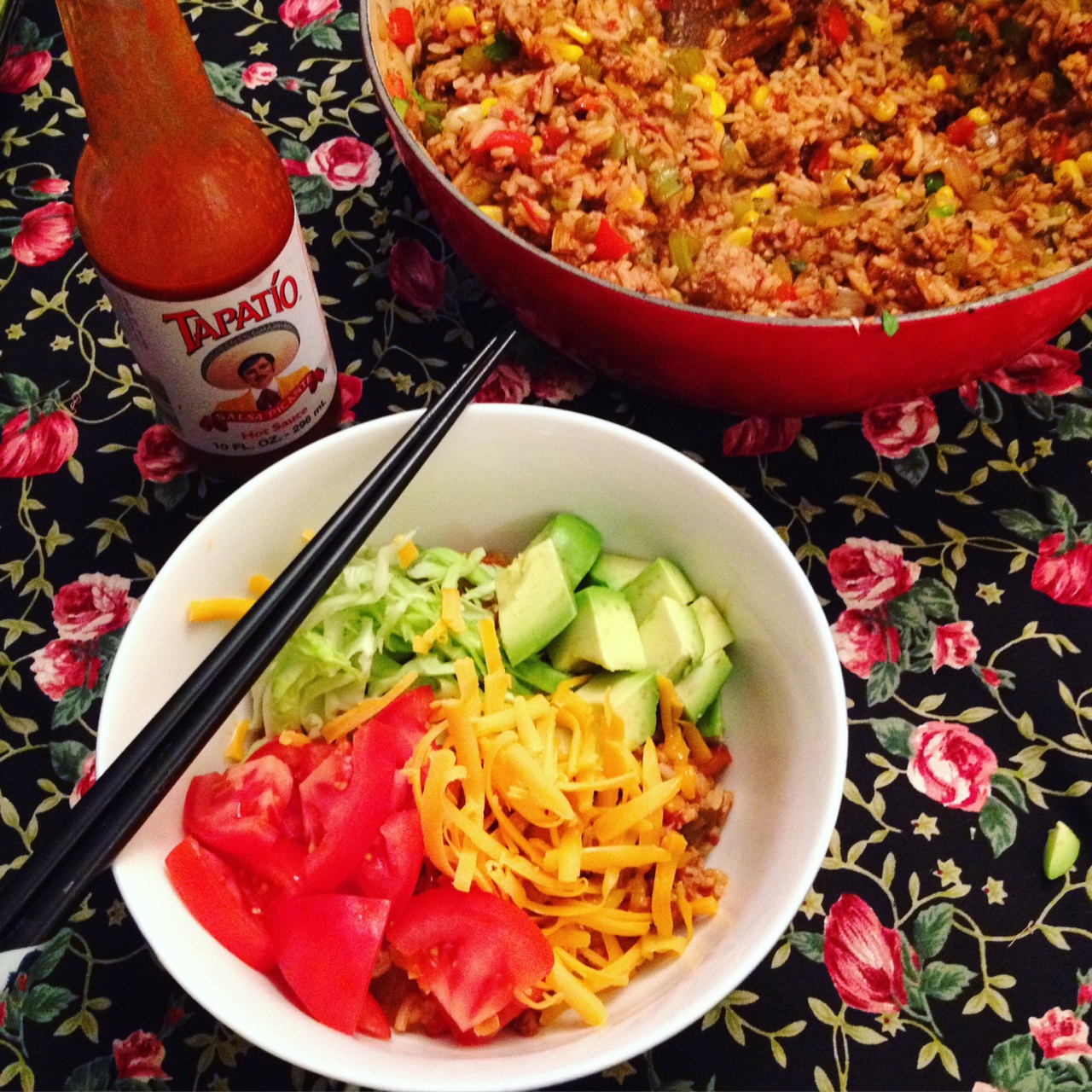
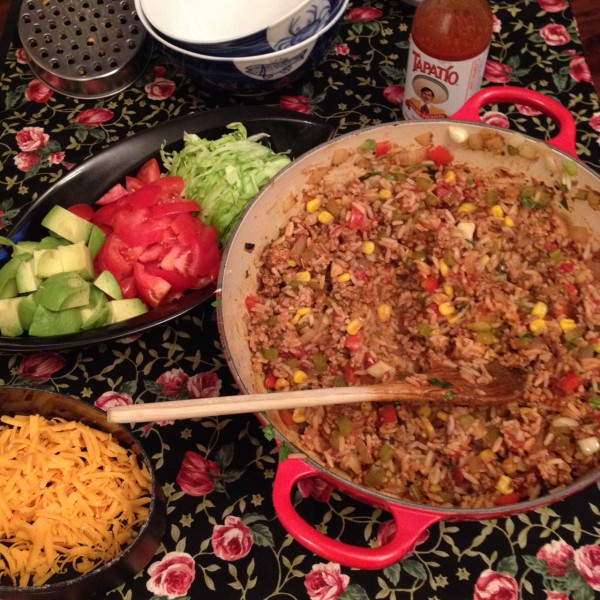
Taco fried rice baseIn short, what I thought was taco rice was not taco rice at all. Taco rice is a layered thing – spiced, fried ground meat on top of white rice, with lettuce and tomatoes and cheese on top of that. Taco fried rice is unholy in its own way, the kind of thing you would make if you were drunk in your kitchen late at night, or if it was the 1950s. It’s exotic! Except it’s not.

It’s comfort food and you should be comfortable when you eat it.

So, here’s my misinterpretation of taco rice. What is authenticity anyway?

Taco fried rice

(Makes 4 servings.)

  • 3 tbsp. canola oil
  • 1 onion, finely chopped
  • 3 celery stalks, halved lengthwise and then diced
  • 1 red bell pepper, diced
  • 1 jalapeño pepper, seeded and finely chopped
  • 6 garlic cloves, chopped
  • 1 cup corn kernels (fresh or frozen)
  • 1 lb. ground pork
  • 1 tbsp. chili powder
  • 2 tsp. ground cumin
  • 2 tsp. smoked paprika
  • 1 tsp. ground black pepper
  • 1/2 tsp. ground coriander
  • 1/2 tsp. dried oregano
  • 2 tbsp. soy sauce
  • 1 tbsp. rice vinegar
  • 3 cups cooked rice
  • 2 cups prepared salsa (either homemade or store-bought)
  • 1/2 cup chopped fresh cilantro

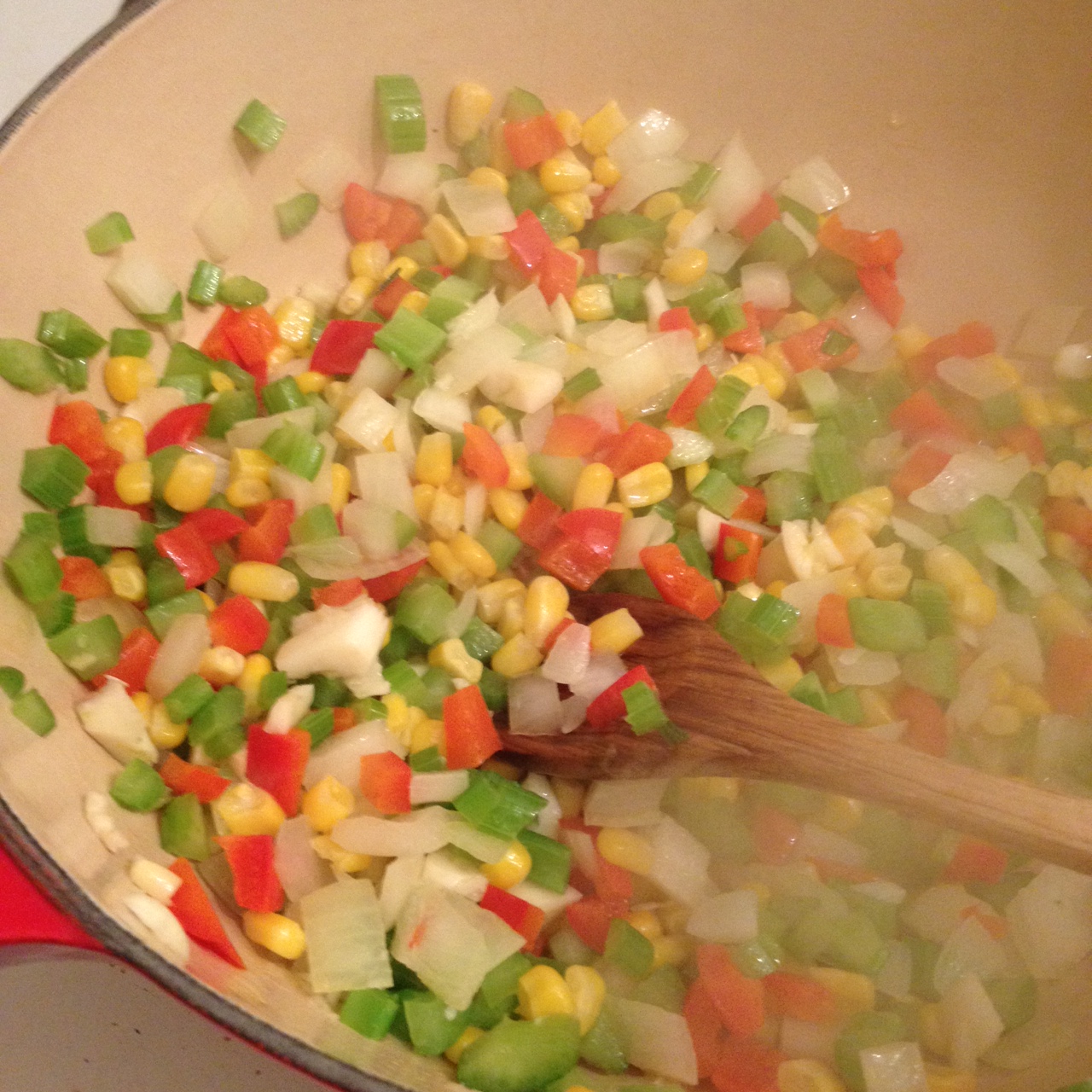
In a large pan or Dutch oven over medium heat, saute onion, celery, bell pepper, jalapeño pepper, and corn until colours have brightened, about two minutes. Add garlic and cook for another two minutes, stirring occasionally until veggies have just begun to soften.

Crumble the ground pork into the pan. Add chili powder, cumin, paprika, black pepper, coriander, and oregano to the pan, and stir, breaking up the pork with a wooden spoon as you go. Cook for about five minutes, until pork is cooked through and the pan appears dry on the bottom.

Add soy sauce and rice vinegar, and stir to combine. Add rice. Stir again.

Add salsa, and stir. Cook for another three minutes, until most of the liquid in the pan has disappeared. Taste, adjusting seasonings as needed. Stir in cilantro and serve with accompaniments.

Taco fried rice with toppingsAccompaniments:

  • Shredded cabbage
  • Sliced tomatoes
  • Diced avocado
  • Thinly sliced jalapeño peppers
  • Shredded cheddar cheese
  • Hot sauce, such as Tapatio or Cholula

EarthBites and Spaghetti alla Carbonara

atung

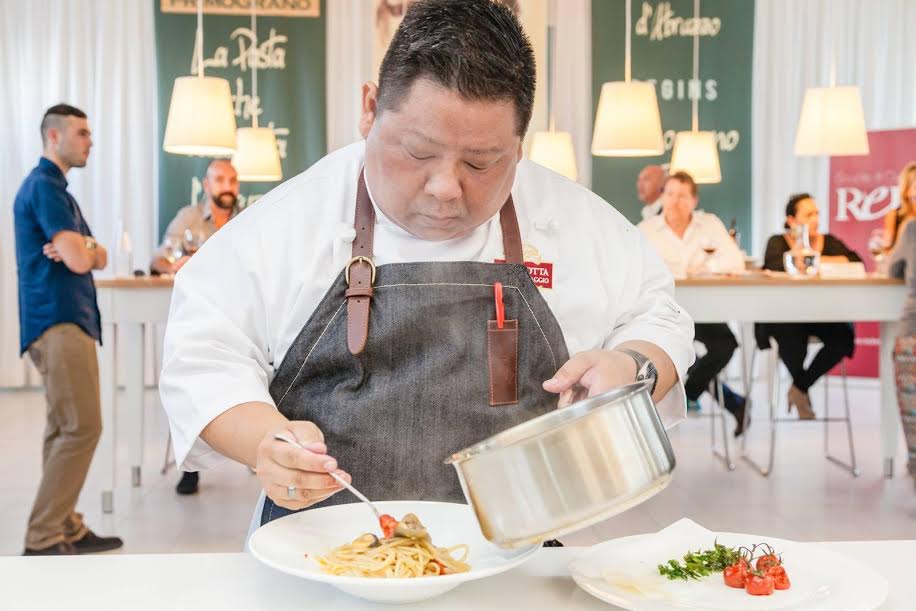
Last week, the folks from Rocky Mountain Flatbread, one of my favourite local pizza places (and a kid-friendly spot to boot!) invited me to sit in on a cooking class with Alex Tung, a Vancouver-based chef with international credentials and a flair for all things Italian. Given that it was a rainy Thursday and there were plates of pasta a chef would make for me while I watched, it didn’t take much convincing. Chef Tung made three dishes: a luscious pomodoro sauce over a fresh pasta he likened to Italian udon, a fregola dish with clams and fresh tomatoes, and Spaghettoni alla Carbonara, a version of which is described below.

The class was part of a fundraising initiative on behalf of EarthBites, a local program that teaches children in schools about food and nutrition. It’s an issue that’s timely and particularly pressing for urban kids who may not have access to gardens at home.

Every year, EarthBites goes into schools to teach thousands of kids how to grow and cook their own healthy meals. The children are instructed by a dedicated team of urban growers, nutritionists and entrepreneurs who are passionate about engaging children with the food they eat.

You can support EarthBites (and maybe learn something new!) by participating in one of their “watch and learn”-style cooking classes with local chefs, including Top Chef Canada contestant Dawn Doucette, and Chopped Canada winner Alana Peckham. Classes run through the fall; visit their website to learn more. I love getting a few chef-tested recipes to play with at home, so between that and the food and the cheffy banter, this was a winner for me.

To whet your palate, here’s a recipe for Spaghetti alla Carbonara from the class I took with Alex Tung (pictured above), an award-winning French-trained chef with a passion for Italian cooking. If you can’t find guanciale, available in Italian delis and specialty stores, use pancetta or bacon. If you can find smoked hog jowl, it’s comparable (but smoked, which guanciale is not), and generally a bit cheaper. In Vancouver, Buy Low Foods often has smoked hog jowl for around $3.50 per, which – at about a pound per piece – I generally can make work for two meals.

While we’re on the topic of kids and food, you might like to know that this dish was picky-eater approved. The kid practically inhaled it, and requested it for lunch the next day, even though he hates cheese and everything else that is savoury and delicious. Dear Alex, I love you.

Spaghetti alla Carbonara

(Adapted from a recipe by Chef Alex Tung. Makes 4 servings.)

  • 1/2 lb. guanciale (or pancetta or bacon), diced
  • 1 lb. spaghetti
  • 3 whole eggs plus 3 egg yolks
  • 1 cup finely grated pecorino romano cheese (slightly cheaper grana padano also works well here)
  • Salt and ground black pepper to taste

In a large pan over medium heat, cook diced guanciale until crispy and until fat has rendered, three to ten minutes depending on the size of your dice.

Meanwhile, heat a large pot of generously salted water to a boil. Chef Tung insists that it must taste like sea water; he is right. Cook pasta according to package instructions, about seven to nine minutes until al dente. Between the salted pasta water, the pork and the cheese, it’s likely that you will not need to season the dish with any additional salt.

While your pork and pasta work their magic on your stove, beat eggs and egg yolks in a small bowl. Add cheese, and whisk to combine. Set aside.

If your guanciale cooks quicker than you expected, remove it from the heat but leave it in the pan to keep the rendered fat liquid.

When pasta is ready, scoop out about a cup of the cooking water. Drain the pasta, then return it to the pot but do not return the pot to the stove. Add the guanciale and its rendered fat (like, all of it), stir, then add the egg mixture, stirring well and quickly. Stir in the water, about a quarter of a cup at a time, until the pasta is coated in an satiny sauce.

Taste. Does it need salt? Add salt.

Scoop the pasta into bowls, then sprinkle liberally with black pepper. Serve immediately.

Learn more about school programs and adult cooking classes at earthbites.ca.


EarthBites_logo_header_200This post wasn’t exactly sponsored, but I did get to take the cooking class for free. No one told me what to say, but I think the assumption was that I would say something good? I don’t know. Maybe no one should ever assume that of me. I can be a real jerk.

Hunger Awareness Week: Barley porridge and “baked” apples.

We’ve talked about who needs food banks (people like you and I), and the kinds of products food banks frequently receive and the services they offer. Food Banks Canada is an incredible, essential resource for hundreds of thousands of people and families every year. It’s inspiring, and there’s a lot you can do to help.

You can donate food. Food drives during the holidays are a great start, and food donation bins at your local supermarket are a great way to give all year. Do you shop at places like Superstore (or other Loblaw’s stores), or Shopper’s Drug Mart? Take advantage of points programs (PC Plus and the Shopper’s Optimum program, respectively) that reward you with points toward cash to buy more than you need and donate the excess, or cash in your extra points for groceries you can donate anytime of year.

You can donate money. You can give once, or you can set up monthly donations. You can also make a gift in honour of a friend or family member, either in celebration or in memory. Wondering where your money goes? Read Food Banks Canada’s Donor Impact Report.

You can donate time. Consider hosting a food drive, starting a fundraiser, or setting up a food donation bin in your workplace or school. Get the whole family involved and make hunger an issue you tackle together.

You can change the conversation online. We talk a lot about food porn and foodies, but not enough about food security or food justice. Tweet about hunger. Participate in #FoodbankFriday on Instagram and share your donation with your audience to inspire them to do the same. And share on Facebook about food drives in your area to draw attention to campaigns to food bank stock shelves in your community.

You can bug your politicians. And, as we’re right smack in the middle of election season, you can ask your candidates what they plan to do to address poverty and hunger in your community and across the country. Make them earn your vote, and put them to work once they’re elected. Politicians aren’t food insecure; don’t let them forget that many people are and that they can do something about it. 

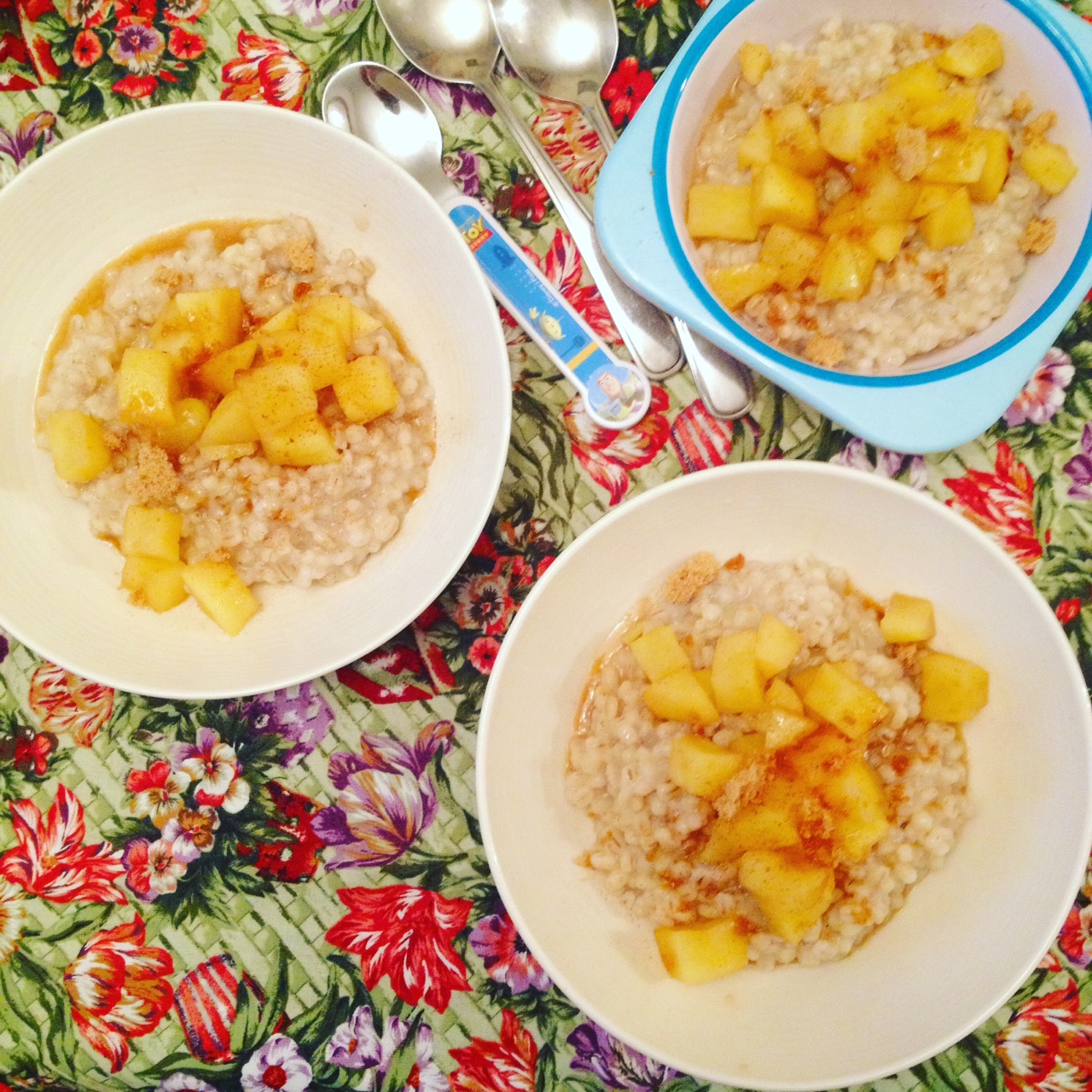
Overnight barley porridge with applesMy last Hunger Awareness Week recipe is a breakfast recipe, because people who have a little something in their bellies to start the day perform better at work, have fewer accidents, and have the energy to get through the day. Kids who eat breakfast are less disruptive in school, pay more attention, and are less likely to act out. This recipe for overnight barley porridge is easy, and requires just five minutes in the morning. Take advantage of your microwave to fake the taste of baked apples. This is way better than cold buttered toast as you run out the door.

Overnight barley porridge with “baked” apples

Porridge:

  • 1 cup pearl barley, rinsed
  • 1/4 tsp. coarse salt
  • 1/2 cup milk
  • 2 tbsp. brown sugar
  • 1/4 tsp. cinnamon

Apples:

  • 1 lb. sweet, firm-fleshed apples (such as ambrosia, honeycrisp or braeburn; about two medium apples), peeled, cored and diced
  • 1 tsp. butter
  • 2 tsp. brown sugar
  • 1/4 tsp. cinnamon

In a saucepan with a tight-fitting lid, bring barley, salt and three cups of cold water to a boil. Once it’s hit a rolling boil, turn off the heat and slap the lid on it. Let it sit on your stove overnight.

When you wake up in the morning, place diced apples, butter, brown sugar and cinnamon in a microwave-safe bowl, and cover with a lid or plastic wrap. Microwave on high for four minutes.

Meanwhile, add half a cup of milk, brown sugar and cinnamon to barley, and stir to break up the grains. Heat for three to five minutes, until liquid is bubbling and grains are hot.

Serve porridge in bowls, topped with apples and additional sugar, as desired.

Hunger Awareness Week: Slow cooker borscht.

Food bank use in Canada is 25 per cent higher now than it was before the first recession hit in 2008. One of the reasons for this is that many typically reliable or well-paid jobs, especially blue-collar jobs, have disappeared. Another is that wages, especially for what blue-collar jobs or less skilled labour roles remain, have not increased with the cost of living. Particularly vulnerable populations, such as the elderly or those on disability, have also been affected by inflation and corresponding lack of increase in benefits. In addition to providing emergency food hampers, many food banks provide additional services.

People who turn to food banks often need other types of assistance. Food banks have responded and many now provide advocacy and supports such as:

  • providing skills training such as food preparation skills,
    helping people to search for jobs and transition into employment,
  • raising community awareness about hunger and poverty,
  • assisting with the search for safe, affordable housing,
  • helping people find good quality, affordable child care,
  • providing referrals to other social agencies and support services.
    (Source: Food Banking in Canada)

One of the major barriers to cooking healthy meals at home is time. The logistics of poverty are often time-consuming, particularly as the cost of living in urban centres increases; to afford housing, people often live a long way from where they work or from the services they need to access. Many people rely on public transportation which, particularly in Vancouver, is only reliable in urban centres; the farther you get from the city, the bigger a hassle it can be to get to where you need to go on public transit.

Spending all day in transit can sap the enthusiasm for dinner-making from even the most devoted home-cook. The allure of convenience foods is strongest in those moments when even a pantry meal feels impossible, particularly when you need to feed other people (especially small children, who are not known for their patience or empathy).

For people who are pressed for time, crock pot recipes can be a life-saver. You can purchase an inexpensive, good quality slow cooker at department stores, but you can also find gently used slow-cookers online for pretty reasonable prices on sites like Craigslist or Kijiji. Mine holds about six quarts, which I find handy as it makes enough for dinner and for leftovers, which I can freeze or take to work for lunch.

The following recipe for a slow-cooker borscht is ideal for people for whom time is in short supply. I like to brown the meat and assemble the ingredients the night before, then put everything in the cooker in the morning before I head out the door.

It’s warming and hearty, and it makes generous use of inexpensive but nutrient-dense vegetables like beets, carrots and cabbage. And it makes a lot of it, so you can pack it into containers and reheat it whenever you need a bowl of something warm. Use cheap cuts of beef, like chuck, shank, or brisket, or omit the meat entirely (in that case, just add the butter straight to the Crock Pot).
Slow-cooker borscht

(Makes six servings.)

  • 3 tbsp. butter
  • 1 lb. cubed stewing beef (such as chuck or brisket) or beef shank
  • 1 onion, sliced
  • 2 lbs. beets, peeled, trimmed and diced
  • 1 lb. waxy potatoes, such as red or Yukon Gold, diced
  • 4 carrots, peeled and cut into one-inch pieces
  • 1/2 small head of red cabbage, cored and thinly sliced
  • 7 garlic cloves, divided
  • 1 bay leaf
  • 5.5-oz. (128 mL) can tomato paste
  • 2 tbsp. apple cider vinegar, divided
  • 1 tbsp. coarse salt
  • 1 tsp. ground black pepper
  • Sour cream and fresh or dried dill, to garnish

Melt butter over medium-high heat and add beef. Brown on all sides, and then pour into the slow cooker.scraping the pan as you do so as not to waste any of those good flavours.

Add onions, beets, potatoes, carrots, cabbage, and six smashed garlic cloves to the cooker. Add the bay leaf.

In a large bowl, whisk together the tomato paste, one tablespoon of apple cider vinegar, salt, pepper, and six cups of water. Pour this mixture over beef-and-veggie mixture.

Cook for eight to 10 hours over low heat.

Before serving, mince remaining clove of garlic and add the remaining tablespoon of apple cider vinegar. If using beef shank, remove meat from pot and shred it off the bone using the tines of a fork, then return meat to the pot and discard bones. Taste, adjusting seasonings as needed.

Serve with toasted bread and a dollop of sour cream and a sprinkle of dill.

Hunger Awareness Week: Potato cakes with salmon and kale.

While you might imagine that the food bank is all about canned and boxed non-perishable goods, the reality is that 40 per cent of the food donated is fresh and frozen produce.

In Canada, 80 per cent of food banks provide at least one service above and beyond hampers and meals. In some communities, this can mean gardening programs or community kitchens, where people learn to cook and preserve what they harvest. These programs are empowering and sustainable, and engage young people and communities in the food system. If you’re not able to get to a store and buy food to donate, consider donating cash.

Funds donated to Food Banks Canada go a long way. Food Banks Canada and provincial and regional food banks form partnerships with retailers, local businesses and farmers, and are able to stretch their dollar considerably; the Greater Vancouver Food Bank Society reports that every dollar donated is actually worth three dollars, which supports not just community programs, but also the purchase fresh produce and protein sources when they are most needed.

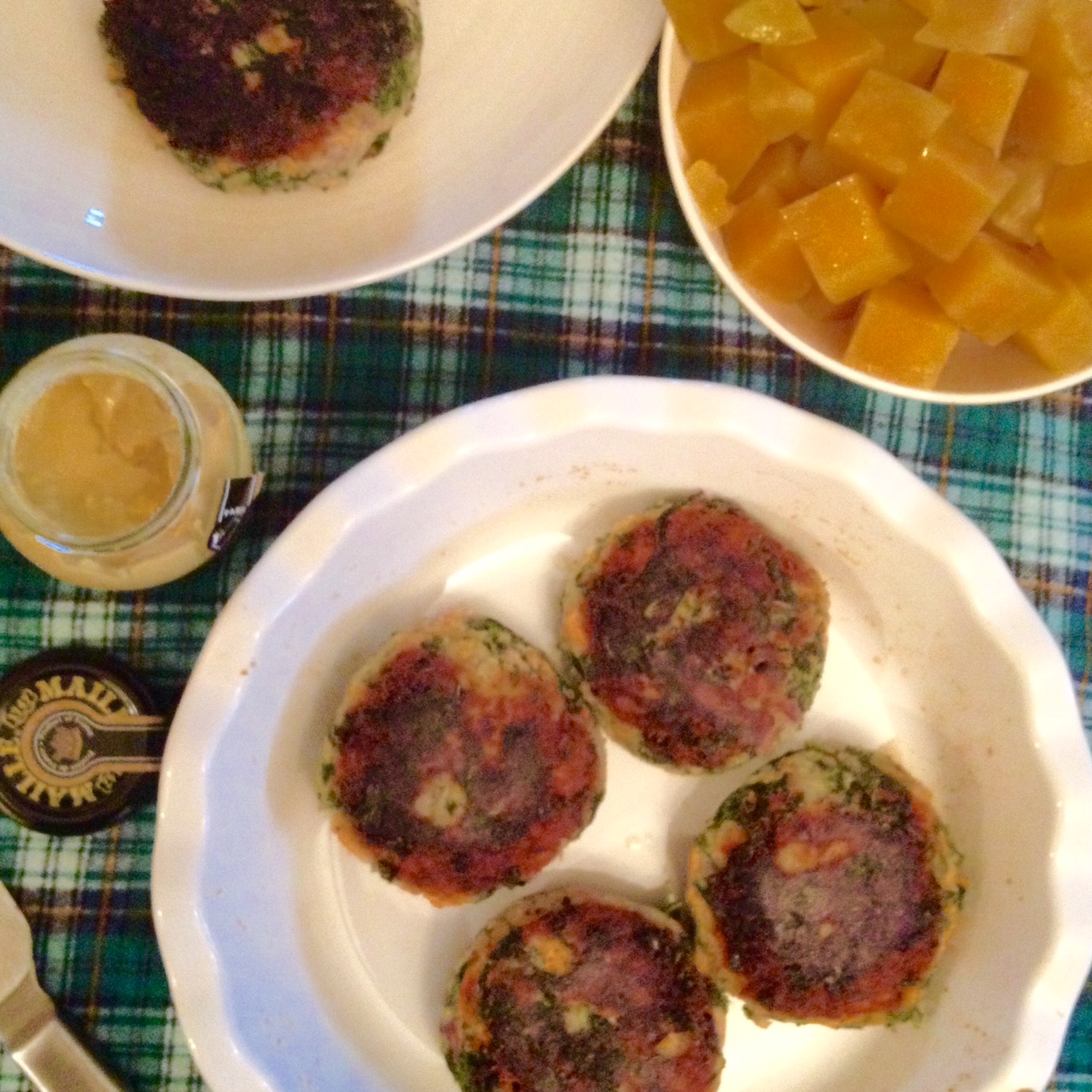
Today’s recipe combines fresh, in-season produce with canned salmon (rich in brain-boosting DHA) for a hearty meal that works as well for breakfast as it does for dinner. This is something you can mix up ahead of time; it’s also easily adapted to the leftovers you have in your fridge. It uses kale, because kale grows like weeds and it’s hardy enough to live in your fridge for a few days while you use up other things.

Potato cakes with salmon and kale

(Makes 4 servings.)

  • 1 lb. red-skinned potatoes
  • 1 tbsp. canola or vegetable oil
  • 1/2 medium onion, finely chopped
  • 2 cups finely chopped fresh kale, stems discarded
  • 3 garlic cloves, minced
  • 7.5-oz. (213 mL) can salmon, drained
  • 1 tsp. Dijon mustard
  • 1 tsp. hot sauce, such as Sriracha or Tabasco
  • 1 tsp. coarse salt
  • 1 tsp. ground black pepper
  • 2 eggs, lightly beaten
  • Oil for frying

Preheat your oven to 350°F.

In a large pot of salted water, bring diced red potatoes to a boil (make sure to leave their skins on!) and cook until tender, about 10 minutes.

Heat one tablespoon of oil in a pan over medium-high heat. Add onion, and cook until lightly browned, about two minutes. Add kale, and then garlic. Toss to coat kale in oil.

Drain the potatoes, reserving 1 cup of the cooking liquid. Pour reserved liquid into the pan with the kale, and cook, stirring frequently until water evaporates and kale has wilted, another minute or so.

Pour kale and potatoes into a large bowl. Mash, then set aside to cool enough to continue, about 15 minutes.

Add salmon in chunks, removing bones. Add mustard, hot sauce, salt and pepper. Add eggs. Mush the whole mixture together until thoroughly combined, then form into eight cakes.

Cakes!Working in batches, fry over medium-high heat, about two minutes per side. Place cooked cakes in a pie plate and keep warm in the oven until you’re ready to serve.

Serve cakes with boiled or steamed vegetables or a garden salad, and a glob of mustard for dipping.

Hunger Awareness Week: Whole grain pasta with chickpeas and caramelized tomato sauce.

http://www.youtube.com/watch?v=X0GB_YDamjQ

A well-stocked pantry has saved my butt on more occasions than I can count. Being able to open a cupboard and see a few simple things that could equal dinner is something I don’t take for granted – it’s a reassuring thing, and a luxury for many. Whether it’s because payday is too far away or I’m just too lazy to get to the market over the weekend, pantry meals warm my home and filled my belly most weeks, and have for my whole life.

When choosing non-perishable items to donate to the food bank, try to select nutritious items to fill the pantries of those with diverse dietary needs.

  • Fifty per cent of food bank users are families, including children; consider donating kid-friendly items like granola bars, breakfast items like oatmeal or other hot cereals, sugar-free applesauce, or peanut- or gluten-free items for school lunches.
  • If 20 per cent of people who use the food bank are seniors, consider seniors’ health issues (diabetes, heart disease, hypertension): select low-sodium canned goods, low-sugar or sugar-free canned or pureed fruits, lean proteins including peanut butter and legumes, whole grain and gluten-free pastas, and high-fibre grains and cereals.
  • For families with babies and young children, consider donating baby food, infant formula, or diapers in a range of sizes (not just newborn). Nursing mums need nutrition too – fortified cereals, canned fish (especially sardines, salmon, herring and mackerel), low-sodium canned soups and stews, and parboiled grains can be beneficial, especially for parents who are pressed for time.

Pasta with caramelized tomato sauce and garlic.A pantry with a few staples you’ll use again and again can go a long way to making you feel secure. Today’s recipe is an easy one – it’s comprised of stuff you probably already have, and it’s hearty enough to feed a family of four to a comfortable degree of fullness. It’s kid-friendly, at least at my table. It’s also suitable for people with diabetes, and it reheats well for lunch at work the next day.

Whole wheat pasta with chickpeas and caramelized tomato sauce

(Makes four servings.)

  • 1 lb. whole-wheat or other whole-grain pasta, such as penne or rotini
  • 19-oz. (540 mL) can of chickpeas, drained and rinsed
  • 1/4 cup butter
  • 1/2 medium onion, finely chopped
  • 4 garlic cloves, sliced
  • 1/2 tsp. red chili flakes (optional)
  • 5.5-oz. (128 mL) can low-sodium tomato paste
  • Salt and pepper to taste
  • Parsley to garnish

Bring a large pot of salted water to a boil, and add pasta. Cook according to package instructions, about 11 minutes.

Meanwhile, melt butter in a large pan over medium heat. Add onion, and cook for two minutes, until just translucent. Add chili flakes (if using) and garlic. Cook until onions and garlic have just turned golden, another three minutes. Add tomato paste. Stir constantly to keep the paste moving around the pan and cook until colour deepens and butter seems to have disappeared, four to six minutes.

Before draining the pasta, reserve about two cups of cooking water. Drain pasta, and add pasta and chickpeas to the pan. Stir, then add water half a cup at a time until sauce has loosened and coats the noodles thoroughly. Taste, adjusting seasonings as desired. Sprinkle with parsley and serve.

Hunger Awareness Week: Rice and lentil pilaf.

https://youtu.be/ru3AFJD1LxU

It’s funny how we think about poverty, and how we distance ourselves from it in reassuring ways. It’s a thing that happens to other people, and it is complicated. Maybe it’s because of their choices, we reason. As if we have made the right choices. (I, personally, am an expert in making questionable choices.) It’s a thing that happens to other people, not to us.

Not to us. But a third of us are still living paycheque-to-paycheque, at least in Canada; in the US, the numbers are even higher. According to Food Banks Canada, one in six people who access the food bank are currently employed, or have been recently. Sixty-four per cent of people who need the food bank are paying market rent. In Vancouver, nearly 20 per cent of those who need the food bank in a given week are seniors.

It could totally happen to us, to quite a few of us.

September 21 to 25 is Hunger Awareness Week in Canada. According to Food Banks Canada, “Hunger Awareness Week is about raising awareness of the solvable problem of hunger in Canada.”

Hunger in Canada exists because deep and persistent poverty continues in the country. For more than a decade, diverse and inter-related factors have sustained this situation: a labour market that fails to provide enough jobs with stable, livable wages; a rise in precarious and non-standard employment; a fraying income security system that does not provide sufficient financial support for those in need; a lack of affordable, social housing; and accessible and affordable child care. (Source: hungerawarenessweek.ca)

During Hunger Awareness Week, organizations across Canada have come together to raise awareness about the realities of poverty and the people who need food banks most. One of the major goals of this campaign is to dispel some of the myths around who accesses food banks and why. This is essential, because we’re never going to truly tackle hunger and poverty and inequality if we don’t see ourselves as part of it.

It’s not a stretch to see yourself moving from broke to poor. I can see it from here, just on the other side of some accident or emergency.

Food security is an issue that’s important to me, and so I’m spending the week highlighting a few simple, nutritious recipes a person could make to feed a family using some typical food bank staples. I’ll use the platform I have here to support the campaign, share my tips for stretching your budget and making donations anytime of year, and hopefully you’ll get a few budget-friendly recipes you can enjoy anytime, whether you need them or not.

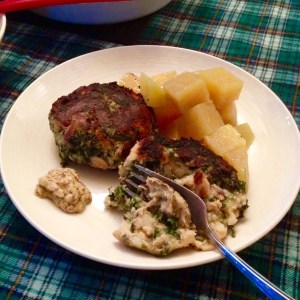
What follows is a recipe for rice and lentil pilaf, a weeknight-friendly gluten-free vegetarian dish that’s easily made vegan. It’s good (and filling) on its own, or as a side for roasted veggies or sausages or pork chops, or as an alternative to stuffing for those who don’t do gluten. It tastes a bit like stuffing, because it’s meant to be comfort food. I serve this with beet pickles.

Rice and lentil pilaf with apple and mushrooms

(Makes four servings.)

  • 3 tbsp. butter
  • 1 medium onion, diced
  • 1 medium apple, cored and diced
  • 3 stalks celery, diced
  • 4 cloves garlic, minced
  • 1/2 lb. mushrooms, roughly chopped
  • 2 tsp. coarse salt
  • 1 tsp. dried sage
  • 1 tsp. dried thyme
  • 1 tsp. ground black pepper
  • 1 cup basmati rice, rinsed
  • 1 cup green or brown lentils, rinsed
  • Celery leaves, for garnish

In a large, heavy pot with a tight-fitting lid, such as a Dutch oven, melt butter over medium-high heat. Add onion, apple, and celery, and saute until fragrant and until onions are translucent, about three minutes.

Add garlic and mushrooms. Cook for another three to five minutes, until the mushrooms have given up most of their liquid. Add salt, sage, thyme, and pepper, and cook for one more minute, stirring to coat the veggies in the herbs.

Add rice and lentils. Add four cups of water (use chicken or vegetable stock if you prefer), and bring to a boil. Cover, then reduce heat to medium, and cook for 20 minutes.

Let rest, covered, for five minutes before serving. Garnish with celery leaves.

Crock pot membrillo (quince paste).

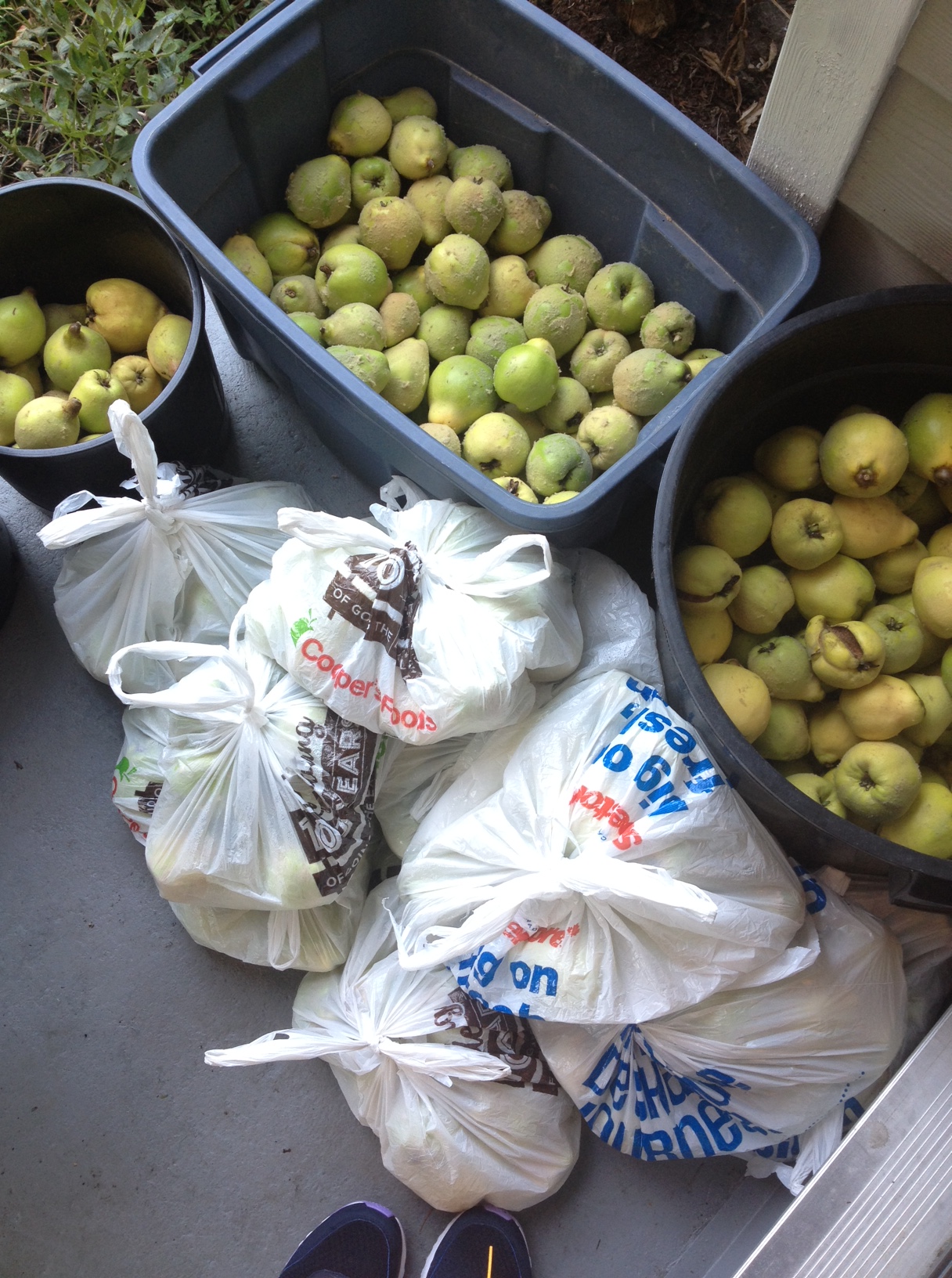
Country road, quince standMy friend Eileen bought a cute little house on a country road and planted quince trees. Perhaps not anticipating how prolific the trees would be, or how heavy the fruit, she planted four of them, four different varieties, and then recently took to Facebook to advertise the couple of hundred pounds of fruit she was looking to get rid of. For CHEAP.

Quince is a very dense apple-pear-type thing, and you have to cook it – it’s inedible raw. It’s got a musky, almost floral taste – a little rosy, a little appley, a little bit something else. It has a firm core that’s hard to cut through, and fuzz on its skin you have to wash off. If you’re in North America, you’re mostly relegated to getting it through friends, from abandoned orchards, or some Farmer’s Markets (if you are very lucky). It is very high in pectin.

Years ago, I got my hands on a few pounds of quince for something like $7 per pound. The market only had maybe ten pounds of them for the whole season, and because scarcity makes me irrational I bought as many as I could afford and then hoarded the jam I made out of them until a bunch of jars of it went bad in the back of my fridge when someone else opened and forgot about them.

The worst thing about marriage is when the other person lets your jam go bad without telling you. Just lets it happen. It’s still so hard to believe.

Quince haulThis time, with Eileen’s quinces, I was no less greedy but the price was much better and I was better prepared. Also, many of them were still green, and so they’ve been ripening in batches, four or five pounds at a time, and so I’ve been processing them at a leisurely pace, putting up a few here and a few there and barely breaking a sweat.

This is, in part, thanks to my trusty old Crock Pot.

The very best use for quince is a jammy paste the Spanish serve with cheese at breakfast and at tapas. It’s called membrillo, and it’s thick and sticky and garnet-red, and the process for making it is pretty straightforward but also quite time-consuming. I don’t have one million hours to peel and core and stir and stir and stir. Even if I did, I am profoundly lazy and as such, am always looking for the easier way of doing something.

The standard membrillo recipe calls for, at minimum, a ratio of two pounds quince to one pound sugar. You can add spices like cinnamon or vanilla, or strips of lemon peel, but you don’t have to.

If you were to make this on the stove, you would peel and core the quinces, add water, and cook until quinces are tender. Then you would puree them. Then you would cook them and their liquid down until a thick paste formed. Hours upon hours would pass, and this might satisfy a younger version of yourself but not this version, with her arthritic hands and arms and ill temper.

Shortcuts. Let’s take the easy way out. For this particular shortcut,  your best bet is a slow-cooker and a food mill fitted with your finest grinding disk. No food mill? A fine-mesh sieve will also work, but it will be a lot more work.

First, wash and halve your quince. For whatever weight of quince you prepare, add half the amount of sugar by weight. So, if you have five pounds of quince, use two and one-half pounds of sugar. Pour this over, and toss to coat fruit.

Slam your slow cooker lid down on the thing, set the cooker to low, and let ten hours pass. Overnight is nice. Your place will smell so good in the morning.

Get your canning stuff ready, if you plan to can. You can also freeze it.

The quince will start out yellow-peeled and white-fleshed, and by morning will have turned a winy kind of red. Working a couple of pieces at a time, process your quince halves through the food mill into a large non-reactive pot, such as a Dutch oven. Strain any remaining liquid into the pot as well, and turn your burner on to medium.

Cook until the paste has thickened and the mush appears to pull away from the the sides of the pot as you stir; the texture and consistency will be somewhat like apple butter; same idea, really. How long this takes depends on how much liquid remains in your slow-cooker; you will likely cook the paste down on the stove, stirring occasionally, for an additional 20 to 60 minutes. Some varieties of quince, like pineapple quince, may release more liquid and take longer to cook down. The colour will be a very dark red you might have a hard time believing at first.

Spoon quince paste into sterilized jars, run a knife around the edges to remove any large air pockets, and process for 20 minutes.

I started with about five pounds of quince, and ended up with just over two quarts of finished paste.

Serve on bits of bread with creamy goat’s cheese, or with an aged, nutty cheese like Manchego. Definitely have wine with it. The good stuff, the kind that comes in a bottle. And definitely invite a friend to share it, maybe one you don’t see very often, like your friend Eileen.

Three ingredient Nutella “ice cream” bars.

pops
Smoke over the highway. Weird red sun.You can expect that it will rain here; it always does, sometimes for weeks on end. It hasn’t rained in a long time though, and forests are burning all over the province and the smoke has blanketed the city and surrounding areas, drifting across the mountains and over the prairies, making it as far east as Toronto, allegedly.

Even NASA has noticed.

Every time I see someone with a lit cigarette I think about following them to make sure they don’t toss the butt into the grass, which is basically just thin kindling now. We’re in a drought, officially, though that’s been obvious for a while. There was no snow on the mountains this year.

It’s weird. It’s hot. Everyone’s weather app is saying “smoke” instead of sun or clouds. All the lawns are dead and the leaves in the tree outside my living room window are crisp and brown. The sidewalks are like flypaper, sticky with aphid goop from the trees that drifts through the air like dew would if there was any.

Creepy yellow sky; smoke cover.You can’t blame a kid for only wanting watermelon, or ice cream. I mean, I’m right there with him, but at some point you have to be a role model. Or whatever. Or, at the very least, you have to look seriously at your budget and think about whether or not you can sustain a box-a-day habit of Fudgsicles for however long this summer will last.

This recipe is easy, and you can make it in a heat wave. It’s just overripe bananas, yogurt with a generous percentage of milk fat (I like Liberté or Krema, depending on what’s on sale), and a big glob of Nutella, which in this weather is practically liquid. You throw it in a blender, and then pour it into ice pop molds, and then you wait. No cooking, and not the worst thing for you if you’ve been living primarily on gin slurpees and handfuls of berries.

Nutella “ice cream” bars

Makes 6 to 8 pops, depending on the size of your molds.

  • 1 cup plain, full-fat yogurt
  • 3 medium over-ripe bananas
  • 1/2 cup Nutella

Pour all ingredients into a blender, and blend until smooth. Pour into ice pop molds and freeze, minimum six hours or overnight.

To remove from the molds, run a little hot water over the base of the mold to loosen.