Nasi goreng.

For the past six months, with one of us being off work and on parental leave, after the rent and car insurance come out there isn’t much left for the first two weeks of the month. I spent what little was leftover on clothes to wear to job interviews and a cute outfit for the baby, and why can’t I stop buying cute outfits for the baby? He’s like a damp, squirmy doll. One that never stops eating. The kid lives for food – convulses for it, even – so maybe the outfits are a kind of reward for fitting in with the rest of us around here?

Anyway, we’re in for a week or two of pantry meals.

One that we eat frequently during times like these is nasi goreng, a spicy Dutch/Indonesian fried rice dish I learned about the first time I went to meet Nick’s family. There’s a Dutch breakfast restaurant near us that serves nasi goreng wrapped in a pannekoek. The Dutch are into it.

It was Nick’s and his sister’s birthday when he first brought me over, and he’d requested nasi goreng with beef for their special birthday meal. I wasn’t eating red meat at that point, so his mom made me a separate meal (Relationship tip: start out high-maintenance, especially with your in-laws!). I was grateful – “nasi,” as they called it, looked semi-unappealing due to the unusual and disgusting (to me) addition of fried bananas.

Nasi goreng is one of Nick’s favourite dishes, so fortunately I would encounter it again later after I had re-embraced red meat and understood that bananas aren’t mandatory. Side note: I am living proof that there is someone for everyone, even if he probably did something awful in a past life to deserve this. He doesn’t like bananas either.

There are no actual unappealing parts to this dish, which I would come to learn (bananas aside). It’s salty and spicy and meaty, and there is so much garlic in it (I use nine cloves, but you can use less if garlic isn’t its own food group at your house). It’s especially good after Christmas or Easter dinner when you end up with a lot of leftover ham – a little diced ham goes a long way in this. If you have a lot of leftover chicken, dice that up instead of the ground meat. Add shrimp if you’ve got it. Make it vegetarian with smoked tofu and a few handfuls of frozen peas.

This is best if you have a lot of leftover rice, but more often than not I end up making rice fresh due to my having forgotten to plan ahead. We use brown rice, but you can use whatever you want – three to four cups of cooked rice is about what you’ll need. And if you don’t have the ingredients I have listed below, substitute freely – soy sauce and sugar for the ketjap manis, sriracha for the sambal oelek.

Nasi goreng

(Serves four to six as a main course.)

  • 2 cups long-grain brown rice
  • 3 cups vegetable stock
  • 3 tbsp. vegetable oil
  • 6 to 9 cloves of garlic, sliced
  • 1 shallot, roughly chopped
  • 2 tbsp. sambal oelek*
  • 2 tbsp. ketjap manis (sweet Indonesian soy sauce) **
  • 2 tbsp. fish sauce
  • 1 tbsp. sesame oil
  • 2 tsp. lime juice
  • 3/4 tsp. ground cumin
  • 1 lb. lean ground beef
  • 2 cups grated carrot
  • 1 cup finely sliced cabbage, packed
  • Salt and pepper

Accompaniments

  • One fried egg per serving
  • Cilantro, for garnish
  • Chopped scallions
  • Additional sambal oelek

In a medium heavy-bottomed pan with a tight-fitting lid, over medium-high heat, bring rice and vegetable stock to a boil. Reduce heat to low, cover, and cook for 45 to 50 minutes. Set aside and allow to cool completely, which will take between two and four hours.

In a large pan over medium-high heat, sauté garlic in oil until it is golden and crispy but not burned (two to three minutes – any longer and it will become too bitter). Remove garlic from pan with a slotted spoon, and drain garlic on a plate lined with paper towel. Set aside.

In a blender or food processor, purée the shallot with the sambal oelek, ketjap manis, fish sauce, sesame oil, lime juice, and cumin. Set aside.

Add ground beef to the now garlic-infused cooking oil in your hot pan. Continue cooking over medium-high heat until meat has browned and is cooked through. Add cooked rice, shredded carrot, and cabbage. Pour shallot mixture over pan contents and stir to coat. Cook an additional three to five minutes.

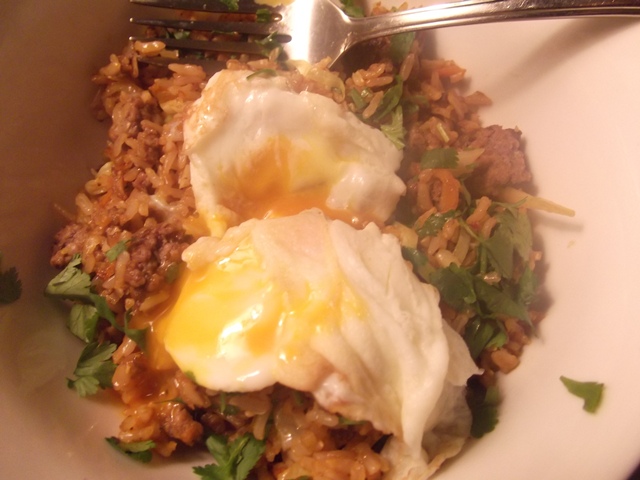
Stir the crispy garlic into the rice. Taste, adjusting seasonings with salt and pepper to taste. Serve hot, topped with a sprinkle of cilantro, some scallions, and an egg fried over-easy, so that the yolk is still runny. Nick always adds more sambal oelek, and then apologizes as he douses the whole thing in Maggi sauce.
*I find sambal oelek hotter than our usual hot sauces, so tread lightly if you’re spice-sensitive. If you don’t have sambal oelek, Chinese chili garlic paste will work, and so will Sriracha (which goes with everything).

**If you don’t have or can’t find ketjap manis (also called kecap manis), use two tablespoons soy sauce with one tablespoon brown sugar. You can find ketjap manis as Asian grocers or Southeast Asian specialty markets – I got a huge bottle for  less than three dollars at Thuan Phat Supermarket on Broadway and Prince Edward in Vancouver (though I hadn’t had much luck finding it at T&T). You can also find it online.
Merry Christmas!

‘Tis the night before Christmas, or, more accurately, the early morning of, and the cat and I are the only ones here stirring. I hear the rattle of paper on poorly wrapped gifts under the tree, and Molly hopping in and out between the branches. I hear the ornaments jingle as her tail flicks and flits, and the occasional soft “mew” as she reminds me that she has chosen my company over that of those warm, sleeping bodies in the room down the hall.

I should be sleeping. If I were smart, I would be – this is our busiest weekend of the year, and we have got to be at our best for these long days. There will be marathon meals and endless wine and rum drinks, and staying awake will be mandatory for most of it. Someone will have to watch the baby.

But it is my Christmas too, and I like being alone, puttering away in my kitchen, making something wonderful. If that has to happen well after midnight, then I’ll take it as it comes (with chilled vodka and a whisper of  Meyer lemon).

Time for myself and time with my knives and pots and stove has been hard to come by these past few months, which I suppose is to be expected with a newborn, though I don’t like being defeated so easily. I have taken to buying challenging ingredients just to have on hand in case a burst of energy lines up with a wide enough window of time. Last night I braised goat ribs. Tonight I am waiting on pork belly.

Christmas morning belongs to Nick and I, and for the past three years I have made something special for the occasion. This year I’m making David Chang’s pork belly buns, from the Momofuku cookbook. You can find the recipe online at Epicurious as well.

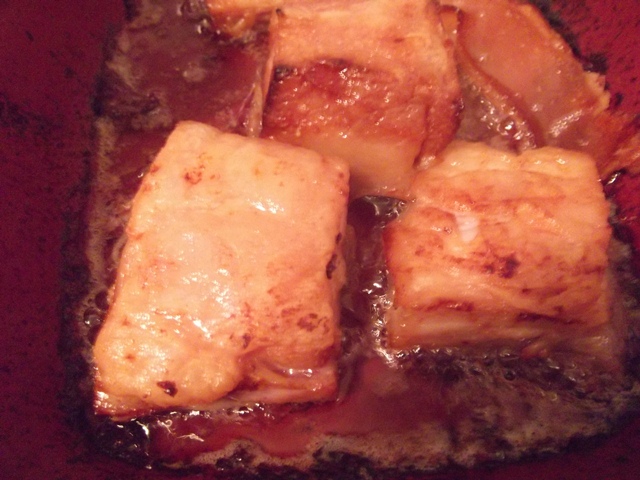
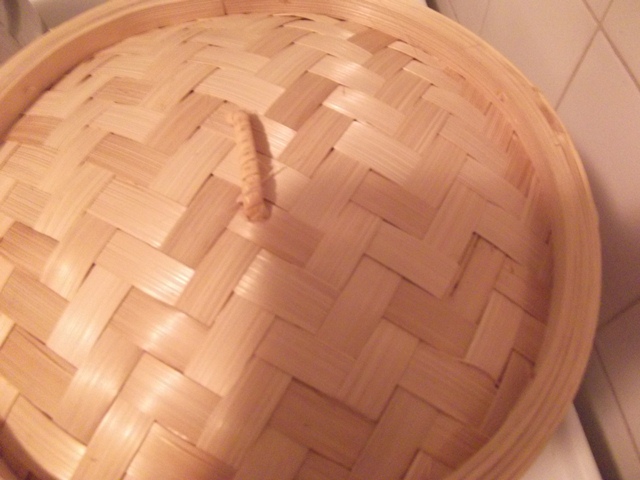
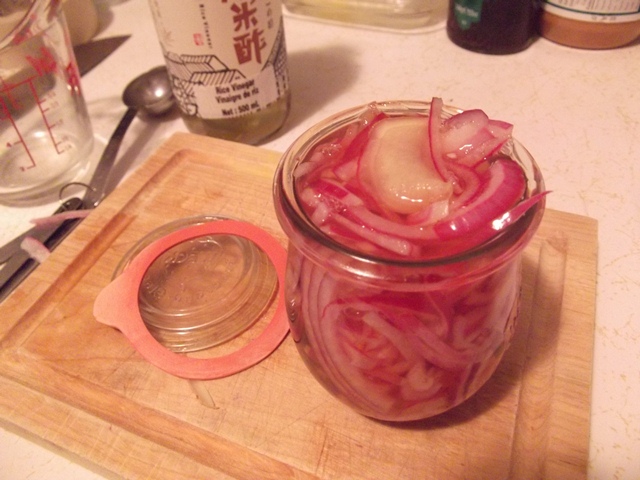
Tomorrow morning, we’ll sip chilled prosecco and assemble sandwiches of tender slices of pork belly on steamed buns with cold cucumber, hoisin sauce, and pickled red onions. Right now, the aromas of pork and vinegar and spices and yeast have taken over the apartment, overpowering the smells of cookies and cranberry-scented candles that lingered here before. These are my sugarplums. The meat is sizzling in its slowly rendered fat, turning golden in a burst of high heat. So this is Christmas.

So Merry Christmas. I hope that you find a moment today to enjoy your favourite sort of magic, and that you get to do a little bit of what you want to do. If you can find a few minutes for a sip of sparkly wine and a sandwich, all the better.

Season’s Greetings, and I look forward to being in the kitchen more often and spending more time with you here. Maybe even in daylight.

Rabbit cacciatore.

Yesterday Nick and I celebrated our third wedding anniversary. Kind of. I made a nice dinner, and then we zoned out in front of a bunch of cooking shows on the PVR. This year has kind of been a wash, celebration-wise; we haven’t celebrated any of our milestones properly. Nick turned 30 on Friday and we didn’t have plans, and I was all-day morning-sick on my birthday in April. We’re thinking of putting off Christmas until January. It’s been a busy year.

Fortunately I am a bit of a hoarder, and I figured we’d be all out of energy right around now. I have stocked the freezer, fridge, and pantry with everything we’ll need to eat reasonably satisfying and healthy meals until my employment insurance kicks in, so I was able to put together a luscious rabbit cacciatore while the baby dozed and the cat napped.

Rabbit is a very lean meat and a great alternative to the usual chicken or pork. It’s also a sustainable alternative, as rabbits are small, plentiful, reproduce quickly, and do not have the same impact on the environment as larger or more industrially farmed meats. If you can’t find rabbit at your local market, ask your butcher.

I adapted this recipe from Simply Recipes, adding pancetta, more veggies, a spot of wine, and some different herbs and spices, and it was just fancy enough for an anniversary dinner, but easy enough to put together between feedings and phone calls and commercial breaks.

If you don’t have bunnies in your freezer, you could substitute six to eight chicken thighs for the rabbit pieces. Serve over pasta, polenta, or rice.

Rabbit Cacciatore

(Serves six to eight; adapted from Simply Recipes)

  • 2 heads garlic plus 3 cloves
  • 4 tbsp. olive oil
  • 1 2- to 3-pound rabbit, cut into six or eight pieces
  • 1/4 cup all-purpose flour
  • 1/4 lb. pancetta, diced
  • 1 medium onion, diced
  • 2 ribs celery, diced
  • 1 large carrot, diced
  • 1 tbsp. capers, chopped
  • 1 tsp. red chili flakes
  • 1 tsp. dried rosemary
  • 1 tsp. dried oregano
  • 1/2 tsp. dried thyme
  • 1 large red bell pepper, chopped
  • 1/4 lb. mushrooms, sliced
  • 1/2 cup red wine, such as Cabernet-Sauvignon
  • 3 cups chopped tomatoes (or 1 28-oz can diced tomatoes including juice)
  • 2 bay leaves
  • Salt and pepper, to taste
  • Chopped parsley

Roast two cloves of garlic in an oven preheated to 350°F for 30 to 45 minutes until golden and tender.

Heat olive oil over medium-high heat. Pour rabbit pieces, flour, and about a teaspoon each salt and pepper into a sturdy plastic bag. Hold or seal the top of the bag, and shake to coat rabbit.

Brown rabbit pieces in olive oil, then remove to a plate. Set aside.

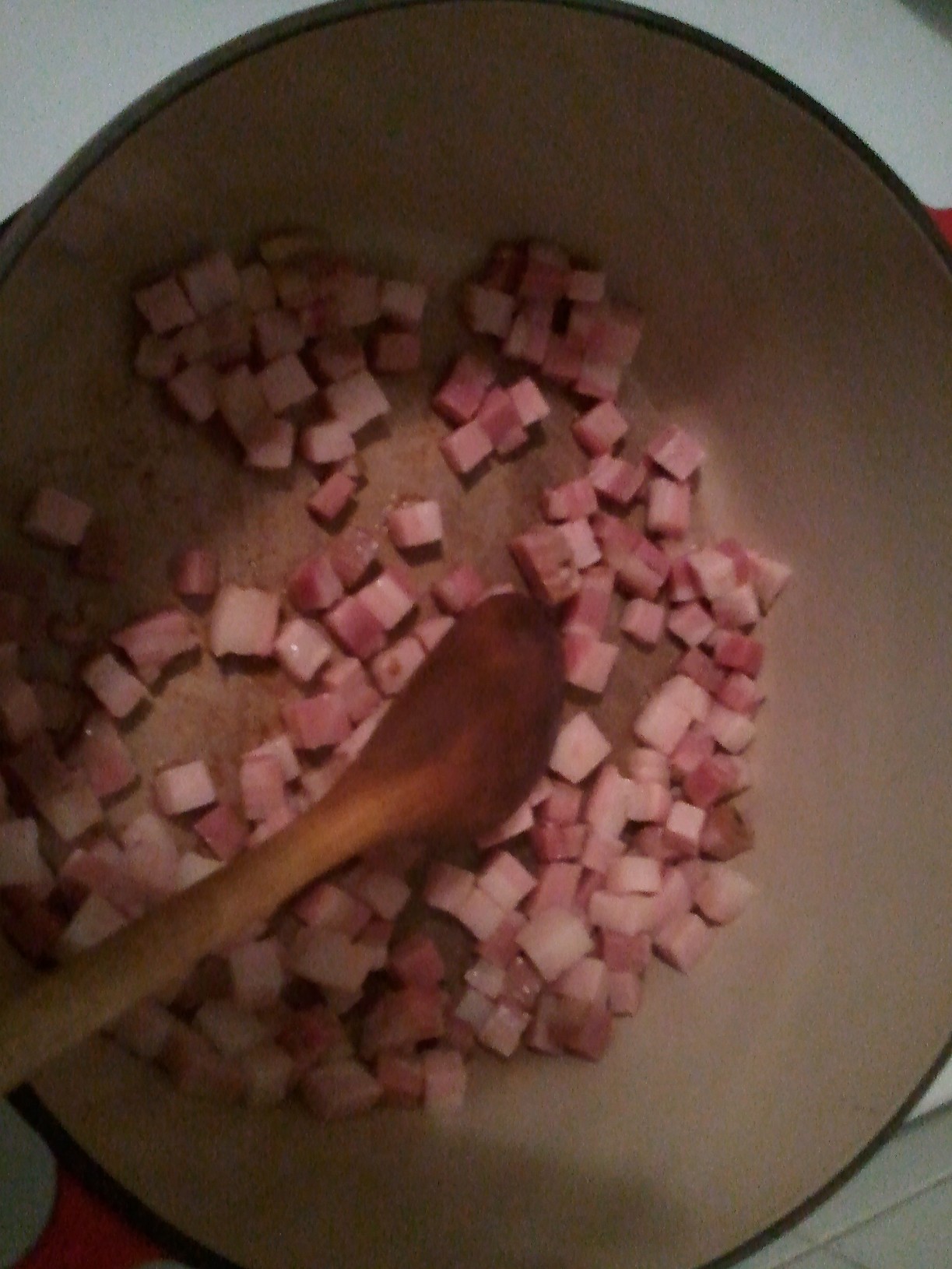
Brown pancetta in same pan. Add onion, three chopped cloves of garlic, celery, and carrot, and cook for three minutes.

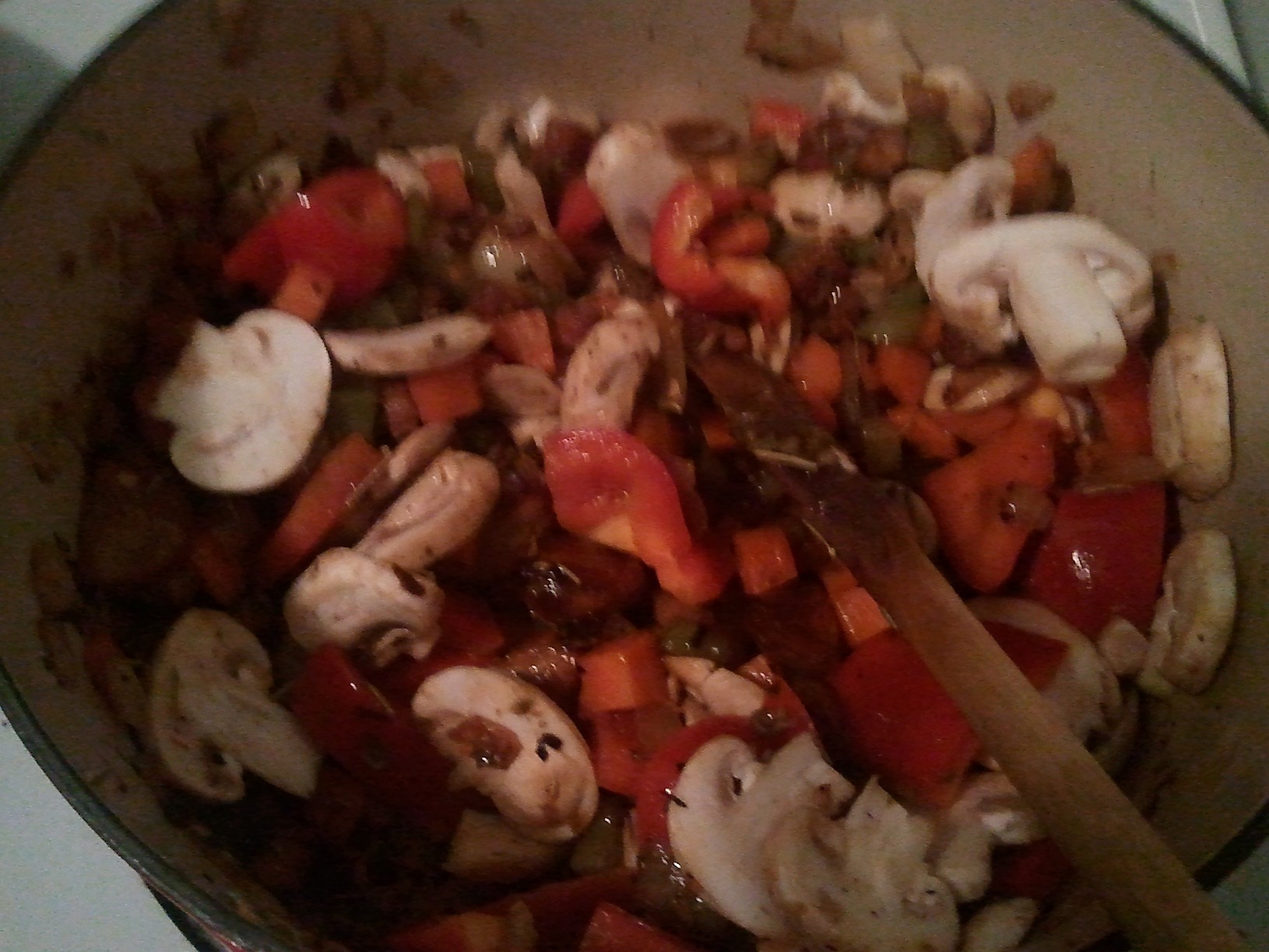
Add capers, chili flakes, rosemary, oregano, and thyme. Stir to coat pancetta and veggies, then add bell pepper and mushrooms. Cook an additional two minutes. Add wine and scrape browned bits off the bottom of the pan, then reduce heat to medium. Add tomatoes and roasted garlic and bay leaves. Taste, adjusting seasonings as needed.

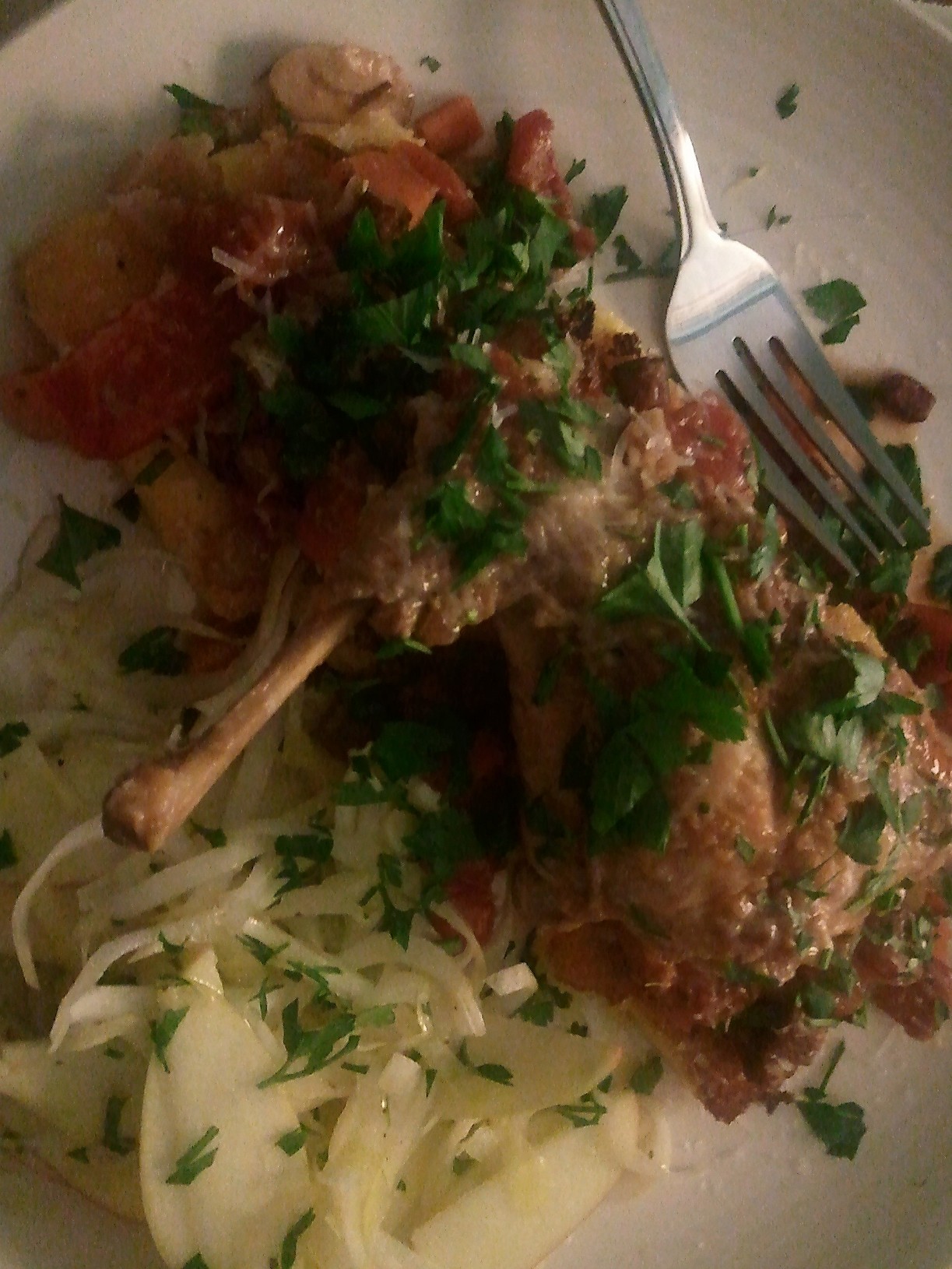
Add rabbit, pushing the pieces into the pot so that they are submerged. Cover, reduce to medium-low, and cook for 35 minutes, until rabbit is cooked and tender. Remove lid and simmer an additional 10 minutes to reduce sauce. Sprinkle with parsley before serving.

Pepper pot.

A friend and I once took a Caribbean cooking class through the Vancouver School Board’s Continuing Education program. I had taken other classes through the same program and they were all taught by professional chefs and I learned some fabulous things, including recipes I still use on a regular basis, so I thought the Caribbean class would be equally useful.

When we got to the first class, the instructor was wearing a lot of red lipstick, some of it on her lips, and a T-shirt printed with a picture of her face. She was no longer allowed to sell her herbs and spices in class – the school board forbade it – so if you wanted to come out to her car after class, she’d sell you spices in Zip-Loc bags. I can imagine how it would look, buying a baggy of dried thyme from the trunk of someone’s car in a south Vancouver high school parking lot, but I guess that’s how she supplemented her income; she would mention her spices two to three times, every time.

She also ran a catering company and would deliver your Christmas turkey or Hanukkah feast, and taught she taught basic cookery to children (I was once handed a recipe for a spaghetti dessert involving raisins, cottage cheese, and cinnamon – I think it was supposed to be Noodle Kugel, but it missed the mark … a bit). The course was four classes long and basically one giant commercial. And the food was terrible.

What I did get out of the class, aside from a Certificate of Attendance and a desire for my own face on a T-shirt, was an introduction to some of the basic flavour combinations that comprise Caribbean cooking. What follows is a version of Caribbean Pepper Pot, which I was introduced to in that class, but which has evolved into something less complicated but infinitely more complex.

It is mildly sweet, as spicy as you want it, and full of autumn veggies, which makes it a cozy dinner that’s lovely this time of year. I hope you’ll try it. And no need to follow me out to my car afterward.

Pepper pot

(Serves six to eight)

  • 2 tbsp. vegetable oil
  • 8 chicken thighs, bone in, skin removed
  • 1 medium onion, halved lengthwise and sliced
  • 3 cloves garlic, chopped
  • 2 tbsp. dark brown sugar
  • 1 1/2 tsp. dried thyme
  • 1 tsp. ground allspice
  • 1/4 tsp. ground cinnamon
  • 2 bay leaves
  • 1 1/2 lbs. yams or sweet potatoes, peeled and chopped into one-inch pieces
  • 2 cups diced fresh tomatoes
  • 1 to 2 scotch bonnet or habañero peppers, pierced (unless you like it really hot, then chop the peppers finely … but be careful)
  • 2 cups chicken stock
  • 1 14 oz. can coconut milk
  • 1 lime, zest and juice
  • 1/2 lb. okra, chopped into one-inch pieces
  • 1 red bell pepper, chopped
  • 1 cup chopped kale, packed
  • 1/2 cup chopped fresh cilantro
  • Salt and pepper, to taste

Heat the oil in a Dutch oven or other large, heavy-bottomed pan over medium-high heat. Add chicken thighs and brown each side. Remove from pan and set aside.

Add onions and garlic to the pan, scraping up any chicken bits from the bottom. Add bay leaves, brown sugar, thyme, allspice, and cinnamon. Cook until fragrant.

Add tomatoes, sweet potatoes or yams, scotch bonnet or habañero pepper(s), chicken stock, coconut milk, and lime zest and juice. Bring to a gentle boil, then reduce heat to medium, and simmer for 30 minutes.

Add okra, red pepper, and kale and simmer for an additional 10 to 15 minutes, until okra is soft. Stir in cilantro. Taste, adjusting seasonings as needed. Remove pepper and bay leaves. Serve with rice.

On moving apartments and melting cheese.

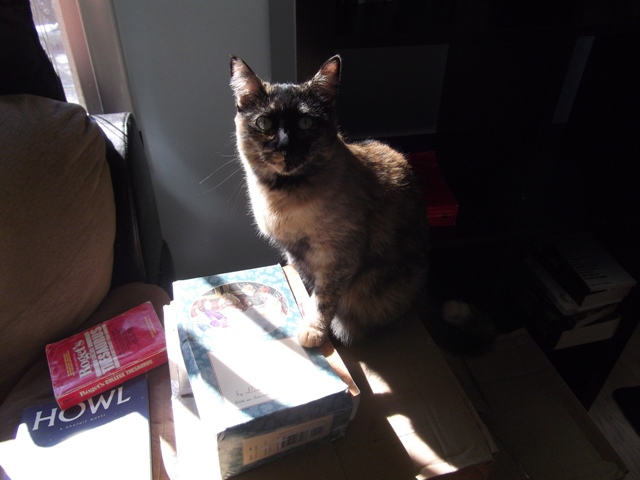
We have a new apartment. We have the Internet, at last. The landlord has promised that I’ll soon have a new stove. And now that we’ve had our first dinner party in our new apartment, the place feels like home and I can breathe. Nick painted the place before we moved in and it’s very blue, so for the first time ever we’re living together in a place that we can describe the colour of using adjectives that don’t also describe bodily fluids. The cat still blends in with all the furniture, but Nick looks better because the walls match his eyes.

We have more windows and better light, and we’ll have lots of time to enjoy these things as the rent on the place will prohibit us from spending much on anything else. Cat has not settled down since we finished moving in last week because there are so many new rooms and cupboards and hallways to explore, and I hear her little voice from all the corners of the apartment reminding me she’s still here. She checks in once in awhile, but she still has a lot to do. There’s an upstairs to this place, and she has to rub her face on every inch of every step and that takes more energy than a five-pound furball can muster all at once.

My kitchen in this new place is the same size as the old one. The advantage is that here I have a window above the sink, and the drawback is that my fridge is half the size. I am twice the size now, having rounded the corner on my thirty-third week with a belly that’s measuring closer to 35 or 36 weeks, so I have yet to start feeling comfortable in my space. It’s hard to relax when you’ve got a habit of knocking crap off the counters or searing-hot pans off the stove at every turn. All of my shirts have stains on them.

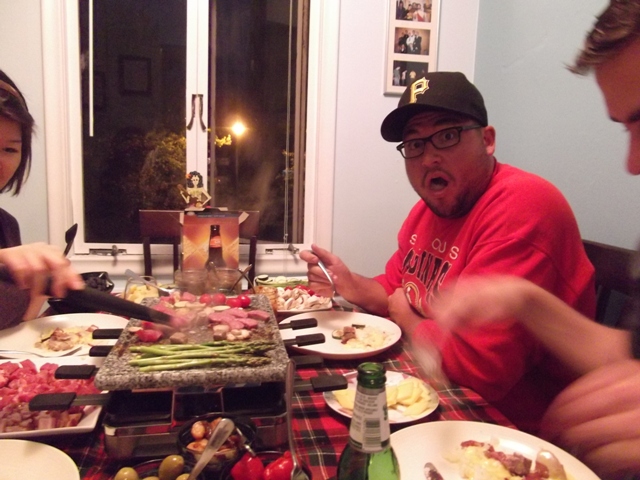
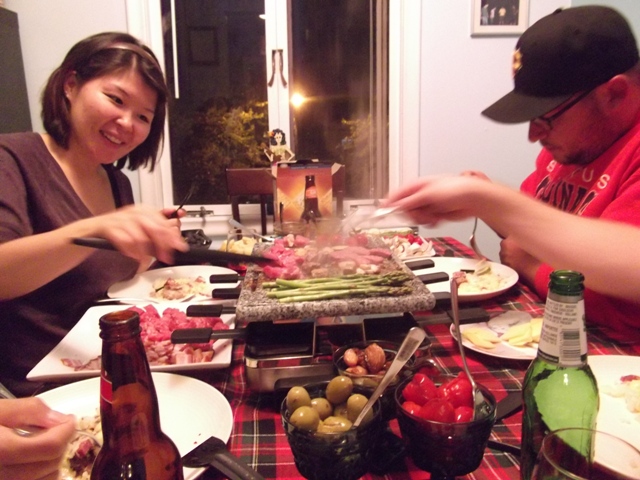
I wanted to have friends over for dinner, because a feast in a new apartment is like a bottle broken on the hull of a boat; it’s how you make things official. The first dinner shared with people in a new apartment (not eaten out of boxes on the floor, but at an actual table) is the thing that makes the place a real home. Ordinarily my effort would reflect the importance of this, but I am irritable and my back hurts and the more things I have to do, the more complaints I am able to muster. Fortunately, we have a raclette.

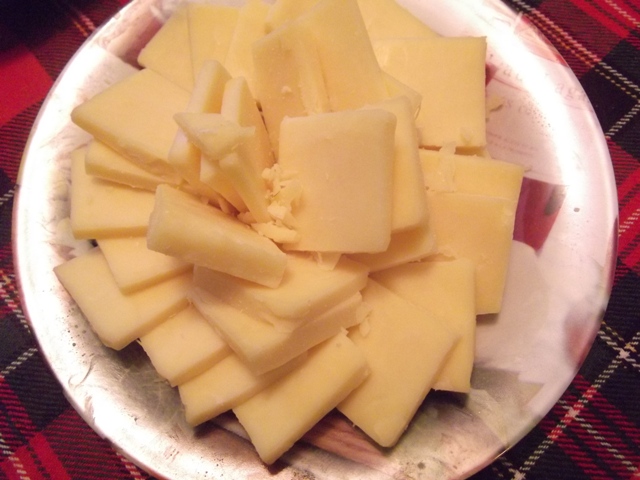
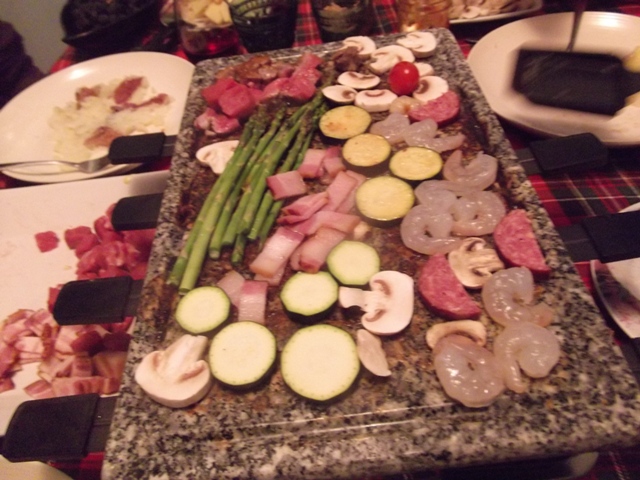
A raclette is a wonderful thing. It’s like a fondue pot, except instead of dipping things into melted cheese, you pour melted cheese over things. We learned about raclette a few years ago in the home of my friend Chelsea and her then-boyfriend, an accented Swiss-German named Marco who was a Physics professor by day and a drummer in a Celtic punk band by night. Raclette is both the name of the apparatus and the type of cheese, though we used good white cheddar and it was delicious.

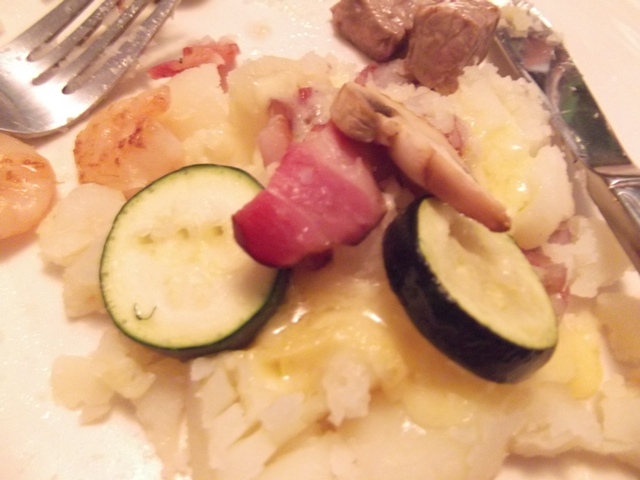
Your guests will cook their meat and veggies to taste on top of the raclette grill while melting cheese under its broiler. They will eat their cooked morsels with potatoes and drizzle the melted cheese over top. They will do this more times than they can count, and at the end of the meal they will be very sleepy.

To make a proper raclette meal, you boil more quartered red or white potatoes than you think you’ll need, and slice quite a lot of cheese. I boiled a pound of potatoes per person. There were five of us, so I sliced two pounds of cheese. We had asparagus, mushrooms, zucchini, and grape tomatoes for our veggies, and cubed steak, chopped bacon, shrimp, and rounds of Farmer’s Sausage for our protein. Start with the bacon to lube up the grill a bit before cooking the other things. If you’re a vegetarian, wipe the top down with a bit of olive oil before starting.

Because a meal based on the holy trinity of meat, cheese, and potatoes can be, uh … rich, set the table with little bowls of acidic, pickly things, like olives and beet pickles and peppadews and gherkins and cocktail onions – whatever you have in your pantry will do, but if you have to make a special trip, make use of a store’s olive bar, where you can buy just a few of everything for not very many dollars.

Little ramekins with good salt, freshly ground pepper, and Dijon mustard round the dinner out. The whole thing ends up being an inexpensive, rather European feast, and it is made better with wine or good cold beer. It is a warming treat in the wintertime. You will want to have Beirut playing in the background, and perhaps you and your guests will wear sweaters and it will be snowing.

I have bought raclettes as wedding gifts, and know that you can get a pretty good one for $50, less if there’s a sale. Department stores sell them in their small appliance sections, and better cookware stores sell more expensive versions (up to $250), with heavier-duty grills. We have a fancy one, because my parents bought Nick a raclette for Christmas the year he discovered his obsession with it. Ours serves eight people, but Nick would happily melt cheese every night on his own if cheese in Canada was cheaper and if he didn’t have to clean the raclette every time.

There is little more enjoyable than sitting around a table full of food with people who are genuinely enjoying themselves, though keep in mind that you should take the meal slowly, and if you are planning some after-dinner diversion to start the meal a bit earlier. If dinner ends at 10:00, the night ends at 10:00. Meat and potatoes and cheese are good inspiration for long naps, but not one of your husband’s nerdy board games even if that was the plan at the start

What about you? It’s been awhile. How are you warming up to fall? Are you embracing the idea of sweaters and meals of cheese, or putting it off as long as you can? How are you doing?

Rich, hearty meat sauce.

With the exception of a four-hour period last Friday during which I managed to score an excruciating, now-peeling sunburn from sitting on a patio during lunch, this part of the world has been slow to summer. Which is just as well, because I’ve recovered most of my appetite, and after Paris the taste I’m looking for is unctuous. Unctuous like long-roasted meat, and like the sauce around it, so rich with that slowly melted fat that coats your mouth and the inside of your belly, leaving you full and sleepy.

I went with Grace (and Claude, but that is a story for another time) to a restaurant in Paris called Bistroy Les Papilles where we were brought just such a dish. Three steaks of pork belly were served in a tomato sauce filled with navy beans, thyme, and fresh spring vegetables; the pork had been cooking long enough that most of the fat found itself in the sauce, so that the meal was deceptively rich. I succeeded in eating only a small plateful, though it was a satisfying plateful.

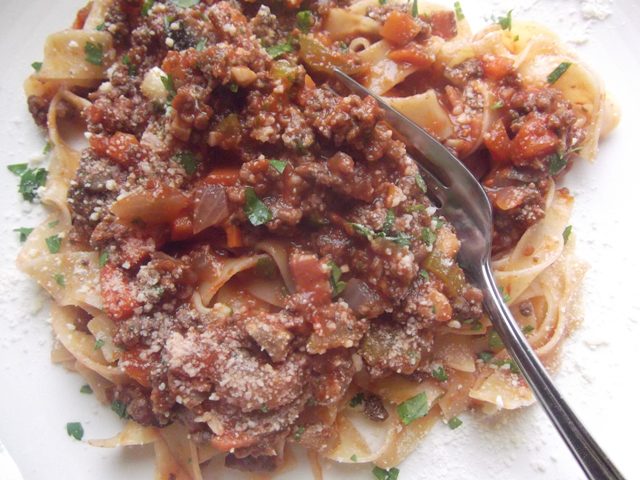
It’s not really possible during the week to cook a slab of pork belly until it melts down into and plumps several pounds of white beans, not when one has to go to a place of business and complete tasks each day – I do have a slow-cooker but it’s the kind that sets things on fire. It is possible to mimic that unctuousness on a weeknight at home; the secret is to use good-quality meat, a combination of pork fat and olive oil, and a cheaterly handful of minced mushrooms. Top with cheese.

This sauce is easy, but it’s not slimming. The point is comfort (as my point so often is), and this is one of those dishes you could serve to company some rainy night, even on the weekend. It’s layered, and tastes as though it cooked for much longer than it did. The cinnamon adds balance to the meatiness, so if you are unsure about it, just add a little bit and see what you think.

Meat sauce for pasta

(Serves eight.)

  • 6 strips bacon, chopped
  • 3 tbsp. olive oil
  • 1 medium onion, finely chopped
  • 1 cup celery, finely chopped
  • 1 cup carrots, finely chopped
  • 1 1/2 lbs. good quality ground meat (I like a combination of beef and venison or pork, but you could use just beef if that’s what you have)
  • 1/2 lb. mushrooms, finely chopped
  • 4 cloves garlic, minced
  • 1/2 cup dry red wine
  • 1 28 oz. can crushed tomatoes
  • 1 1/2 tsp. dried oregano
  • 1 tsp. ground black pepper
  • 1/2 tsp. dried basil
  • 1/2 tsp. cinnamon
  • 1 cup beef stock
  • Salt to taste
  • 1/4 cup finely chopped fresh parsley

Brown bacon in a large pot over medium-high heat. Remove from pot to a plate lined with paper towel using a slotted spoon.

Add olive oil, followed by the onion, celery, and carrots. If the veggies are cooking too quickly, reduce heat to medium, and cook until soft and lightly golden, about ten minutes. Remove from pot to a plate using a slotted spoon. If you reduce the heat, put it back before the meat goes in.

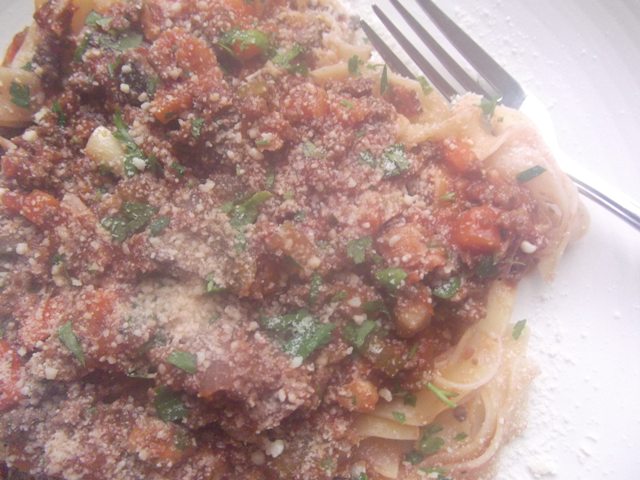
Add meat, mushrooms, and garlic, breaking the meat up with a wooden spoon as it cooks. When meat has browned, add back vegetables and deglaze the pan with the wine. Add crushed tomatoes, oregano, pepper, basil, and cinnamon, and then beef stock. Stir to combine, and then taste. Depending on your bacon and stock, you may or may not need to add salt. Let simmer over medium-low heat for 30 to 40 minutes, stirring occasionally. Before serving, add parsley. Serve over pasta with additional parsley for garnish, and a sprinkling of cheese.
For us, this is enough for dinner and leftovers, and for a bit to put in the freezer for dinner another night. It is better the next day. And if you live nearby, you will need it tomorrow because it will still be raining. If you are a cat, the birds will tease you relentlessly as they hide in the branches of the tree just outside your window. Right now we all need our share of meat sauce.

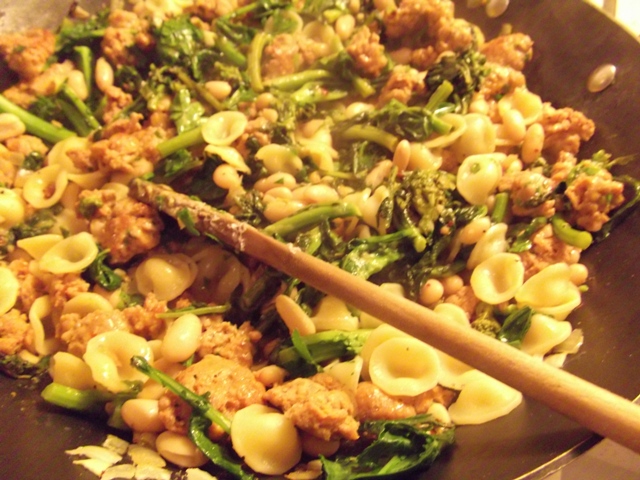
Rapini and sausage with white beans and orecchiette

When we found out that Nick has diabetes, we were  lucky in that we were already eating mostly pretty well, most of the time, cheese and butter and cream aside, and that we didn’t have to make significant dietary changes. I threw out one stale half-bag of poor-quality elbow macaroni that I might have bought at Walmart that dark year I was an intern and had to have three roommates in a basement suite where the front door only kind of locked and where when it rained the water ran into the suite right over the electrical panel. We weren’t going to eat it anyway.

The only thing I really miss now that Nick is restricted is having pasta as a default – not being able to serve up a big plate of refined white carbs when I don’t feel like putting in a real effort, which can happen a couple of times a week, means adapting to a new kind of laziness. And the difference between pasta and something like, say risotto or sushi, which is also white and low on the glycemic index, is that pasta tends to last a couple of meals so you get that good blood-sugar spike a couple of days in a row. Fine for me, shakes and comas for him.

He can still have a small amount of pasta, of course. What he can have is likely what would be considered a normal portion size. And when you get down to comparing labels and noting the varying levels of carbohydrates, the rice pastas and whole-wheat pastas and gluten-free pastas are all similarly bad news carbohydrate-wise; a plate of the whole-wheat stuff is going to affect Captain Diabetes the same way that a plate of the delicious semolina stuff will.

So we adapted. Instead of a big plate of pasta, we have a big plate of stuff with pasta in it if there isn’t enough time to devise a huge and clever feast, or if the idea of opening a cupboard is too daunting to even consider. Here is one of those meals. It calls for blanching, which may qualify as a step that’s too daunting, but it’s really nothing. I promise.

Rapini and sausage with white beans and orecchiette

(Serves four.)

  • 1 lb. rapini, chopped
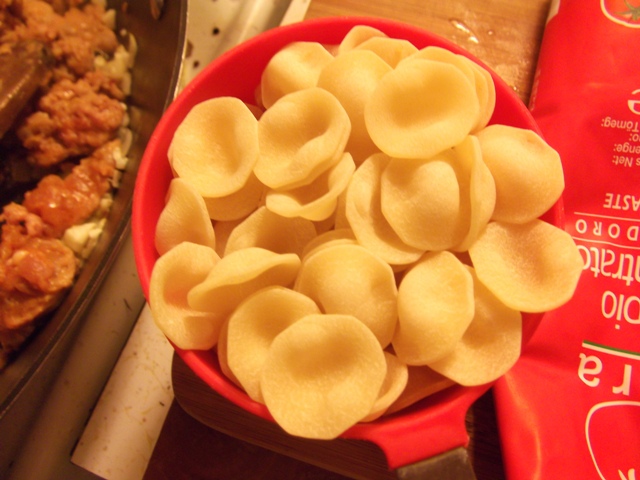
  • 1 cup uncooked orecchiette pasta
  • 1 lb. spicy Italian sausage, casings removed
  • 3 tbsp. olive oil
  • 1 small onion, chopped
  • 3 cloves garlic, minced
  • 1 tsp. red pepper flakes
  • 2 tbsp. tomato paste
  • 1 19 oz. can white beans, drained and rinsed
  • 1/2 lemon, zest and juice
  • 1/2 cup chopped fresh parsley
  • 1/4 cup grated Parmesan
  • Salt and pepper, to taste

Bring a large pot of lightly salted water to a boil. Drop chopped rapini in, and boil for two to three minutes until wilted and brightened in colour. Remove rapini from water, reserving liquid, and plunge into a large bowl of icy water. Set aside.

Return the pot to the heat and bring water back up to a boil.

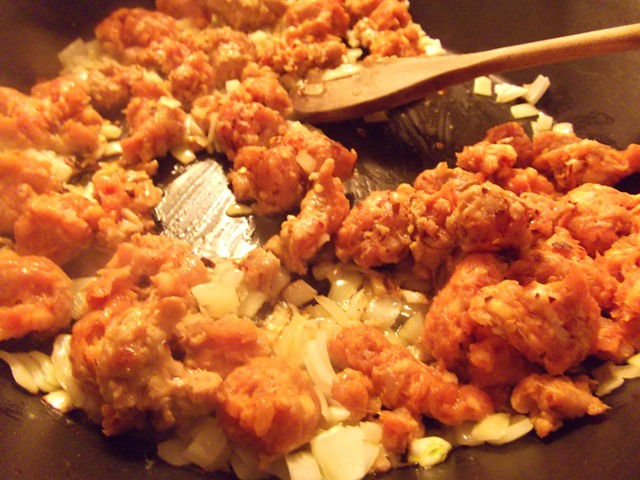
Meanwhile, heat olive oil in a large pan over medium-high heat. Cook onions until translucent. Add garlic, then crumble sausage into the pan. Stir with a wooden spoon, breaking the meat up as you go. Add red pepper flakes and tomato paste and continue moving the meat around the pan.

When the water has come to a boil, add pasta and boil until al denté, about eight minutes.

Drain and then add rapini to the pan, stirring to coat in pan juices. As pasta finishes cooking, add beans and lemon zest and juice, then add pasta. Reserve some of the pasta water in case the pan becomes too dry.

Add parsley and cheese. Taste, and adjust seasonings as needed. Serve with additional cheese.

Bacon.

You know when you finally do something you’ve been wanting to do for a long time but for whatever reason you kept not getting around to it, and then when you finally do get around to it you feel so silly for having waited all that time?

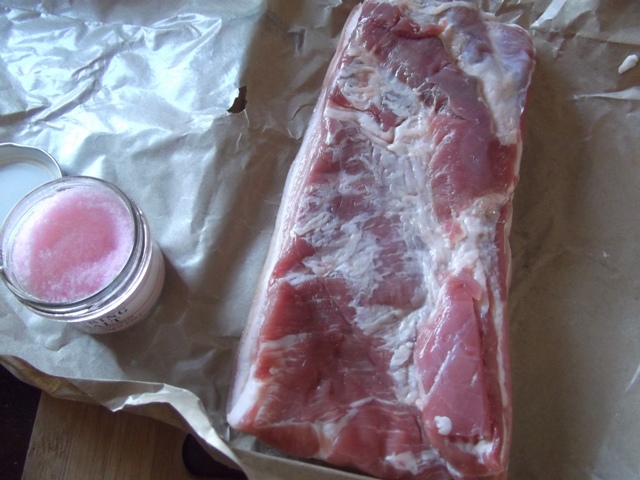
For me, the thing was bacon. Homemade bacon, which I always knew you could do but put off because for some reason the thought of finding curing salt was rather daunting, even though I knew you could buy it literally three blocks from my apartment. I don’t know. I think I figured once I had the pink salt, I’d have to commit, and then what if I wasted my money and half a kilo of pork belly? There was a lot to consider, and the threat of failure and food poisoning put me off.

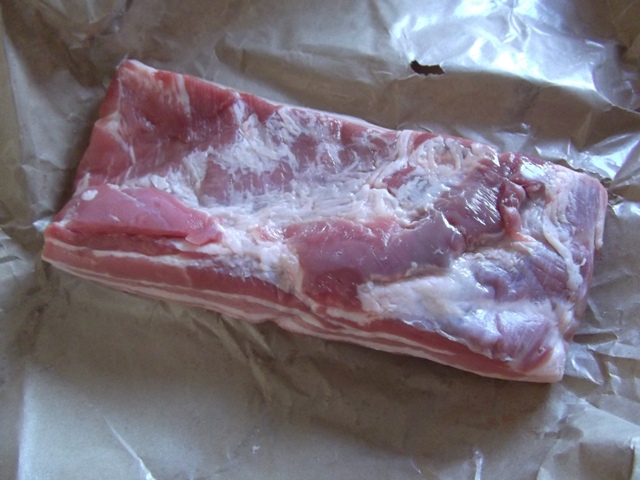
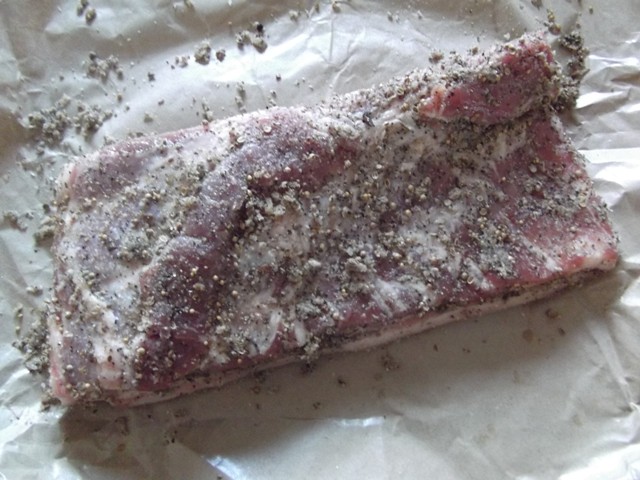
Then a couple of weeks ago the director at work told me about a butcher shop that her French cooking teacher recommended and I went there to buy something else, and there, in its fatty, rosy glory, I found just over two pounds of local pork belly, just the right amount to make my first batch of bacon. I found a Michael Rhulman recipe, and bought my pink salt, and in about ten minutes I had done everything I’d need to do to the meat to make it bacon. After that, it would need seven days, and to be mostly left alone.
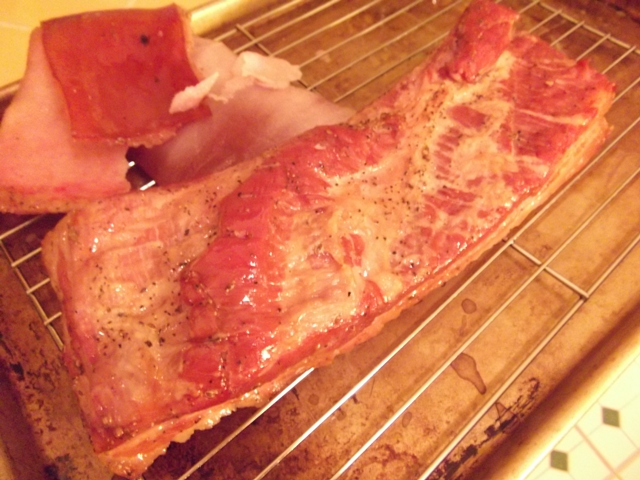
I feel silly for having waited all this time.
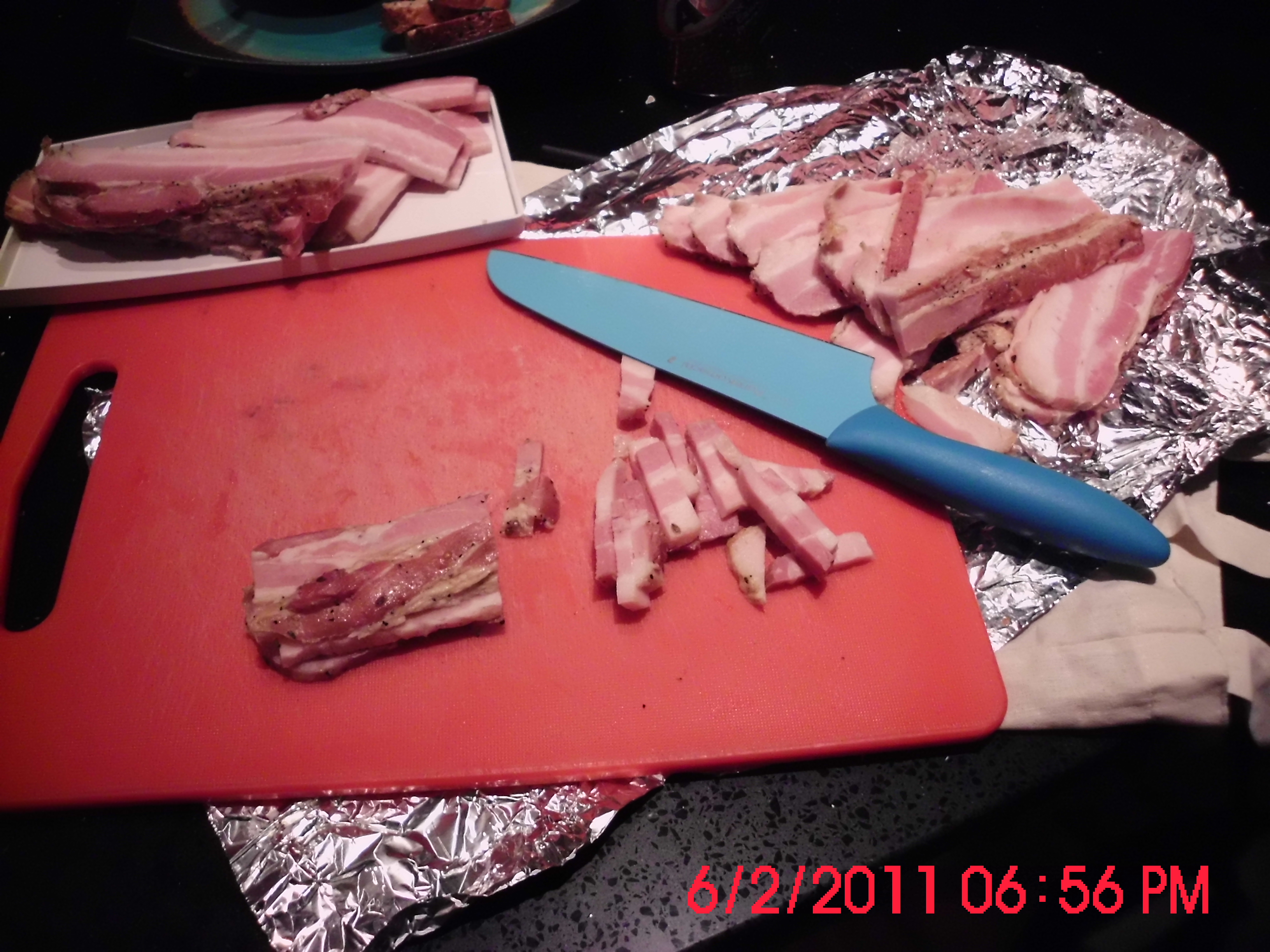
The result was impressive, meatier than regular bacon and not as salty, with a pronounced garlickyness that was thrilling – garlic and bacon go almost as well together as bacon and cheese. I cut it thick, about an eighth of an inch (my parents have a meat slicer they let me use … *mental note: add meat slicer to wish list*), but it would last longer in thinner strips (some of us never learned when to say no).
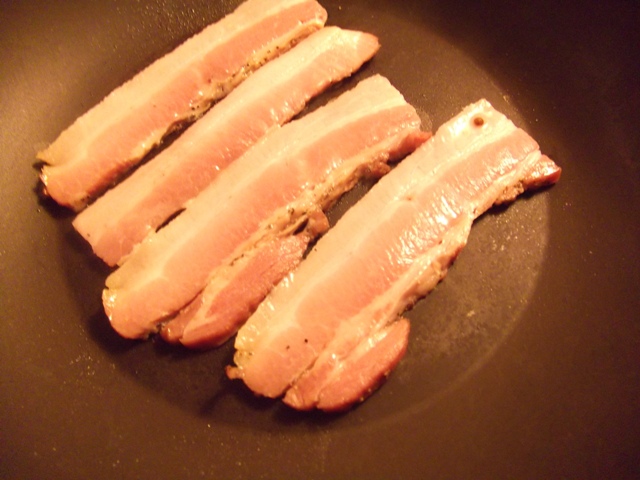
Bacon might just be a gateway charcuterie. One cannot simply stop at a slab of cured pork belly; there’s pancetta to think about, and guanciale, and corned beef, and sausage … I already have plans to convert a wine fridge I got as a wedding gift to a climate-controlled curing chest, and even though our apartment is already crowded with kitchen tools and the hydro bill grew exponentially with the addition of the deep-freeze, Nick is okay with this – he stopped just short of encouraging me. For him: salumi.

I’m asking for Charcuterie for Valentine’s Day, which we don’t usually celebrate but neither of us has a greater love than cured or smoked meats – I am not exaggerating when I say Nick would trade me for my weight in bressaeola, and I’d happily swap him for a lifetime’s supply of jamón ibérico de bellota – and I can’t quit now.

But I’m getting ahead of myself. Big plans, no direction: story of my life. Have you done this before? Have you cured, smoked, dried, or otherwise preserved meat and made it more wonderful with salt and spices and air? Have you done it at home? Can you teach me? At this point I fear nothing, not food poisoning or living in an apartment that smells like a delicatessen, and there’s no going back to store-bought bacon.

And if you haven’t made bacon at home? Don’t wait any longer. Start your first batch today.

Paprika roast chicken, again.

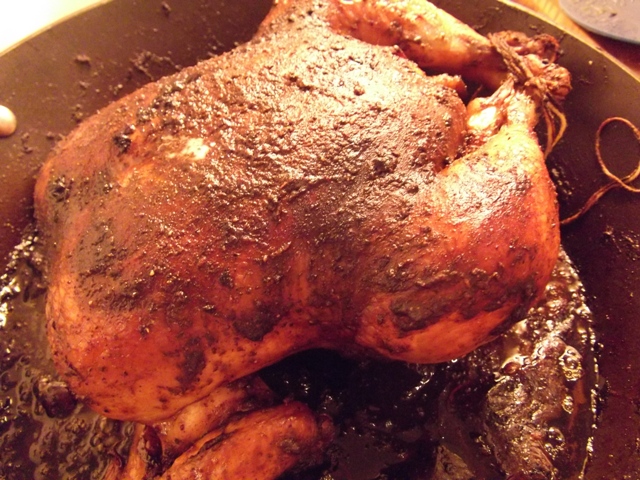
When speaking of this site, Nick and I call it Bloggy, affectionately as it is a large part of our existence. “Will it go on Bloggy?” Nick asks when dinner is good. Well, today is Bloggy’s second birthday. We celebrated with an update to the roast chicken I wrote about in my very first post. It’s strange, but this week has felt just as long as it did the first time I wrote, and just as much now as then, we both felt that spicy roast chicken would solve all our problems and be just the thing to help us move into another seven days. Chicken’s magical the way it does that, isn’t it? Well, maybe not, considering the part wine plays.

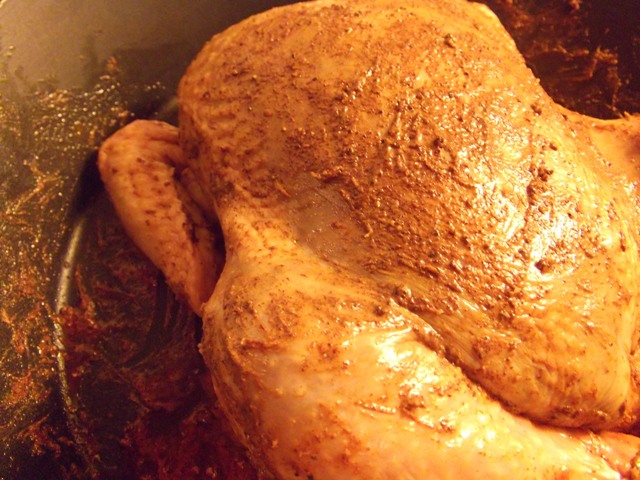
In two years, my paprika roast chicken has undergone some changes. I’ve streamlined the process and added butter, so now you simply slather the chicken in a paste of spices and butter, and roast it with a bit of white wine for 90 minutes in a 425°F oven. The last part is because of Ina Garten, who roasts her chickens in a similar way, and who is right about how to do things quite a lot of the time.

To roast a chicken in this way is to save yourself steps, time, and fussing; the result is a meal that makes itself (save for a couple rounds of basting when you’re passing through the kitchen to refill your wine glass – if you’re like me, in 90 minutes you will do this three or four times and if it’s the weekend you may need to open a second bottle but that’s okay because you’re cooking and cooking is art).

Paprika roast chicken

  • 1 whole chicken, 4 to 5 lbs.
  • 2 tbsp. unsalted butter or olive oil
  • 3 cloves garlic, minced
  • 1 tbsp. sweet paprika
  • 1 1/2 tsp. cayenne pepper
  • 1 tsp. cinnamon
  • 1 tsp. ground black pepper
  • 1 tsp. salt
  • 1/2 cup dry white wine

Let chicken rest at room temperature for an hour. Preheat oven to 425°F.

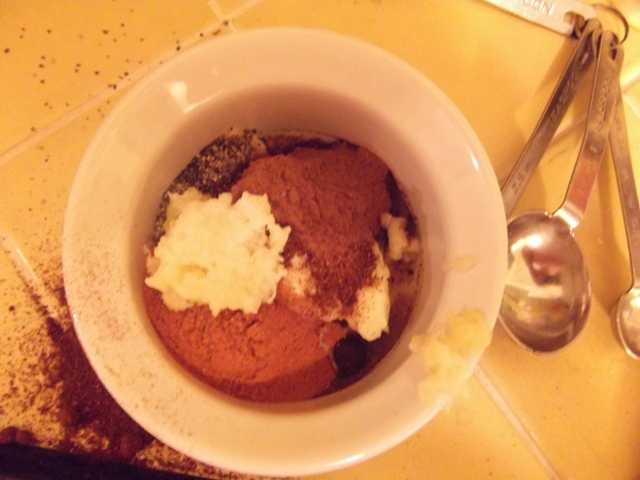
In a small bowl, combine butter or oil, garlic, paprika, cayenne pepper, cinnamon, black pepper, and salt. Mush together with a fork until the mixture forms a paste.

Using your hands, slather the paste all over the chicken, sliding your fingers under the skin to rub the paste into the breast, legs, and thighs. Wash your hands, then truss the chicken, folding the wing tips behind the bird, and place it into a roasting pan. Pour wine into the bottom of the pan. Optionally, you could throw in some chopped carrots or onions at this point. Sweet potatoes would also be lovely.

Roast the chicken for 90 minutes (or 18 minutes per pound), until the juices run clear when you cut into the spot between the leg and thigh. Baste periodically, adding additional wine or water as needed to moisten the bottom of the pan.

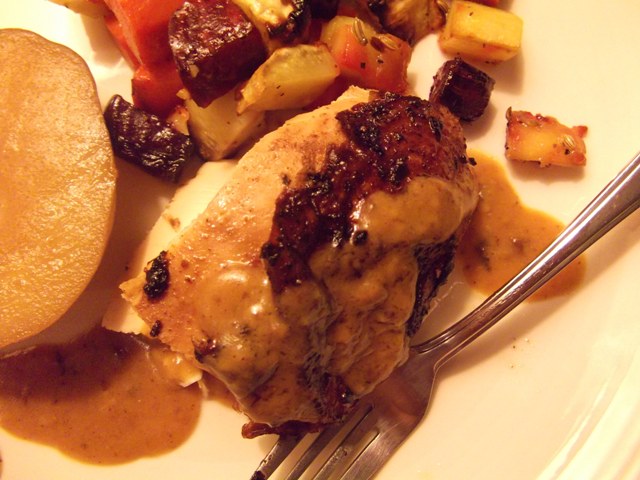
Remove from oven and tent with tin foil. Let rest 20 minutes before serving. You can make a spicy, luscious gravy by tossing a handful of flour into the pan drippings and stirring in a bit of milk or cream. If there are leftovers they are wonderful in pozole, and the carcass makes a glorious stock.

Tamale pie with black beans and red peppers.

Nick’s birthday was last week, and to celebrate we went out to the Tiki Bar at the newly renovated Waldorf Hotel. It was snowing, so I drove so I could still wear cute shoes and eschew a warmer, frumpier coat in favour of something that went better with my outfit. For awhile, the outfit was perfectly acceptable, because on a night like that there’d have been no reason to go outside.

I don’t know what happened.

Somehow, Nick’s friends decided that The Waldorf wasn’t fun anymore, and because it was Nick’s birthday and I drove them, I went along with their new plan to go to some house party on Commercial Drive. We parked the car at his friends’ house, because they said the party was within walking distance – closer than possibly having to park somewhere out of the way, I was assured – and on a warmer night, it might have been. First we walked several blocks to Commercial Drive, and then we headed south. I wasn’t wearing socks inside my stilettos, and my coat only buttoned halfway.

It was a 25-minute walk, and the snow was already several inches thick on the ground. And while Nick’s veins had been warmed by tequila before we left the bar, mine had not. This caused a variety of predictable problems for us as we plodded along.

I remember telling Nick I was going to stab him in the face and leave him to bleed or freeze to death in the snow. A few minutes later, we got to where we were going.

There was a $10 cover for each person, and as we climbed the stairs to the house, I realized that I am far less open-minded than I thought I was. The unmistakable stink of incense wafted down from the front door to the first landing on the stairs up, and when we got inside, we were instructed to remove our shoes. A sign informed guests that there would be no alcohol permitted in the house or outside of it.

This was the sort of place where I would be inclined to drink heavily. In a room with a beaded doorway, a woman warbled poetry and played what I think was a sitar, but it might have been that someone was stepping repeatedly on a cat, or a herd of cats – there was no way to be certain without going into the room, and I am uncomfortable sharing my personal space with a lot of strangers. On the back porch, an erotic cuddle puddle seemed to be forming, and downstairs, there was a performance I’m pretty sure included interpretive dance. I was in hell.

So we left. And we walked, again, in the snow until I was sure my toes would blacken with frostbite and fall right off. When we finally got home, I crawled into my fleece footie pajamas and drank tea so hot it was still boiling in the mug. When I woke up the next morning, I noticed a scratch in my throat, and by Monday, the cold was going full-bore.

This week is for very thick socks, sensible outerwear, and comfort food. Tonight I made a big pan of tamale pie, which is essentially Shepherd’s Pie with cornmeal instead of potatoes. I used a base I adapted from Homesick Texan’s Mexican Chorizo recipe; what resulted was a huge dish of food, one that will last as long as I need soothing, which, given the chill still haunting my toes and the cold fogging up my brain, might be a long time.

Tamale pie

(Serves six.)

  • 1 onion, halved
  • 2 cloves garlic
  • 1 7 oz. can chipotle peppers in adobo sauce
  • 1 tbsp. apple cider vinegar
  • 1 tsp. cumin
  • 1/2 tsp. ground coriander
  • 1/2 tsp. dried oregano
  • 1/4 tsp. cinnamon
  • 1/4 tsp. cayenne pepper
  • 2 tsp. salt
  • 1 lb. ground pork
  • 1 tbsp. olive oil
  • 2 cups chopped red bell pepper
  • 1 19 oz. can black beans, drained and rinsed
  • 1 14 oz. can diced tomatoes
  • 1 5.5 oz. can tomato paste
  • 1/2 cup chopped fresh cilantro
  • 4 cups water
  • 1 cup cornmeal
  • 1/2 tsp. salt
  • 1/4 cup butter, cold
  • 2 eggs, beaten
  • 1 cup shredded Cheddar cheese

Preheat oven to 400°F.

Chop one half of the onion, and place in a food processor or blender with garlic, chipotle peppers, vinegar, cumin, coriander, oregano, cinnamon, cayenne pepper, and salt. Blend until smooth.

Place pork in a bowl, and pour the blended pepper mixture over top. Mush the meat and the liquid together with your hands until combined. Wash your hands.

Mince the other half of the onion, and heat it in olive oil in a large pan over medium-high heat. Add peppers, and saute until they’ve begun to sweat. Add meat, breaking it apart with a wooden spoon, and then add black beans, and both kinds of tomatoes. Simmer until liquid has reduced, about 10 minutes. Stir the mixture regularly while it simmers. Add cilantro, and remove from heat.

Meanwhile, bring four cups of salted water to a boil over high heat. Whisk cornmeal in, and reduce heat to medium, whisking frequently until thickened, three to five minutes. Remove from heat.

Stir in butter, then eggs. Keep the mixture moving as you add the eggs so that they don’t scramble and ruin everything. Add cheese.

Pour meaty mixture into a 9″x13″ baking dish. Pour the cornmeal mixture over top of the meaty, beany pepper mixture.

Bake for 35 to 40 minutes, or until golden on top and bubbling around the sides. Let rest five to 10 minutes before serving, so that the topping can set. Serve with sour cream or thick yogurt.