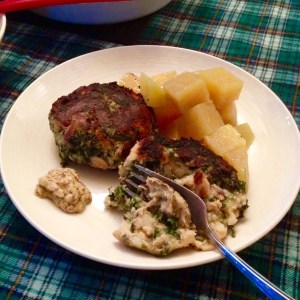
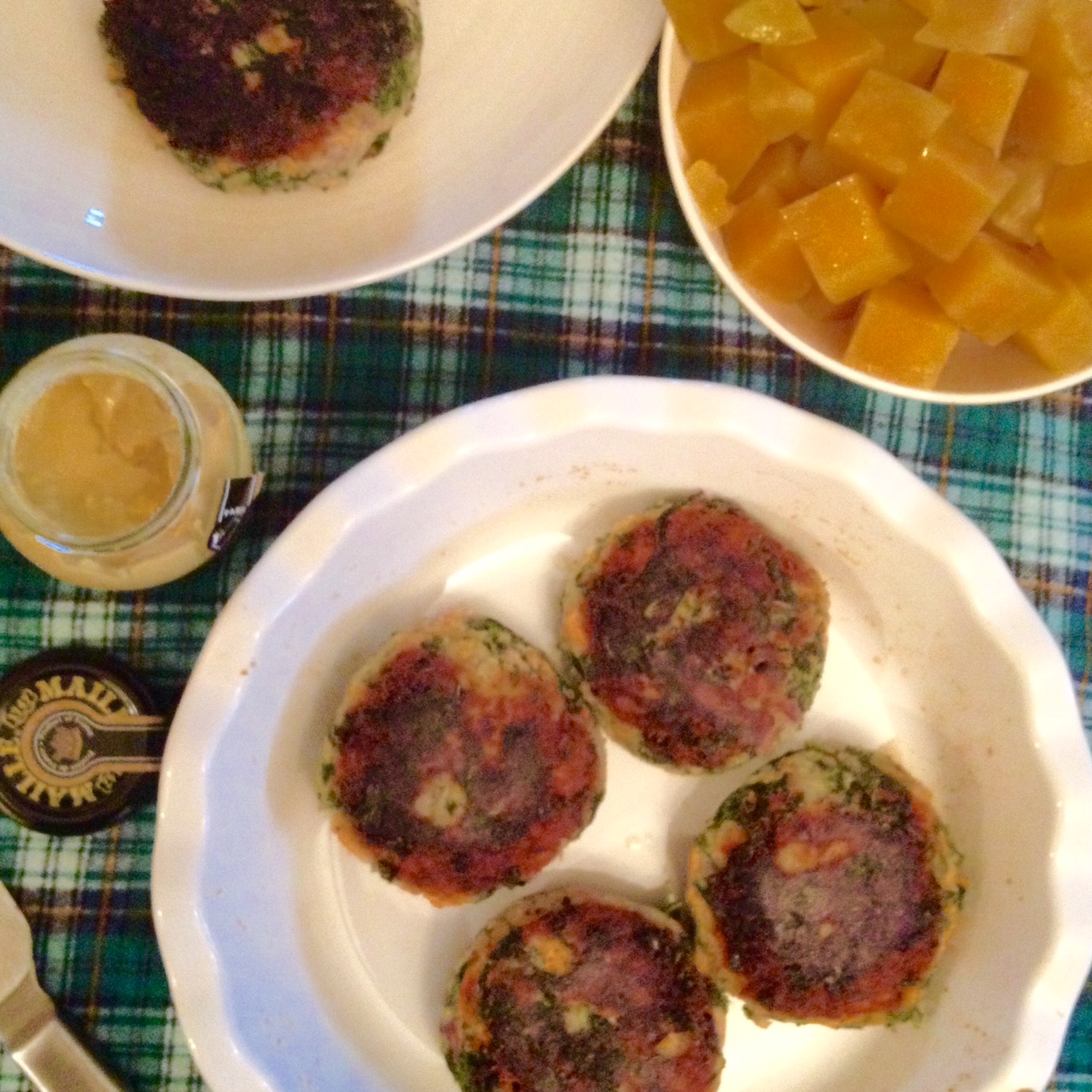
Hunger Awareness Week: Potato cakes with salmon and kale.

While you might imagine that the food bank is all about canned and boxed non-perishable goods, the reality is that 40 per cent of the food donated is fresh and frozen produce.

In Canada, 80 per cent of food banks provide at least one service above and beyond hampers and meals. In some communities, this can mean gardening programs or community kitchens, where people learn to cook and preserve what they harvest. These programs are empowering and sustainable, and engage young people and communities in the food system. If you’re not able to get to a store and buy food to donate, consider donating cash.

Funds donated to Food Banks Canada go a long way. Food Banks Canada and provincial and regional food banks form partnerships with retailers, local businesses and farmers, and are able to stretch their dollar considerably; the Greater Vancouver Food Bank Society reports that every dollar donated is actually worth three dollars, which supports not just community programs, but also the purchase fresh produce and protein sources when they are most needed.

Today’s recipe combines fresh, in-season produce with canned salmon (rich in brain-boosting DHA) for a hearty meal that works as well for breakfast as it does for dinner. This is something you can mix up ahead of time; it’s also easily adapted to the leftovers you have in your fridge. It uses kale, because kale grows like weeds and it’s hardy enough to live in your fridge for a few days while you use up other things.

Potato cakes with salmon and kale

(Makes 4 servings.)

  • 1 lb. red-skinned potatoes
  • 1 tbsp. canola or vegetable oil
  • 1/2 medium onion, finely chopped
  • 2 cups finely chopped fresh kale, stems discarded
  • 3 garlic cloves, minced
  • 7.5-oz. (213 mL) can salmon, drained
  • 1 tsp. Dijon mustard
  • 1 tsp. hot sauce, such as Sriracha or Tabasco
  • 1 tsp. coarse salt
  • 1 tsp. ground black pepper
  • 2 eggs, lightly beaten
  • Oil for frying

Preheat your oven to 350°F.

In a large pot of salted water, bring diced red potatoes to a boil (make sure to leave their skins on!) and cook until tender, about 10 minutes.

Heat one tablespoon of oil in a pan over medium-high heat. Add onion, and cook until lightly browned, about two minutes. Add kale, and then garlic. Toss to coat kale in oil.

Drain the potatoes, reserving 1 cup of the cooking liquid. Pour reserved liquid into the pan with the kale, and cook, stirring frequently until water evaporates and kale has wilted, another minute or so.

Pour kale and potatoes into a large bowl. Mash, then set aside to cool enough to continue, about 15 minutes.

Add salmon in chunks, removing bones. Add mustard, hot sauce, salt and pepper. Add eggs. Mush the whole mixture together until thoroughly combined, then form into eight cakes.

Cakes!Working in batches, fry over medium-high heat, about two minutes per side. Place cooked cakes in a pie plate and keep warm in the oven until you’re ready to serve.

Serve cakes with boiled or steamed vegetables or a garden salad, and a glob of mustard for dipping.

Hunger Awareness Week: Whole grain pasta with chickpeas and caramelized tomato sauce.

http://www.youtube.com/watch?v=X0GB_YDamjQ

A well-stocked pantry has saved my butt on more occasions than I can count. Being able to open a cupboard and see a few simple things that could equal dinner is something I don’t take for granted – it’s a reassuring thing, and a luxury for many. Whether it’s because payday is too far away or I’m just too lazy to get to the market over the weekend, pantry meals warm my home and filled my belly most weeks, and have for my whole life.

When choosing non-perishable items to donate to the food bank, try to select nutritious items to fill the pantries of those with diverse dietary needs.

  • Fifty per cent of food bank users are families, including children; consider donating kid-friendly items like granola bars, breakfast items like oatmeal or other hot cereals, sugar-free applesauce, or peanut- or gluten-free items for school lunches.
  • If 20 per cent of people who use the food bank are seniors, consider seniors’ health issues (diabetes, heart disease, hypertension): select low-sodium canned goods, low-sugar or sugar-free canned or pureed fruits, lean proteins including peanut butter and legumes, whole grain and gluten-free pastas, and high-fibre grains and cereals.
  • For families with babies and young children, consider donating baby food, infant formula, or diapers in a range of sizes (not just newborn). Nursing mums need nutrition too – fortified cereals, canned fish (especially sardines, salmon, herring and mackerel), low-sodium canned soups and stews, and parboiled grains can be beneficial, especially for parents who are pressed for time.

Pasta with caramelized tomato sauce and garlic.A pantry with a few staples you’ll use again and again can go a long way to making you feel secure. Today’s recipe is an easy one – it’s comprised of stuff you probably already have, and it’s hearty enough to feed a family of four to a comfortable degree of fullness. It’s kid-friendly, at least at my table. It’s also suitable for people with diabetes, and it reheats well for lunch at work the next day.

Whole wheat pasta with chickpeas and caramelized tomato sauce

(Makes four servings.)

  • 1 lb. whole-wheat or other whole-grain pasta, such as penne or rotini
  • 19-oz. (540 mL) can of chickpeas, drained and rinsed
  • 1/4 cup butter
  • 1/2 medium onion, finely chopped
  • 4 garlic cloves, sliced
  • 1/2 tsp. red chili flakes (optional)
  • 5.5-oz. (128 mL) can low-sodium tomato paste
  • Salt and pepper to taste
  • Parsley to garnish

Bring a large pot of salted water to a boil, and add pasta. Cook according to package instructions, about 11 minutes.

Meanwhile, melt butter in a large pan over medium heat. Add onion, and cook for two minutes, until just translucent. Add chili flakes (if using) and garlic. Cook until onions and garlic have just turned golden, another three minutes. Add tomato paste. Stir constantly to keep the paste moving around the pan and cook until colour deepens and butter seems to have disappeared, four to six minutes.

Before draining the pasta, reserve about two cups of cooking water. Drain pasta, and add pasta and chickpeas to the pan. Stir, then add water half a cup at a time until sauce has loosened and coats the noodles thoroughly. Taste, adjusting seasonings as desired. Sprinkle with parsley and serve.

Hunger Awareness Week: Rice and lentil pilaf.

https://youtu.be/ru3AFJD1LxU

It’s funny how we think about poverty, and how we distance ourselves from it in reassuring ways. It’s a thing that happens to other people, and it is complicated. Maybe it’s because of their choices, we reason. As if we have made the right choices. (I, personally, am an expert in making questionable choices.) It’s a thing that happens to other people, not to us.

Not to us. But a third of us are still living paycheque-to-paycheque, at least in Canada; in the US, the numbers are even higher. According to Food Banks Canada, one in six people who access the food bank are currently employed, or have been recently. Sixty-four per cent of people who need the food bank are paying market rent. In Vancouver, nearly 20 per cent of those who need the food bank in a given week are seniors.

It could totally happen to us, to quite a few of us.

September 21 to 25 is Hunger Awareness Week in Canada. According to Food Banks Canada, “Hunger Awareness Week is about raising awareness of the solvable problem of hunger in Canada.”

Hunger in Canada exists because deep and persistent poverty continues in the country. For more than a decade, diverse and inter-related factors have sustained this situation: a labour market that fails to provide enough jobs with stable, livable wages; a rise in precarious and non-standard employment; a fraying income security system that does not provide sufficient financial support for those in need; a lack of affordable, social housing; and accessible and affordable child care. (Source: hungerawarenessweek.ca)

During Hunger Awareness Week, organizations across Canada have come together to raise awareness about the realities of poverty and the people who need food banks most. One of the major goals of this campaign is to dispel some of the myths around who accesses food banks and why. This is essential, because we’re never going to truly tackle hunger and poverty and inequality if we don’t see ourselves as part of it.

It’s not a stretch to see yourself moving from broke to poor. I can see it from here, just on the other side of some accident or emergency.

Food security is an issue that’s important to me, and so I’m spending the week highlighting a few simple, nutritious recipes a person could make to feed a family using some typical food bank staples. I’ll use the platform I have here to support the campaign, share my tips for stretching your budget and making donations anytime of year, and hopefully you’ll get a few budget-friendly recipes you can enjoy anytime, whether you need them or not.

What follows is a recipe for rice and lentil pilaf, a weeknight-friendly gluten-free vegetarian dish that’s easily made vegan. It’s good (and filling) on its own, or as a side for roasted veggies or sausages or pork chops, or as an alternative to stuffing for those who don’t do gluten. It tastes a bit like stuffing, because it’s meant to be comfort food. I serve this with beet pickles.

Rice and lentil pilaf with apple and mushrooms

(Makes four servings.)

  • 3 tbsp. butter
  • 1 medium onion, diced
  • 1 medium apple, cored and diced
  • 3 stalks celery, diced
  • 4 cloves garlic, minced
  • 1/2 lb. mushrooms, roughly chopped
  • 2 tsp. coarse salt
  • 1 tsp. dried sage
  • 1 tsp. dried thyme
  • 1 tsp. ground black pepper
  • 1 cup basmati rice, rinsed
  • 1 cup green or brown lentils, rinsed
  • Celery leaves, for garnish

In a large, heavy pot with a tight-fitting lid, such as a Dutch oven, melt butter over medium-high heat. Add onion, apple, and celery, and saute until fragrant and until onions are translucent, about three minutes.

Add garlic and mushrooms. Cook for another three to five minutes, until the mushrooms have given up most of their liquid. Add salt, sage, thyme, and pepper, and cook for one more minute, stirring to coat the veggies in the herbs.

Add rice and lentils. Add four cups of water (use chicken or vegetable stock if you prefer), and bring to a boil. Cover, then reduce heat to medium, and cook for 20 minutes.

Let rest, covered, for five minutes before serving. Garnish with celery leaves.

Crock pot membrillo (quince paste).

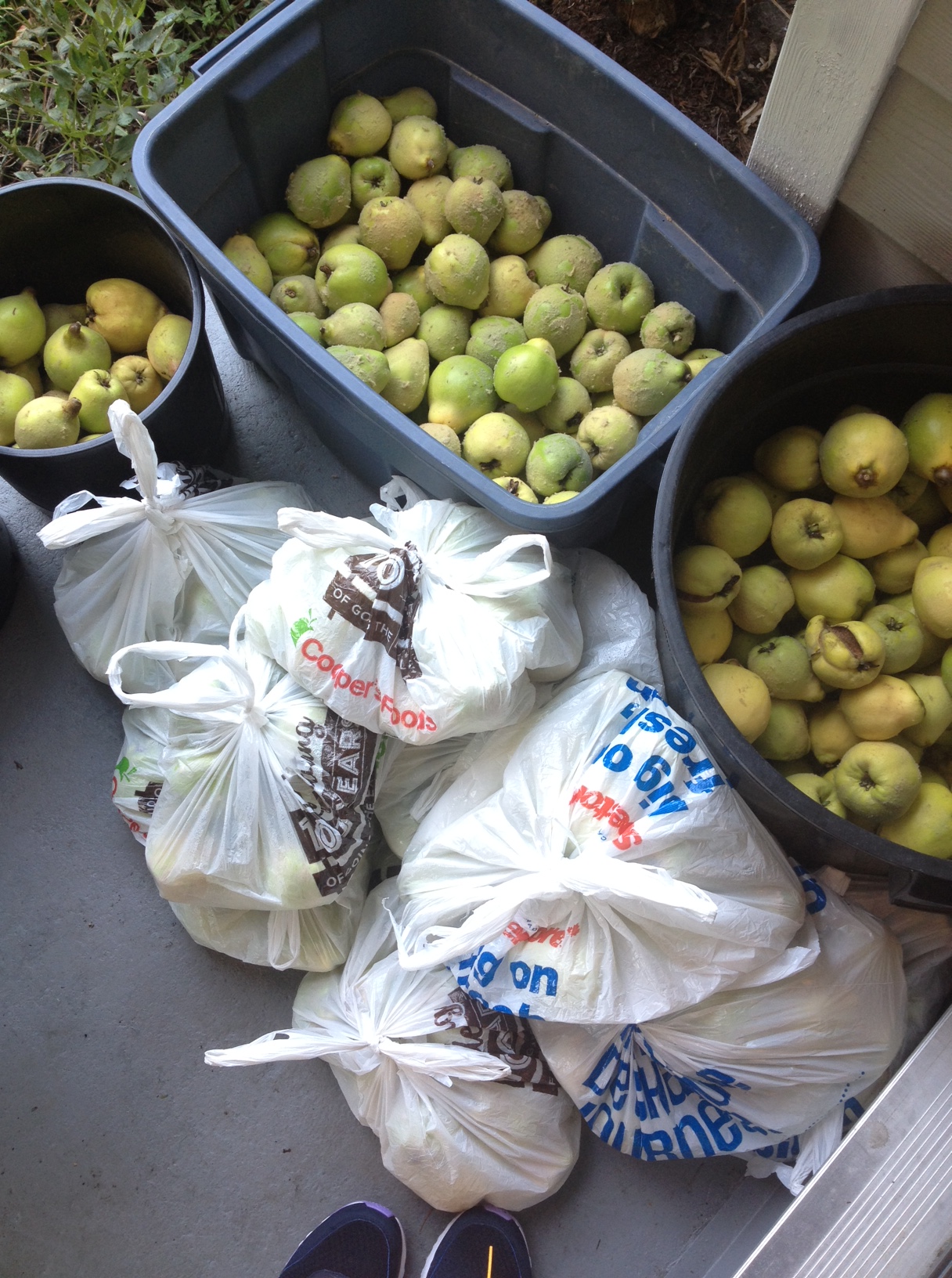
Country road, quince standMy friend Eileen bought a cute little house on a country road and planted quince trees. Perhaps not anticipating how prolific the trees would be, or how heavy the fruit, she planted four of them, four different varieties, and then recently took to Facebook to advertise the couple of hundred pounds of fruit she was looking to get rid of. For CHEAP.

Quince is a very dense apple-pear-type thing, and you have to cook it – it’s inedible raw. It’s got a musky, almost floral taste – a little rosy, a little appley, a little bit something else. It has a firm core that’s hard to cut through, and fuzz on its skin you have to wash off. If you’re in North America, you’re mostly relegated to getting it through friends, from abandoned orchards, or some Farmer’s Markets (if you are very lucky). It is very high in pectin.

Years ago, I got my hands on a few pounds of quince for something like $7 per pound. The market only had maybe ten pounds of them for the whole season, and because scarcity makes me irrational I bought as many as I could afford and then hoarded the jam I made out of them until a bunch of jars of it went bad in the back of my fridge when someone else opened and forgot about them.

The worst thing about marriage is when the other person lets your jam go bad without telling you. Just lets it happen. It’s still so hard to believe.

Quince haulThis time, with Eileen’s quinces, I was no less greedy but the price was much better and I was better prepared. Also, many of them were still green, and so they’ve been ripening in batches, four or five pounds at a time, and so I’ve been processing them at a leisurely pace, putting up a few here and a few there and barely breaking a sweat.

This is, in part, thanks to my trusty old Crock Pot.

The very best use for quince is a jammy paste the Spanish serve with cheese at breakfast and at tapas. It’s called membrillo, and it’s thick and sticky and garnet-red, and the process for making it is pretty straightforward but also quite time-consuming. I don’t have one million hours to peel and core and stir and stir and stir. Even if I did, I am profoundly lazy and as such, am always looking for the easier way of doing something.

The standard membrillo recipe calls for, at minimum, a ratio of two pounds quince to one pound sugar. You can add spices like cinnamon or vanilla, or strips of lemon peel, but you don’t have to.

If you were to make this on the stove, you would peel and core the quinces, add water, and cook until quinces are tender. Then you would puree them. Then you would cook them and their liquid down until a thick paste formed. Hours upon hours would pass, and this might satisfy a younger version of yourself but not this version, with her arthritic hands and arms and ill temper.

Shortcuts. Let’s take the easy way out. For this particular shortcut,  your best bet is a slow-cooker and a food mill fitted with your finest grinding disk. No food mill? A fine-mesh sieve will also work, but it will be a lot more work.

First, wash and halve your quince. For whatever weight of quince you prepare, add half the amount of sugar by weight. So, if you have five pounds of quince, use two and one-half pounds of sugar. Pour this over, and toss to coat fruit.

Slam your slow cooker lid down on the thing, set the cooker to low, and let ten hours pass. Overnight is nice. Your place will smell so good in the morning.

Get your canning stuff ready, if you plan to can. You can also freeze it.

The quince will start out yellow-peeled and white-fleshed, and by morning will have turned a winy kind of red. Working a couple of pieces at a time, process your quince halves through the food mill into a large non-reactive pot, such as a Dutch oven. Strain any remaining liquid into the pot as well, and turn your burner on to medium.

Cook until the paste has thickened and the mush appears to pull away from the the sides of the pot as you stir; the texture and consistency will be somewhat like apple butter; same idea, really. How long this takes depends on how much liquid remains in your slow-cooker; you will likely cook the paste down on the stove, stirring occasionally, for an additional 20 to 60 minutes. Some varieties of quince, like pineapple quince, may release more liquid and take longer to cook down. The colour will be a very dark red you might have a hard time believing at first.

Spoon quince paste into sterilized jars, run a knife around the edges to remove any large air pockets, and process for 20 minutes.

I started with about five pounds of quince, and ended up with just over two quarts of finished paste.

Serve on bits of bread with creamy goat’s cheese, or with an aged, nutty cheese like Manchego. Definitely have wine with it. The good stuff, the kind that comes in a bottle. And definitely invite a friend to share it, maybe one you don’t see very often, like your friend Eileen.

Gnocchi with kielbasa and caramelized corn.

gnocchi

There is so much choice when it comes to ingredients, and such a range of qualities and price points that it can be hard to know where to save your dollars and where to splurge. I sometimes get asked about this, but my answer is always pretty wishy-washy, as it’s one of those personal preference issues I can’t really call one way or the other. What matters to you? What do you notice when it’s not there? I buy both good and crappy vanilla, because the good stuff has its place but the crappy stuff can pass unnoticed, which makes the good stuff last longer.

You don’t need fancy ingredients to make good food. Most people can’t tell the difference between The Best and Good Enough anyway, the way most people will taste a wine and only know for certain whether it is white or red. They might think they can, and the truly gauche might say it out loud, but the reality is that a thoughtful meal comprised of modest ingredients is more than the sum of its sale-priced parts.

For the experienced cook, this is not news. But the novice cook, the young person who is just starting out and is perhaps swayed by pretty pictures in magazines or on Pinterest might be led to believe that there is no sense in doing something half-assed.

This is important: the only thing culinary you ever have to use your full ass for is eating. This is home-cooking; we are not cheffing around. The people you’re serving are already impressed that they didn’t have to make dinner. You can haul out the big guns, the good stuff, the meticulous technique and gourmet ingredients for special occasions – fancy company or holiday dinners or desserts – but when it comes to getting dinner on the table on a weeknight, half your ass will do.

The secret to good home-cooking is knowing where to take shortcuts, and where to spend your time.

If it’s corn season, highlight corn by gently caramelizing it with a finely chopped onion until your kitchen smells like butter and brown sugar; this is one of those gratifying things you can do while your small person tears around, suddenly naked, shouting the Rescue Bots theme song. If a package of gnocchi was on sale for a dollar, don’t bother hand-rolling fresh gnocchi; no one wants to do that on a weeknight anyway and you’re, like, what? Not supposed to ever have gnocchi? No. The shortcuts you take will emphasize the ingredients you lingered over, and everyone will love you for your efforts.

What follows is a recipe that takes full advantage of leisurely caramelizing and store-bought potato dumplings and the seasoning effects of Polish sausage. The great thing about this dish is that it kind of seems like something fancy, but if your people are like my people they won’t quite know why and you’ll somehow manage extra credit which you can use to excuse yourself from unsavoury tasks like scrubbing the cast iron or trying to wrestle a big-for-his-age three-year-old into the pajamas he would prefer not to wear.

Gnocchi with kielbasa and caramelized corn

(Makes 4 servings.)

  • 3 tbsp. grapeseed or other neutral-tasting oil, divided
  • 1/2 lb. kielbasa or farmer’s sausage, diced
  • 1 medium onion, finely chopped
  • 2 cups corn kernels, fresh or frozen (from two or three cobs if using fresh)
  • 3 tbsp. garlic cloves, minced
  • 1/2 tsp. Kosher salt
  • 1/2 tsp. ground black pepper
  • 1 lb. store-bought gnocchi
  • Smoked cheese, such as cheddar

Vinaigrette:

  • 2 tbsp. grapeseed or other neutral-tasting oil
  • 1 tbsp. red wine vinegar
  • 1 tbsp. minced fresh parsley
  • 1 tsp. grainy Dijon mustard
  • 1 garlic clove, minced
  • 1/4 tsp. Kosher salt
  • 1/2 tsp. ground black pepper

Heat one tablespoon of oil in a large pan over medium heat. Cook kielbasa for about two minutes, until lightly browned, then scoop from pan onto a plate lined with paper towel and set aside.

Depending on how fatty your kielbasa is, you may or may not have to add additional oil at this point. If the pan is looking dry, add additional oil as needed. Reduce heat to medium-low, and add onion. Cook, stirring often, until browned, about five minutes. Add corn, and stir often until the colour has deepened and the kernels have browned in places, about fifteen minutes. Add a small amount of water as needed to dissolve the layer forming on the bottom of the pan. Add garlic, salt and pepper, and cook until garlic has softened.

Make the vinaigrette by combining oil, vinegar, fresh parsley, mustard, garlic, salt and pepper in a small bowl or jar and stirring or shaking to combine. Set aside.

Meanwhile, bring a large pot of salted water to a boil. When the corn has turned colour and smells buttery and sweet, add gnocchi to the pot and cook according to package directions. Gnocchi will cook for about two minutes, most likely.

Reserve half a cup of the gnocchi cooking water, then drain. Add gnocchi to the pan with the corn. Add the sausage back. Deglaze the pan with the water, scraping the bottom of the pan and stirring to coat the gnocchi in the sauce that forms.

To serve, spoon vinaigrette over gnocchi and corn, and top with shaved or shredded smoked cheese. If you are not able to find smoked cheese, use an aged white cheddar.

http://www.youtube.com/watch?v=OvctVdoMgTQ

(This is the soundtrack to my life right now. Just FYI.)

Three ingredient Nutella “ice cream” bars.

pops
Smoke over the highway. Weird red sun.You can expect that it will rain here; it always does, sometimes for weeks on end. It hasn’t rained in a long time though, and forests are burning all over the province and the smoke has blanketed the city and surrounding areas, drifting across the mountains and over the prairies, making it as far east as Toronto, allegedly.

Even NASA has noticed.

Every time I see someone with a lit cigarette I think about following them to make sure they don’t toss the butt into the grass, which is basically just thin kindling now. We’re in a drought, officially, though that’s been obvious for a while. There was no snow on the mountains this year.

It’s weird. It’s hot. Everyone’s weather app is saying “smoke” instead of sun or clouds. All the lawns are dead and the leaves in the tree outside my living room window are crisp and brown. The sidewalks are like flypaper, sticky with aphid goop from the trees that drifts through the air like dew would if there was any.

Creepy yellow sky; smoke cover.You can’t blame a kid for only wanting watermelon, or ice cream. I mean, I’m right there with him, but at some point you have to be a role model. Or whatever. Or, at the very least, you have to look seriously at your budget and think about whether or not you can sustain a box-a-day habit of Fudgsicles for however long this summer will last.

This recipe is easy, and you can make it in a heat wave. It’s just overripe bananas, yogurt with a generous percentage of milk fat (I like Liberté or Krema, depending on what’s on sale), and a big glob of Nutella, which in this weather is practically liquid. You throw it in a blender, and then pour it into ice pop molds, and then you wait. No cooking, and not the worst thing for you if you’ve been living primarily on gin slurpees and handfuls of berries.

Nutella “ice cream” bars

Makes 6 to 8 pops, depending on the size of your molds.

  • 1 cup plain, full-fat yogurt
  • 3 medium over-ripe bananas
  • 1/2 cup Nutella

Pour all ingredients into a blender, and blend until smooth. Pour into ice pop molds and freeze, minimum six hours or overnight.

To remove from the molds, run a little hot water over the base of the mold to loosen.


Medias de seda.

Pinky drinks.The weather warnings are already in effect, and I’m kicking us for not buying that goddamned air conditioner when we saw it on sale last December. It’s going to be a hot one they say, a scorcher! It’s already hot.

Summer struck the west coast before it struck a lot of places – we’re running out of berries during what would otherwise be the beginning of berry season. Cats everywhere have been wilting for weeks. Last week a pigeon flew into our apartment through one of the wide-open windows and I thought we’d have to leave everything behind and move. And the air outside is all flowers and barbecue smoke and cigarettes and wet concrete, and my neighbours on this busy apartment block are stripping down, nude or nearly nude flesh visible in every uncovered window. It would all be very sexy if I was younger, or if I had that air conditioner.

The feeling of my skin on my skin is, at times, unbearable. Now is not the time to talk about berry smoothies or fresh-pressed juice. Oh, it’s blender-drink time, to be sure, but I’m not longing for some ascetic mix of ice and fibre that’s not going to take me anywhere.

Gin me, is what I’m saying. And I don’t even really like gin.

(There was a summer, and there were four friends from high school and boys from somewhere else and Cultus Lake and gin and the feeling that I was going to live forever followed very quickly by the feeling that I was going to die of gin poisoning and my parents would have to come pick me up from an unmarked spot off a logging road where a boy named Monty who had nipple rings would have had to explain everything. In summary, gin and I have some history.)

These are sticky, sweaty times and times like these call for cold, sweet drinks. I’ve told you about my lazy go-to, my shameful sangria, but this new thing is even better. It’s called medias de seda, and it tastes like some vague memory I can’t place, a little like vanilla and malted milk and something else. It’s sweet and creamy and just the right shade of pink.

My parents brought this cocktail back from Mexico, from Puerto Vallarta maybe, and it’s as decadent as a milkshake and just as pink. I guess it kind of is a milkshake, but a very adult kind of milkshake and if you are lucky someone else will make it for you while you dip your feet into a pool of cold water. It could be a pool like you might find in Puerto Vallarta, or it could be a turtle-shaped kiddie pool filled with hose water and your naked toddler and several dozen bath toys in your parents’ back yard; the important thing is that you make this drink your excuse to sit and cool off. My dad tinkered with the recipe so that it serves two, probably to sedate my mom and me at the same time.

Here’s to your hot, sticky summer. Gin you.

Medias de seda

Serves 2.

  • 1 1/2 oz. gin
  • 1 1/2 oz. creme de cacao
  • 3/4 oz. grenadine
  • 2 cups ice cubes
  • 1 1/2 oz. light cream or half-and-half

Combine gin, creme de cacao, grenadine and ice cubes in a blender and blend until smooth. Add cream or half-and-half, and blend until combined. Divide evenly between two glasses. Marvel that this is kind of like an Orange Julius. But like, with gin. A Gin Julius! Repeat yourself in case no one heard you. Find yourself hilarious while you cool your overheated body in a patch of shade with your feet in some cold water.

Drink selfie because drinks.

There is no baby left.

IMG_2211

These kids, they are like people.

Nick is away for the weekend pretending to make sacrifices for our family by procuring a few months’ worth of rainbow trout. Hunting is work – there is no beer-drinking during the day because of all the guns and wolves and potential death/dismemberment – but fishing is primarily beer drinking in boats on quiet lakes and it will be at least 30 degrees Celsius this weekend and he packed the strongest sunblock I have because he will really suffer under all that sunlight, his dry, paper-white skin just searing in the heat while he gives his all for future fish dinners I will have to cook.

To say that I begrudge him his leisure time would be … well, I begrudge him his leisure time. But he did clean the apartment before he left. But he didn’t wash the floors. Marriage is like this, always weighing but trying not to, always wanting the best for the other person but not really.

So the little one and I are together all weekend, for four days and four bedtimes, and he has already cried for Daddy three times since Nick left at 4:00, twice after falling down at the park and once more at bedtime, when I told him he would not get away with lying about things Daddy would never have promised and he broke down. “Daddy wouldn’t be mean to me,” he whimpered into his pillow. “Yes he would,” I said, because I don’t know. I forgot to brush his teeth.

But in the moments when we find ourselves in harmony, this kid and I, we are a team. “I will help you cook dinner,” he said as I pushed him in a shopping cart past the packaged meats at Buy Low. “You like hot dogs, mum?”

“We should get the chocolate chip ice cream,” he said as we passed the frozen treats. “I have been pretty good today I think.”

Sometimes having a preschool aged child is like being buckled into a windowless cargo van that’s hurtling over a cliff while a rabid chimpanzee screams in your ear about all the times you have ever been wrong, but sometimes there are flickers of humanity in these little primates. Sometimes, you see in him an ally. And you know you have to do better with him – you have to remember to brush his teeth, even when he’s being a bit of a shit – but sometimes, you let him do what he needs to do, and you see yourself in him, and it is kind of fun.

I do like hot dogs. He helped me make dinner tonight, standing on a chair in front of the stove and offering to stir noodles and then dropping stuff all over the floor but meaning so well. And we had Kraft Dinner and hot dogs and ketchup and chocolate chip mint ice cream and it was filled with sodium and we all probably have heart disease now or at least hypertension but he picked a meal and he helped put it together and it didn’t involve toast or Nutella or crying.

This is a level of progress that was unimaginable even three months ago. There’s no baby left in him.

We ate dinner together while he told me about his day, chattering on about all the ways he was very helpful and very good. He asked me about my day, and if I had been good and if the scientists had been helpful and if I was tired.

“We work very hard, mum.”

“Yes we do, monkey.”

“I like making dinner with you,” he said, and for a moment I forgot about the screeching chimp and everything I did wrong and hoped that maybe we’re onto something.

We’re off to a good start, at least.

Guest post: Old McDonald’s

I met Brooke Takhar on the Internet, which is pretty much how adults are supposed make friends now that it’s the future. (Please don’t correct me on this probably misguided assumption.)

Brooke was a contender in Vancouver’s Top Mom Blogger competition last year, and I wanted her to win because she is the coolest. It turns out, we like (and dislike) most of the same things. After we bonded over Eater’s Life in Chains series (and this post in particular), we decided to bring a little of that magic home, to our own blogs, where we’re posting our own stories of chain restaurants and what they mean to us. Brooke is here today, and when I figure out how to end mine, it’ll be on her site later this week.

While you read this, I’ll be talking myself out of a trip through the Drive-Thru. Enjoy.

Life in Chains: The Golden Days

Filet-O-Fish

Like many kids of divorce in the 80s, on a late Saturday afternoon you would find me and my brother seated across from our Dad in a warm corner of a McDonald’s.

Shoeless, whooping monkeys who had two parents watching them flip off the slide and get their heels stuck in the rope ladder.

The seats were hardened plastic; if we were lucky they swiveled. My Filet-O-Fish was always the perfect combination of crunchy, squishy and tangy. Every time I gently unwrapped it from its damp and crinkled paper casing, I marveled at how it looked exactly like it did on the menu.

Inspired by Chains: 1In between bites and slurps and sly sharp elbows to ribs, we dutifully answered questions about our week. Shoved five or six ketchup-drowned fries into our mouths while mournfully staring at the kids having the time of their lives in the indoor playground. Shoeless, whooping monkeys who had two parents watching them flip off the slide and get their heels stuck in the rope ladder.

The last 2/3 of our orange sodas always ended up in the dark brown trash bin by the exit. You had to really shove the mouth of it open to deposit your garbage before it snapped shut. I would do it quickly – fearful that my hand would get caught and the rotting corpse of Ronald McDonald’s mother, her red wig greasy and matted, her teeth individual rotting pickles, would grab me and pull me down into the deep.

Back in my Dad’s car, the upholstery was old but efficient at muffling and holding fetid fish farts. We would sit there quietly and let the car warm up, the yellow arches sharp, then smearing under the windshield wipers.

Inspired by Chains: 2My Dad didn’t have many chances to be a hero when we were kids.

One summer afternoon, as we reached for the warmed door handles of the car, I froze and felt fear dart down my spine into my shoes. My retainer, the device in charge of keeping my newly straightened teeth properly in place, wasn’t nestled into my jaw. I had taken it out before I ate my fish sandwich, carefully wrapped it into one of their thin white napkins, and then, somehow, forgot about it. It had been whisked into the garbage with all our other balled up messes and now – oh God, Mom was going to kill me. My teeth were already looking around at each other, eyes wide, jostling their little pearly shoulders, confused at their new-found freedom.

Wearing the McDonald’s brand rubber gloves, my Dad spent what felt like hours picking through the guts of one of those dark brown garbage vessels. We watched. When the retainer was finally triumphantly found, I breathed again, snatched it from his hands and popped it right into my mouth with a satisfying “click.”

I hated all of it with a stalwart teenage passion.

When I was 16, we moved to a new town 45 minutes away from my high school. Businesses were tired and slumped side by side in long brown rows. Hills lead to more hills. Everyone was old. There was one Chinese food place where the owners looked both perpetually unhappy and surprised to be there.

Once a year, with great fanfare, a rodeo came. Neighbours dug out stiff leather boots and cowboy hats, cracked beer cans and celebrated.

I hated all of it with a stalwart teenage passion.

There was a McDonald’s on the main drag that you could hit on your way in to or (blessedly) out of town.

Scan10094My first car, that I maneuvered through that drive-thru often, was my Grandpa’s old brown Honda Civic. I only needed two other seats for my two best friends. We were bonded tightly – rigid in our love of punk rock music, Value Village men’s section ensembles and our tight shaved haircuts, one week green, one week yellow.

One afternoon, as we left the parking lot, a car and its driver did something I perceived as rude. Middle fingers were held aloft as we accelerated away. Two short blocks later, my friend riding shotgun told me quietly, “they’re following us.”

We may have looked tough and brave and strong, but all three of started to cry as we wound our way around and through and back and sideways and around the town again, trying to lose our tail. It was a Scooby Doo car chase, the same landmarks flying past us. I couldn’t go home! They would know where I lived! Did I have enough gas to keep this up? We had a bag of Bugles between us – would we starve before too long?

They eventually got bored and squealed away. We laughed with a bit of that cry-ache in the back of our throats and sped to my house. Told my bored brother about it then watched Red Hot Chili Peppers videos, passing the Bugles back and forth until we were just left with salty, stinging fingers. When it was dusk, we piled into the car again to go to 7-11 for a Bugles re-up.

(Remember how casually and easily you ate garbage in high school? I think I ate fries and Cool Ranch Doritos for lunch for a year and somehow didn’t die of sodium poisoning.)

We pushed through the jangling Exit door of 7-Eleven and our bladders seized. My car was blocked in, by the same car that had terrorized us earlier. We silently climbed inside, locked the doors, avoided eye contact and sat there shaking, whispering, the loudest sound being the snap of the Bugles bag being opened. What did these girls want?

They didn’t approach us; they just sat in their car, laughing, snapping gum and watching my surely crazy eyes in the rear-view mirror. I was scared and tired and wild, watching the doors of 7-Eleven for a miracle or a solution. A very cute boy, someone I would have normally walked by, scanned then logged in my mental masturbation journal, stepped out with a sweating Slurpee.

I jumped out of the car with heretofore unknown bravery and pleaded with him.

“Please, help us.”

Words were exchanged, their car was moved, and we followed him like the Pied Piper down a very long, very dark road to a flat open field with a bonfire. My friends and I sat mute on a log, surrounded by a party that seemed like a really good time, but we knew nobody, had no tongues and no alcohol.  A half-dead barn cat wove an infinity circle through our legs until we all mutually agreed to leave, slowly picking our way through the uneven grass back to my still ticking car.

Inspired by Chains: 4We drove up to the drive-thru window, solemnly ordered three strawberry milkshakes and kept our mouths busy with them until we fell asleep in three clumps on my bedroom floor.

After high school I decided to become a vegetarian. I don’t remember why. I liked animals but wasn’t feverish about their well-being. I knew nothing of nutrition so I still remained a loyal McDonald’s customer. I would either pick out the meat or eventually just order all the sandwiches with a pause then an emphatic “with NO meat.”

If you swing open the door to a McDonald’s in Nebraska or Vancouver or Timbuktu, the smell will always be the same.

Because if you eat a cheeseburger with no meat patty, or a Filet-O-Fish with no fried fish wedge, they still taste pretty good. I imagined the hair-netted kids in the assembly-line kitchen merrily juggling the unwanted meat, hacky-sacking it right into the garbage.

My meat-free convictions died the day I walked into my Grandma’s suite and the smell of her slow cooker beef stew punched me in the face. I grabbed a fork and bowl and sat down to a steaming portion of tender carrots, sweet slippery onion, and brown-sauced beef chunks. Twice.

When I was 18, my stomach hurt all the time. There was a fat drunken hummingbird stumbling around in my stomach all the time and I apologized for feeling terrible all the time. I found out right after Christmas I had celiac disease. No wheat or gluten allowed in my life, ever again.

I tried for two weeks to eat better, read labels, and not dramatically mourn chewy bagels, buttered pasta and fluffy white confetti’d angel food cakes.

Then, I got bitter. I got sad, and I got stupid. In my head, food was the enemy. Every day for lunch and dinner, I only ate microwave peaches-and-cream corn with cold glops of salsa swirled  into wedges of day-old white rice prised out of the rice cooker.

One night I picked up my car keys and slid out of the quiet house, heart pumping so loud I’m sure the neighbourhood could hear it as I took familiar turns and pulled into the arrowed McDonald’s drive thru lane. Hello, friend.

I ordered a Big Mac and a Filet-o-Fish and parked. I unwrapped and ate them so quickly, with robot-like precision, staring at nothing. Every bite was so hot, so crispy, so familiar and so mournfully delicious but I couldn’t enjoy a single swallow. I threw out the crushed paper bag and drove home, my stomach and head throbbing, a lump in my throat, and tartar sauce in my crotch.

If you swing open the door to a McDonald’s in Nebraska or Vancouver or Timbuktu, the smell will always be the same. That slightly sweet, slightly yeasty smell of fried comfort. When I pick up my daughter from a day with her Grandma, I can smell it in her hair, wafting off her tiny sweater-clad shoulders.

Inspired by Chains: 5Like an army of children before her, the day a Happy Meal was slid in front of her was the day she knew she was truly alive. That first decision of whether to dunk a boot-shaped Chicken McNugget into sweet-and-sour sauce, ketchup or McChicken sauce is a litmus test. (For the record, the only correct answer is a 50/50 ratio of McChicken and sweet-and-sour.)

She calls it “Old McDonald’s.” I probably taught her that in a moment of silliness, forgetting that when you tell a toddler something once it becomes Biblical Fact.

The only safe menu item for me now is McDonald’s French fries; I eat them maybe twice a year. I’ve eaten a lot of food over these long adult years, some of it glorious, but their fries are still delicious in my mouth. They are too salty which is a large part of their charm. Their shape is perfect; they are manufactured for us to not think when we eat them.

I usually have to share them with a greedy four-year-old. She has her own off-kilter fry pile in front of her, surrounded with tiny plugs of ketchup and a gender-appropriate toy, but of course Mama’s are much better. Most times we eat inside, where it’s cooler, the floor is always being swiped with a grey mop and clots of old men huddle together with coffee, watching sports I don’t recognize on muted TV screens.

I leave our tray on the table when we’re done. I still don’t trust their garbage cans.

When we push out into the night, we hold hands, grains of salt still wedged under our nails. She hoots about absolutely nothing, like all kids do, dried ketchup caught in her smile. I pause and scan the parking lot, then start again; the glow and hum of the golden arches shows me the way back to the car which will take us home.

Brooke Takhar is a Vancouver-based storyteller and Mama of one goon. When she isn’t Netflix parenting or running short distances, she blogs as missteenussr and is a contributor to Blunt Moms and Scary Mommy. You can follow her on Twitter or go make out with her on Facebook.
Velvet that meat.

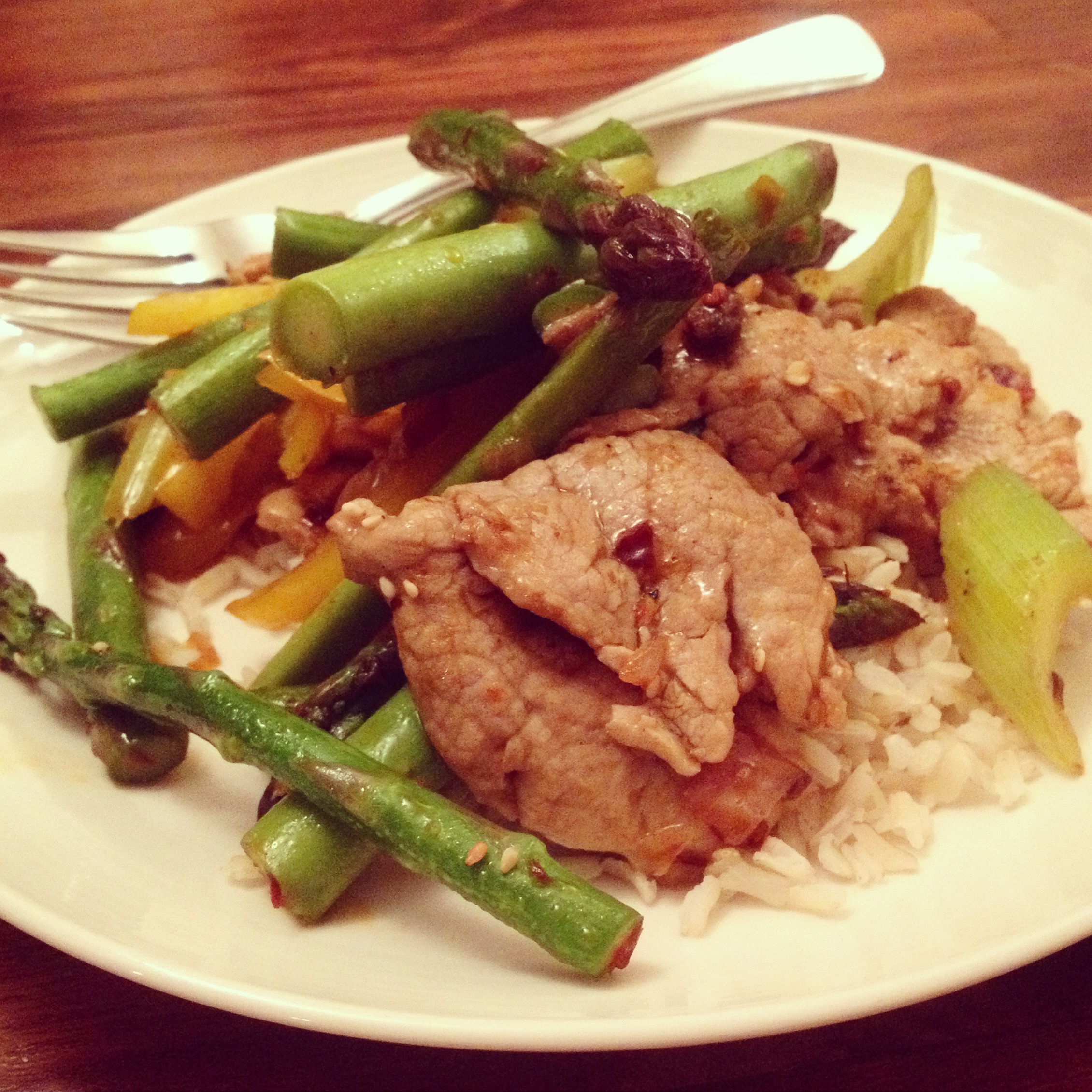
Stir-fried asparagus with velvet porkLet’s talk about velvet. As a verb.

IMG_1175If you’ve ever paused mid Beef & Broccoli to wonder how Chinese restaurants get their stir-fried meats so silky and tender, you may be intrigued by the concept velveting and its implications in your kitchen. This is something I’ve been playing with for a while, as I’ve got one of these small people who finds the texture of meat challenging.

Velveting meat is a gentle approach to meat cookery, and one that prevents the fibres of the meat from tightening and toughening.

Have you ever sat beside someone while they chewed a single bite of hot dog or chicken for 45 minutes? It’s just a marathon of wet mouth noises. There’s no bouncing back from that, and a little piece of you will die as your exhortations to “please, please swallow that right now” become increasingly frantic. Misophonia is a thing, and toddlers are known to aggravate it. And so the resourceful home cook will find that velveting becomes more than just a neat kitchen trick, but a matter of life and spiritual death as well.

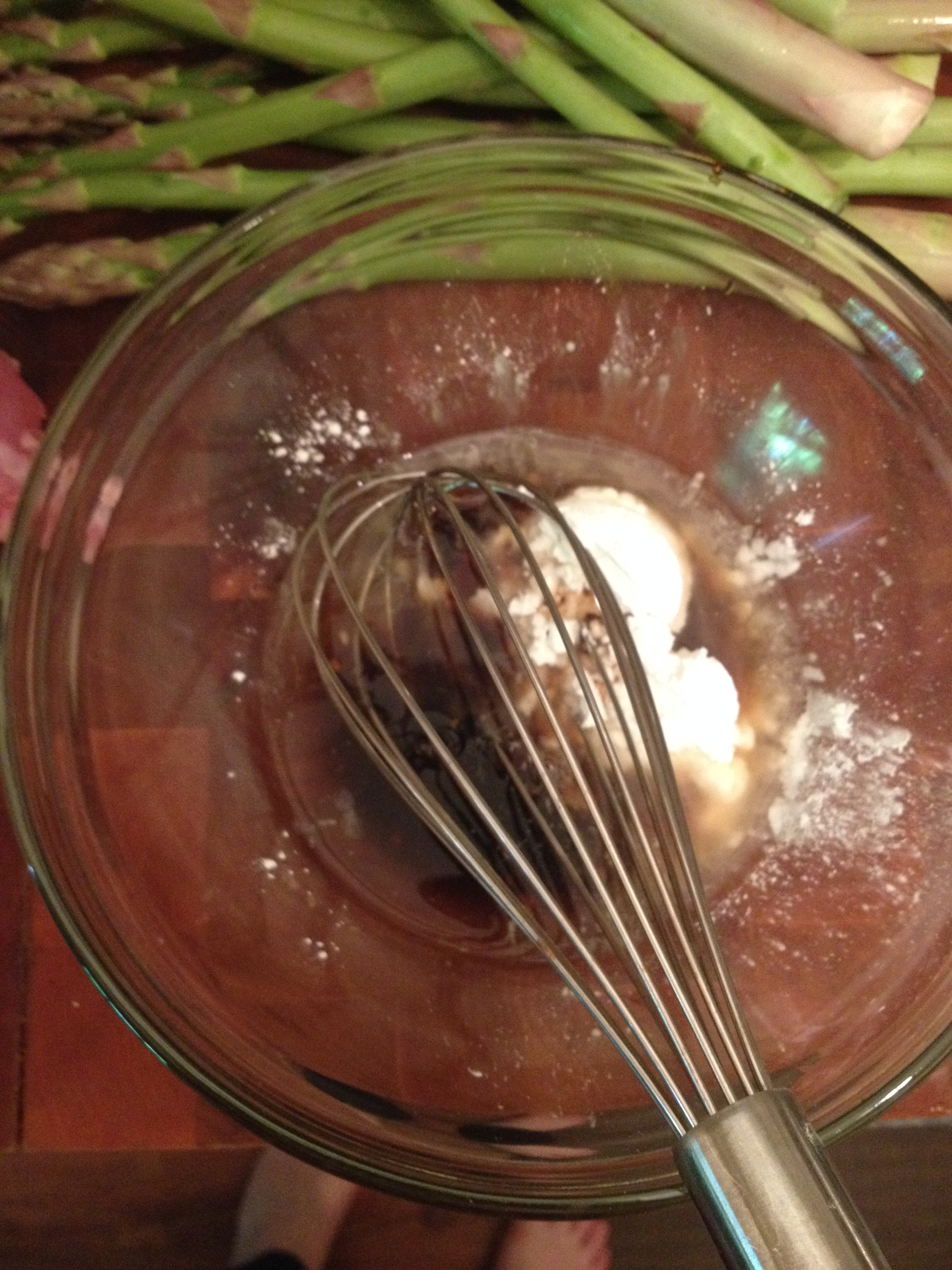
IMG_1176Velveting is not terribly complicated. At its most basic, it’s a bit of raw lean meat that’s thinly sliced, marinated in a mix of egg white, salt, acid and cornstarch. This mixture serves to tenderize the meat, create a barrier between the meat and the heat, and to create a coating that will improve sauce adhesion.

It is then gently poached in oil or water (I prefer water poaching for cost and clean-up reasons) before being added to a stir fry, and the effect is meltingly soft. I’ve seen variations on this idea that don’t include egg white; if you’re dealing with egg allergies, you could certainly skip it. But I like the sort of slick layer the egg white leaves on the meat – it adds an extra element for your sauce to cling to, and the result is a lot of flavor with not a lot of effort.

Once you get into the habit, I mean.

If velveting meat is something you want to try at dinner, be prepared that there are multiple steps and though they are not difficult, they may add up to an additional 45 minutes or so to your dinner prep. This is annoying. Fortunately, you can do it ahead of time.

IMG_1179Because the steps are simple, I’ve found that if I time things correctly, I can prepare the meat for tomorrow’s dinner tonight. The advantage to this little bit of forethought is that you can have dinner prepared in about ten minutes, depending on how fast you chop your veggies. You can also deep-fry velvet meat.

(You can deep fry anything.)

Velveting meat is a Chinese technique and therefore suited to Chinese cooking, but it’s also something you can do in quick stews or pasta dishes. My favourite application of this is to add a few pieces of velvet chicken to a briny puttanesca sauce – the coating gets clingy with the olive oil and capers and tomato juices, and the chicken remains tender and does not compete texturally with the other elements. I bet it would lend something extra special to chicken piccata.

So, how do you do it? The following is a general set of ingredients, and you can substitute what’s listed for whatever you have or flavours you’d prefer. To make this more Mediterranean, for example, one might replace the rice vinegar with lemon juice or wine vinegar, and the soy sauce for coarse salt. You could replace the sesame oil with olive or grapeseed oil.

Velvet pork or chicken

  • 1 lb. lean meat, such as pork tenderloin or chicken
  • 4 tsp. cornstarch
  • 1 tbsp. soy sauce
  • 1 tbsp. rice vinegar
  • 1 egg white
  • 1 tbsp. coarse salt
  • 1 tbsp. sesame oil

Pat the meat dry using clean paper towels. Slice your meat as thinly as you can while still keeping each slice intact.

Whisk together cornstarch, soy sauce, and rice vinegar until no lumps remain. Add egg white, and whisk until thoroughly combined but not frothy.

Pour the egg white mixture over the meat. Squish the mixture together with your hands so that the meat is coated well. Cover, and refrigerate for at least 30 minutes, up to one hour.

Bring four cups of water, salt and sesame oil to a boil in a sauce pan. Working in batches, poach pieces of the meat for about 30 seconds each, removing these from the pot with a slotted spoon into a colander. Let the water come back to a boil between batches.

From here, you would either refrigerate the meat for another use, or add it straight to your current dinner preparation. To brown the meat, fry it quickly before adding your veggies to the pan. For best results, toss the meat in the pan and coat it in the sauce before adding veggies.

Plated asparagus and velvet pork