Something to Read: How to Cook a Wolf

30days

There are times when helpful hints about turning off the gas when not in use are foolish, because the gas has been turned off permanently, or until you can pay the bill. And you don’t care about knowing the trick of keeping bread fresh by putting a cut apple in the box because you don’t have any bread and certainly not an apple, cut or uncut. And there is no point in planning to save the juice from canned vegetables because they, and therefore their juices, do not exist.

In other words, the wolf has one paw wedged firmly into what looks like a widening crack at the door. (How to Cook a Wolf, page 66)

No other book has been as inspirational or as significant in both my cooking and my desire to write about food as MFK Fisher’s How to Cook a Wolf. It’s a book about cooking (and remaining happy) in the absolute bleakest of times – during war, under ration, or when one is limited by finances, shortages, or long, cold seasons. It was written in 1942, then revised in 1954, and it remains timeless in its advice and good sense. It’s also beautifully written.

mfkfisher

It’s not very long – you could probably read it in a weekend. And it’s just so sensible. Gas and electricity are expensive – why not spend one evening making enough soup to last a week? Meat and eggs aren’t always affordable – why not make a meal of corn grits and vegetables? What we’d now call vegan cooking is, in this book, just what you do when you don’t have much else. There are also good tips for working with cheap cuts of meat and offal, recipes for dinners in which eggs are the main course, and instructions for making mouthwash and soap.

Even if you don’t make the recipes, they are a great jumping-off point. Many of the recipes call for things like rabbit and pigeon, which are expensive proteins now and not likely to be in your fridge or freezer anyway. But you can adapt, and stew a tough bit of beef, or cook up chicken thighs or make a meatball or turn your leftovers into something else entirely with a long cook in a bright sauce and a low oven.

It’s also about redefining dinner – dinner does not have to be meat, potatoes, and some boiled vegetable. I don’t know how many times our dinner has been some manner of grain porridge topped with steamed spinach or asparagus and a poached egg; it’s something we eat all the time, not just when we’re broke (but also when I’m lazy, when it’s raining too much to walk to the store, when I just feel like a poached egg and something green …). It’s a good book, and a short book, and not preachy. Where some of Fisher’s other writing is more indulgent, How to Cook a Wolf is a reflection of the time it was written and quite sensible.

I’ve actually made her War Cake a few times, while not at war but certainly without eggs or milk or butter. It’s a nice thing to have when you are 22 and your parents are coming to your damp basement apartment for tea and you want to look like a grown-up but can only afford half the illusion.

If you already have a bit of fat and buy just what you need for this recipe out of the bulk bins, it will cost you just a few dollars to make and you’ll end up with a loaf you can slice and toast or muffins you can freeze. It’s very adaptable as well, so feel free to make substitutions based on what you have in your cupboards already.

War Cake

  • 2 cups flour, white or whole wheat
  • 1/4 tsp. baking soda
  • 2 tsp. baking powder
  • 1/2 cup shortening, oil or bacon fat (always save your bacon fat)
  • 1 cup sugar, brown or white
  • 1 cup water
  • 1 tsp. cinnamon
  • 1 tsp. other spices, such as ginger, cloves, mace, etc.
  • 1 cup chopped dried fruit, such as raisins or prunes

Lightly grease a 9″x5″ loaf pan. Set aside.

Sift together your flour, baking soda, and baking powder. Set aside.

In a pan over medium-high heat, combine the rest of your ingredients, and bring them to a boil. Reduce heat to medium and simmer for five minutes. Remove the pot from the heat and cool its contents completely.

Add the dry ingredients to your cooled wet ingredients, stir to combine, and pour into your prepared loaf pan. Bake at 325°F for about 45 minutes, or until a toothpick inserted in the centre of the loaf comes out clean.

You can also make this recipe as muffins; reduce your cooking time to 20-25 minutes.
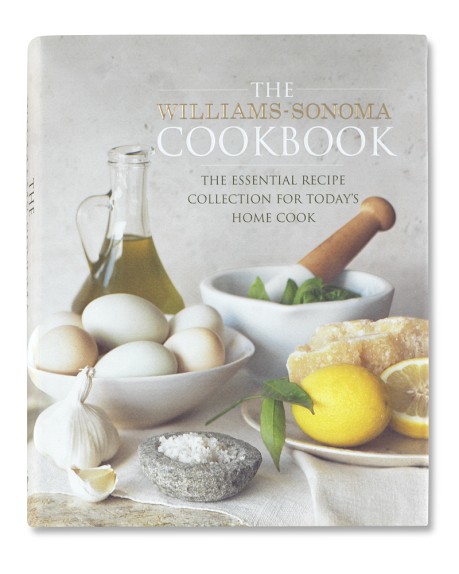
 

Something to Read: The Williams-Sonoma Cookbook

30days

Williams-Sonoma is ridiculous and I love it.

Our last apartment was about half a block off Granville Street, and three blocks away from Vancouver’s only Williams-Sonoma. It was a weird place to live, because the rent was very affordable and many of the apartment buildings were very old, but all the stores were for the fancy rich people who lived up the hill in Shaughnessy. There was a Restoration Hardware, an Anthropologie, and a lot of expensive art galleries. Occasionally I would see an outfit I liked in a shop window and wander inside to look, discreetly search for a price tag, and then high-tail it out of there because who can afford $800 jeans?! Also most of the restaurants in the neighbourhood sold only bland food because rich people don’t like to taste flavours.

But I’d go into Williams-Sonoma a lot, mostly to fondle the expensive enameled cast-iron and copper pots. I rarely bought anything, though occasionally some of their cookbooks would be on sale, and once I bought this great vinaigrette mixer-spritzer that I later broke because I am not gentle with things.

When we were first married, I didn’t have the impressive cookbook collection I now fill an obtrusive shelf in our dining room with, and I wanted to have a few reliable books I could refer to. I happened to be in Williams-Sonoma, and was delighted to discover that The Williams-Sonoma Cookbook (you can buy it for less here) was actually very reasonably priced for a big, fat, hardcover cookbook. The cover price was $40, but it was (miraculously) on sale for only $20. The recipes are easy to follow, even for a beginner cook, and they don’t call for unusual or expensive ingredients. I later acquired a copy of Williams-Sonoma’s Essentials of French Cooking (I think when my aunt was thinning out her cookbook collection), which has also turned out to be pretty good.

wscookbook

It’s been well used, and certainly worth more than what I paid. One recipe in particular has proven itself invaluable, as it turned out to be Nick’s favourite dessert. Nick doesn’t eat much dessert, and didn’t eat much dessert even pre-diabetes (I do not understand this). But this one pleased him so much that he insisted I bring it to his parents’ for his birthday one year, and his family loved it and now it’s in the family cookbook and we have it almost anytime there’s an occasion that calls for dessert.

Panna Cotta

  • Butter (for greasing six ramekins)
  • 1 1/2 cups whole milk
  • 2 packages, or four teaspoons, unflavoured powdered gelatin
  • 1/2 cup granulated sugar
  • 1 vanilla bean (you can use 1 tsp. vanilla extract if that’s what you have in your pantry)
  • 1 1/2 cups heavy cream (whipping cream)

Lightly grease six ramekins with butter. Set the cups on a small baking sheet.

Pour one third, or 1/2 cup of the milk into a small pot. Sprinkle the gelatin over top, and let sit for about three minutes.

Add the rest of the milk and the sugar and heat it until the sugar and gelatin is dissolved, then take the pot off the stove and stir in the cream and vanilla bean. Whisk everything together, then pour the mixture into ramekins. Cover ramekins with plastic wrap, then place in the fridge to set, which should take four to six hours.

To serve, remove the panna cotta from the ramekins by sliding a knife gently around the circumference. It should come out easily, but you can serve it in the ramekins too if you want. It saves dirtying more dishes, which counts for a lot around here.

Serve with fresh berries and whipped cream. In the winter, I warm frozen blueberries with a bit of maple syrup, then let the compote cool to just about room temperature before spooning over the panna cotta.

Something to Read: The Perfect Scoop

30days

Well, I did it. I had my teeth out, and it sucked and apparently I cried. I think I only heard the “sedation” part when I attended my consultation with the surgeon; I did not hear the part about consciousness.

‘It will be like you have had a few too many glasses of wine, Ms. Wight,” they said.

“I have a few too many glasses of wine often enough to know that won’t be sufficient for this procedure,” I said. And then they stabbed a needle into my forearm and took out my teeth and weren’t delicate about it.

And to top if off, they gave me what amounts to strong ibuprofen as part of my recovery goodie bag. It may not need to be said, but I’m not great with pain. I am, in fact, one of the worst whiners in the history of the world and if something serious and prolonged ever afflicts me, I think Nick will take me to an amoral veterinarian and have me put down. I wouldn’t blame him for it either.

So, I have spent the majority of the day in and out of sleep and in and out of gallons of ice cream. Nick, kind man that he is, spent what would ordinarily be our bi-weekly daycare lunches budget on peanut butter-chocolate Häagen-Dazs ice cream and then bought me a Blizzard for dinner. I will not have Nick put down, as he provides a level of service I do not deserve and would not find anywhere else. It may be worth injuring him to prevent him from leaving.

DQ

Anyway, I am swollen and pained and eating thousands of calories of frozen dairy and while I have many complaints I’ll have to admit that from where I sit, I have it pretty good. My parents took Toddler overnight, and I am sitting around in my old maternity clothes and some Pajama Jeans while Nick queues up all my favourite bad movies.

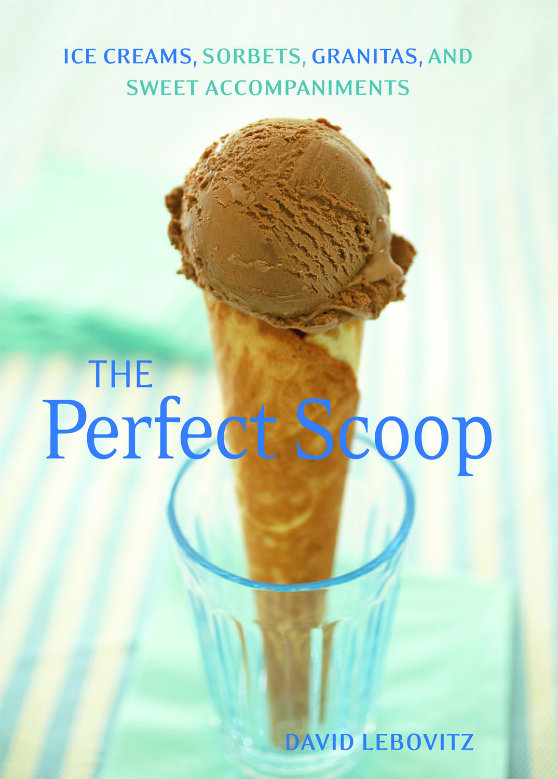
This has been a lot of preamble and I meant to tell you about a book. So, The Perfect Scoop.

PerfectScoop

I think everyone who bakes probably knows about David Lebovitz by now, and if you don’t I won’t bore you with a lot of background which you can easily discover on his eponymous and highly regarded blog. He is very good at what he does.

I have made a great many of his recipes over the past few years, and his basic vanilla ice cream recipe has come to be the base upon which I build almost every ice cream I make. I’ve made it so many times I don’t even need the book anymore; it’s committed to my memory which means that it is something important, and that it probably pushed something I might have really needed out.

In my current (pathetic) state I have been longing for a bite of his salted butter caramel ice cream, which is as close as you’ll get in North America to the salted butter caramel ice cream at Berthillon in Paris, which everyone must experience at least once in their life even if you have to sell an organ to get there. Do you need a kidney? I’d very much like to go back.

perfectscoopberthillon

The ice cream in question is sweet – but not too sweet – and slightly bitter, as the caramel is slightly over-cooked, so that it has just a whisper of burnt taste. If you’re wary, trust me; it’s perfect. To have some right now …

The cookbook has a lot in it that’s useful; I’ve even made his vegan ice cream recipe and found it delightful (I used coconut milk in place of rice milk, as it’s what I had). If you like making ice cream, or if you have an ice cream maker and are looking for an excuse to put it to use, The Perfect Scoop is an invaluable resource, and I think you’ll really love it.

My face hurts, and I’m too lazy to type out David’s recipe … fortunately it already exists on his blog. Go to it. Make it. Mail me some?

We’ll be back on track tomorrow, I hope. Think anti-inflammatory thoughts for me, will you? I’ve got to go pass out in an ice cream coma.

photo (4)


Something to Read: I Like You (Hospitality Under the Influence)

30daysTomorrow I’m going in to have my wisdom teeth removed. I was supposed to do it ten years ago, when they first poked through my gums, but I didn’t have dental coverage or very good dental coverage – I can’t remember – and also I’m a big fat chicken. So, I let them hang out in there, in the back of my mouth, becoming increasingly inconvenient and now it’s a decade later and the oral surgeon is using phrases like “older than would be ideal for this” and “fused to your jaw.”

The worst part is that I’m not allowed to eat for six hours before the surgery, and the surgery is at 10:45 tomorrow morning.

I don’t know when I’m going to get to eat again. This is the part I’m most nervous about.

(I’m lying. I’m pretty nervous about the tooth-to-bone fusion thing, but I’d rather you think I’m tough.)

Anyway, it’s day three of my little plan to tell you about a new book every day for 30 days, and it’s 11:00 p.m. and I’ve already nearly failed. I had planned to tell you about this book I bought on a whim one day at a used book store and it turned out to be a rare edition of a Hungarian cookbook from the 1970s, and that it turned out to be worth $250 on AbeBooks, but I need a little levity today. I needed a Sedaris.

Have you ever read anything by David Sedaris? He’s wonderful, a bona fide freak of nature and I love every word he puts down. If there is darkness in your heart and you love a short story, pick up Me Talk Pretty One Day and laugh until it hurts.

But this is not about David.

This is about Amy.

ilikeyou

I bought I Like You: Hospitality Under the Influence off a clearance table some time after it had come out thinking it would probably be funny and it only cost five dollars so I had very little to lose. I brought it home, cracked it open.

jackpot

It’s like she was singing my life. Photographing it, at least.

This book manages to be a lot of things all in one – comedy, cookbook, DIY for the half-assed and DIY-disinterested. The recipes are pretty reliable, and seem to come from actual recipe boxes; many of the recipes are just scans of hand-written, food-splattered recipe cards. Like real life! I’ve made a few of them, and I don’t know why I am pleasantly surprised each time. Of course they’re good. Amy can do anything!

Anyway, I liked the book so much I went out and bought a copy for my mom for Mother’s Day, and by that point it was no longer on the clearance rack and I had to pay full price. As far as I know, it’s only available in hard-cover. That’s serious commitment.

You cannot read a section without finding something bizarre and potentially useful. The section on alcoholic punches is followed by a section on pantyhose crafts, which is handy as you may not think to do pantyhose crafts without having had a large amount of punch first. I have been led to believe that I will be sedated and then sent home with a baggie of pain-relieving prescription drugs after my surgery tomorrow, and I have a drawer full of snagged pantyhose I always forget are full of runs and holes; maybe I’ll brighten my afternoon with a pantyhose plant hanger (page 268).

If you won’t be heavily sedated, why not grab a copy of the book, a couple of cans of juice concentrate, and make yourself a bowl of punch? Surely you have some well-worn hosiery kicking around. If not, I’m sure you could find some pretty easily.

Amy Sedaris’ Rum Punch Dazzler

  • 1 x 12 oz. can lemonade, frozen concentrate
  • 1 x 12 ox. can limeade, frozen concentrate
  • 1 pint rum
  • 7-Up (or alternative)

Create a ring mold out of some 7-up or water. Put it in the freezer. I don’t have anything to make a ring mold, but you can make one by lining a bundt pan with plastic wrap, pouring your liquid in, and freezing it that way. Just pop the ring of ice out when it’s frozen solid, and put it into a punch bowl.

Add the ring mold to a to a bowl with the ingredients listed above, and some maraschino cherries if you have them.

No time for a ring mold? Ice will work, but drink quickly so as not to water down your punch.

Wish me luck tomorrow. My life insurance policy is through work and not very good, so I’ll need to survive at least until I’m in a management position.


Something to Read: Food and Trembling

30days

I have so many cookbooks and books on food that my collection has its own shelf. We don’t really have room for it, but I’m quite happy to have a shelf full of books I don’t really have room for and won’t hear complaints about my hoarding, so Nick copes. My dream is that someday I will have a kitchen with two small rooms attached – one large pantry, the other a tiny library with a lamp and a desk and a chair. What a wonderful hiding place that would be! It would lock from the inside and maybe there would be a snack cupboard and a small electric kettle.

I wanted to tell you about some of these books. Between work and Toddler and all the little projects that turn into great big things I have to do, I have fallen out of the habit of working on things I’m actually excited about. So for April, while I am trying to wrap up a couple of things, I figured I’d get back into the habit of putting words on web-pages and talk books with you.

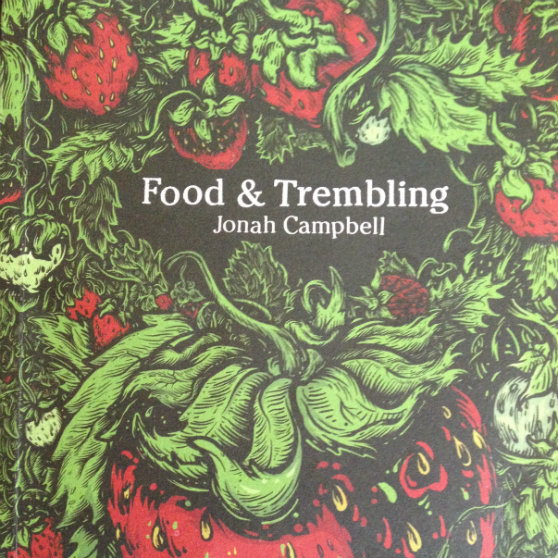
Yesterday, Alice B. Toklas; today, a strange Canadian named Jonah Campbell. His blog, Still Crapulent After All These Years, is one of my favourites. His December 24, 2013 posts, a “drink-by-drink Christmas eve exploration of Charles H. Baker’s 1939 cocktail compendium book, The Gentleman’s Companion,” had me all riled up and inspired and searching my local bookstore for a good drinks book of some glamorous vintage. Now that we have reclaimed Christmas Eve from the urgent familial madness that strikes us each November/December, I might go exploring my own book next year.

campbell

Campbell’s book, Food & Trembling, was an impulse buy when I had a giftcard and my neighbourhood store had no other books of food writing I didn’t already own. The back cover asks “What mysteries lie beneath the subtle perfection of the BLT? What is the etymology of the ‘croissant’? Why did I drink all that scotch?” and describes Campbell as “metalhead, misanthrope, unrepentant good eater,” and I was sold right then. I may never meet him, for he is in Montreal and airfare is expensive, but he seemed like my kind of people.

The book is good. It’s filled with little snippets, like his blog, and his words are like fatty bites of meat, all chew and savour, always with a little left on your tongue afterward. There aren’t really recipes. He is over the top and chaotic at times, but he is amusing and clever and I always get swept up by that.

“For whatever structural reasons, I seem to end up, as I am currently, drunk and alone in my brother’s house more often than my own (correction – getting and staying drunk and alone), and as such, a notable amount of my writing has emerged flanked by his giant cats, toy robots, tastefully arranged clutter, and just the right number of decorative bottles that I have somehow never managed to capture in my own life. The first week, more or less, of my blog’s existence, my late-night discovery of Julia Child’s twenty second omelet recipe, probably a bunch of stuff about fennel and/or rapini, because cheap fennel and rapini season often coincides with my brother needing a cat-sitter; I cannot discount this house in the framing of my creative production.”

It’s the kind of writing I really enjoy, the kind of thing you might devour in one or two long goes. If you buy it, and you read it, make sure you have chips. This seems important. Chips. Lots of them.

Julia Child’s 20-second omelette


Something to Read: The Alice B. Toklas Cook Book

30days

I can be a bit of a pain to travel with, because I don’t care so much about seeing sights or sites and just want to get to the bookstore. In San Francisco, the first time, City Lights Bookstore was my first and most important To Do, and I went there just about first thing on the very first day. I nearly blew my budget that morning, and bought so many books that it was barely noon by the time the plastic bag I had to lug them around in was stretched and torn. We were a long way from our motel room, so I dragged that bag all over the city, my hands sweating against the plastic and the bag slipping constantly out of my grip.

There must be a lesson in that experience, but I haven’t learned it.

In Paris, Grace and I had different interests – her, art; me, books and ice cream – so we would go our separate ways in the morning and then meet again later on, around mealtime. One day, I spent almost an entire afternoon in Shakespeare & Co., sitting in a tattered red armchair upstairs, reading tattered old books and imagining just staying in France forever. That morning, I had gone to Père Lachaise Cemetery to see Gertrude Stein’s and Oscar Wilde’s graves, and was sort of sad to find that Alice B. Toklas’ headstone didn’t seem to bear her name. I made a mental note – if I ever become a Very Important Writer – to let Nick have his own headstone (beside my monument) with his own name on it. It is the least my estate could do.

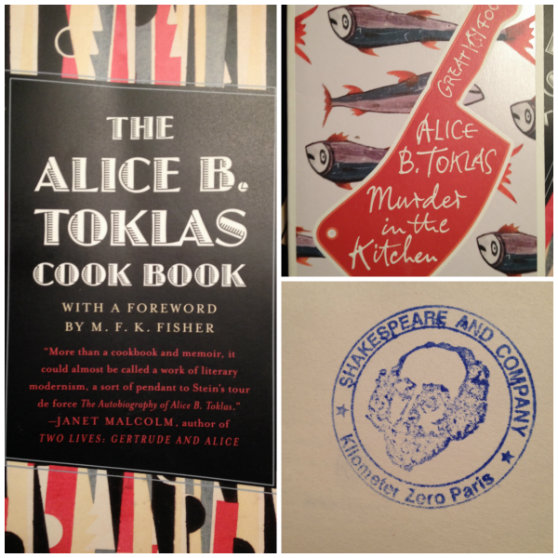
toklas

Anyway, when I made it to Shakespeare & Co., the first book that caught my eye was Murder in the Kitchen, an excerpt from The Alice B. Toklas Cook BookI bought it, and then when I got back to Vancouver bought the full cookbook at the bookstore close to home.

Alice was and still is wonderful, and you cannot read her without feeling at the end that you have come to know her personally. She writes about France during the first world war in studied detail, and many of her recipes are simple and restrained, the sort of unfussy stuff we live for now. The Alice B. Toklas Cook Book is a cookbook only in a loose sense; it’s much more literary, a piece of memoir so compelling that the recipes almost play the role of photographs, giving you a sensual impression of having been where Alice has gone. You really do tour France with Alice, driving away from Paris and through the country in Aunt Pauline, Alice Toklas and Gertrude Stein’s Ford, named for Stein’s Aunt Pauline, who “always behaved admirably in emergencies and behaved fairly well most times if she was flattered.”

This is French cookery that pre-dates Julia Child, and the recipes range from the delicate and fancy – read Murder in the Kitchen for her struggle to prepare stuffed carp for Picasso – to the rustic and comforting, like the one for “Soup of Shallots and Cheese,” which calls for shallots cooked in butter with broth and a dribble of cream, topped with toast and melted cheese. I want to eat that every day of my life. Don’t you?

There are gems throughout the book, and one of these is for “a friend’s” hash fudge, which I read with the kind of excitement you might feel upon learning that your grandparents were way cooler than your parents gave them credit for. Hash fudge! In a book written in the 1950s! I mean, I know intellectually that was a thing that existed then, but still.

“It is the food of Paradise – of Baudelaire’s Artificial Paradises: it might provide an entertaining refreshment for a Ladies’ Bridge Club or a chapter meeting of the FAR. In Morocco it is thought to be good for warding off the common cold in damp winter weather and is, indeed, more effective if taken with large quantities of hot mint tea. Euphoria and brilliant storms of laughter, ecstatic reveries and extensions of one’s personality on several simultaneous planes are to be complacently expected. Almost anything Saint Teresa did, you can do better if you can bear to be ravished by ‘un évanouissement révaillé’.” (Page 259.)

Don’t you want to join that Bridge Club? I have no idea where one might obtain the secret ingredient (I am an old lady before my time, I suppose, and tragically, perpetually un-hip), but I’m sharing the recipe with you anyway. Maybe you have some adult grand-kids you need to shock and awe? Alice writes that this is something “anyone could whip up on a rainy day,” so there you go.

Alice B. Toklas’ Haschich Fudge

  • 1 tsp. black peppercorns
  • 1 whole nutmeg
  • 4 “average” sticks of cinnamon
  • 1 tsp. coriander seeds
  • Handful pitted dates
  • Handful dried figs
  • Handful shelled almonds
  • A bunch of canibus sativa (in North America, Alice advises that you might find canibus indica instead and that it will work fine for these purposes)
  • 1 cup sugar
  • 1 to 2 tbsp. butter (“a big pat of butter”)

Using a mortar and pestle (or a coffee or spice grinder if you’re lazy or you remember it’s the future), grind up your peppercorns, nutmeg, cinnamon and coriander seeds. It might be nice to toast these in a pan over medium heat first? Use your judgment.

Finely chop your dates, figs and almonds, and mix them together (this would go faster with a food processor).

Dissolve the sugar in the butter. The instructions here aren’t clear, but what you’d be going for is a bit of a caramel; you want the sugar to turn liquid, which is best done in a heavy-bottomed pot, such as enameled cast iron, over medium-high heat. Let the sugar melt before stirring. For optimal flavour, allow the sugar to cook until bubbling and golden.

Pulverize your canibus sativa (or indica), and knead it and the spices into your dried fruit/nut mixture (again, the food processor is probably best for this). Add your sugar/butter caramel mixture, and mix until combined.

Press the mixture into a pan, and cut into pieces (or roll into balls) about the size of a walnut.

To serve, Alice advises that you eat this with care, and that two pieces should be quite sufficient.

If you make this, let me know. It sounds like a high-fibre good time, though it might just make one sleepy and hungry for nachos.

And read Alice’s book. It’s a good one.

toklas2

Peanut butter banana cookies.

Cookie monster.

He’s got my nose, but pretty much nothing else. This picky-eating business is flummoxing at best – the kid would live entirely on Nutri-Grain bars if given the option. I don’t get it. There is no “just try it,” no “just one bite.” He must get this stubbornness from his father.

Occasionally it’s nice to save ourselves a fight and just give in and give him what he wants. He wants cookies.

Fortunately he likes things like raisins and bananas, so I can make him cookies and not be tempted to eat every single one. To be honest, baking’s been a bit weird around here. It’s rare that we have a purely decadent baked good, as Toddler adjusts his standard of living very quickly and we’re trying to maintain some standards by keeping him off white flour … at least until he’s reached the age of reason and can be convinced to eat actual food. (The white flour is for me, because I have a lot of feelings to eat.)

2014-02-16 13.02.28

Peanut butter and banana cookies

(Makes about 2 1/2 dozen cookies.)

  • 2 1/2 cups whole wheat flour
  • 1/2 tsp. baking soda
  • 1/2 tsp. salt
  • 1/2 cup butter
  • 1/2 cup peanut butter
  • 1/2 cup granulated sugar
  • 1/2 cup brown sugar, packed
  • 1 egg
  • 1 tsp. vanilla extract
  • 1 cup mashed overripe bananas (about two medium)
  • 2 tbsp. ground flax seed
  • 1/2 cup chocolate chips
  • 1/2 cup raisins
  • Optional: 2 tbsp. hemp hearts or chia seeds

Preheat oven to 350°F.

In a medium bowl, mix flour, baking soda, and salt. Set aside.

In a large bowl, cream butter, peanut butter, and both sugars together until the mixture is fluffy and paler in colour than when you started. Using a spatula, scrape down the sides of the bowl. Add banana, flax, raisins, and chocolate chips, and hemp or chia seeds if using, and mix well.

Add flour mixture to wet ingredients and mix until thoroughly combined,

Roll into balls about an inch in diameter, and placed on a greased or parchment-lined baking sheet, leaving about an inch between each ball. Press with a fork, and bake for 10 to 12 minutes, until lightly golden. You don’t want to over-bake these, as they should be a bit soft and chewy. Serve warm, with milk.

Store in a container with a lid, or portion them off into smaller containers or baggies and freeze.

cookies

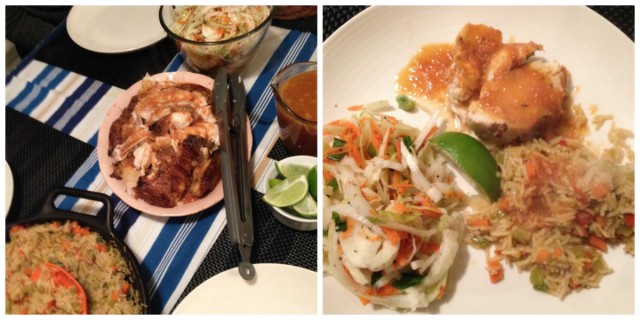
Salvadoran chicken with gravy.

emily

As you may recall, a while back I mentioned I was headed to El Salvador. I think I promised to tell you more about it. One day I am going to achieve work-life balance and then I will actually do the things I say I’m going to do! It’s going to be great.

Anyway, I did go to El Salvador in September. I was invited to tag along with a bunch of people from World Vision Canada on behalf of another site I write for, UrbanMoms.ca, and my job was to learn about poverty and child labour and write about what I saw and how Canadians could help. It was pretty much the ideal situation for a writer; they fed me and gave me endless fact-checking support and information and no specific instructions, just to write. I followed, and I listened. And, of course, I ate.

If you want to learn about someone, find out what they like to eat. If you want to learn about a place, eat its food and visit its public markets and grocery stores and food stalls.

On our third day there, after spending time with kids in a couple of rural villages, we went to San Julian for an early dinner. We didn’t get to much in the way of tourism, but we did find our way into a market there. There were the usual things – piles of fruit and vegetables, fish on ice, and stalls selling clothing, flip flops and soccer balls. It smelled sweet and faintly musky, like ripe mangoes.

There was a stall at the entrance that sold groceries and the woman there sold fresh Salvadoran chocolate in twist-tied sandwich baggies; she also sold spices. I noticed a row of small bags containing a mix of bay leaves, peanuts and sesame seeds, among other things, and tried to communicate my curiosity – I know approximately four words in Spanish.

Elizabeth, who is from El Salvador but lives in Ontario and works at World Vision Canada and who was along with us on our travels, explained (in her beautiful accent) that it’s a kind of seasoning people in El Salvador use for turkey. Because they were only twenty-five cents a package, and because I had never seen such a thing before, I bought several.

In the bus on the way home, she explained that you toast the spices really well in a pan, then mix them with tomatoes and chicken stock and sometimes wine and use it for the sauce you use to baste the bird as it roasts. I demanded a recipe, but she said you don’t need one – “you just mix the relajo and some tomatoes and wine or beer and cook it with turkey or chicken.” If you have leftovers, you eat the turkey and gravy on sandwiches the next day.

Interesting fact: I always pay my bills in the wrong amount because I can never remember the order of digits in a number, but a set of vague instructions for a meal that ends up as sandwiches is the kind of thing I will learn instantly and store in my brain for life.

There was never a chance to eat this poultry or these sandwiches while I was actually in El Salvador. I did eat twice my body weight in pupusas, and as much fresh grilled, raw, cocktailed and ceviched seafood as I possibly could, and at one point there was fried chicken and fried yucca and orange pop and pastries filled with dulce de leche for dessert and I could have died right there because what else do you need?

On our last day before heading to the airport, I managed to get over to the grocery store in the mall across from our hotel. I found more of the spice mix, so I bought another six packages (I am not insane) and was able to translate the ingredients. So when I came home I resolved to make Salvadoran turkey and gravy and sandwiches, and then assemble my own packages of relajo from ingredients I would find at home.

Trouble is, we are a family of three and the smallest of us doesn’t eat “food” so there has been no turkey. But you know what’s smaller than turkey but as (if not more) delicious? Chicken!

I am not sure this recipe is authentic. Everywhere I looked online said you have to purée the tomatoes with the relajo and then strain it and use it as gravy, but my blender is now 12 years old and barely works and I should just throw it out but then I’d have no blender. And I am too lazy for a lot of complicated extra steps.

So here you go.

To make the relajo: mix together a handful of bay leaves, sesame seeds, peanuts, pumpkin seeds in their shells, ground oregano, and one dried guajillo chili (stem and seeds removed). It also requires annatto seeds; if you can only find ground annatto, rub it directly onto the chicken; if you can only find whole seeds, mix them into the spice blend.

Relajo

Each packet I bought varies in the amount of each thing in the mix; I estimate that you’ll need eight to 12 bay leaves, crumbled, a teaspoon of sesame seeds, two or three whole peanuts, a few pumpkin seeds, and a teaspoon or so of oregano and annatto. If you can’t find annatto – and I’m sure this is blaspheme – just use turmeric; annatto is used for colour and doesn’t have a strong flavour. You can find annatto (also called achiote) in Latin American grocery stores or online. I bought it in Vancouver at the South China Seas Trading Co. on Granville Island.

Salvadoran roast chicken with gravy

(Serves four to six people)

  • 1 x 6 to 8 lb. roasting chicken
  • 3 tbsp. olive oil
  • 1 1/2 tsp. Kosher salt
  • 1 tsp. ground black pepper
  • 1 tsp. ground annatto seed (sub. ground turmeric if not available)
  • 3 lbs. tomatoes, halved
  • 1 onion, chopped
  • 1 head of garlic, halved crosswise
  • 1 batch of relajo (see instructions above)
  • 1 cup white wine
  • 1 cup chicken stock
  • 2 tsp. Worcestershire sauce
  • Additional salt and pepper to taste

Preheat your oven to 425°F.

Ideally, you will use one pan for this – a large pan to roast the spices, cook the chicken, and then simmer the gravy. If your roasting pan is stove-to-oven-friendly, then use it for the first step. If not, use a small pan to roast your spices and then put everything together in your roasting pan.

Rub your whole chicken with olive oil, then sprinkle salt, pepper and annatto or turmeric (if using) and rub again. Fold the wings behind the back of the chicken and truss the legs – tie the legs together so that they sit close to the body. Set aside.

Over medium low heat, toast your relajo until the mix is fragrant and your sesame seeds are golden. When this is done, remove the pan from the heat and set the spices aside. Place tomatoes, onions and garlic in the pan, sprinkle with the spices, then nestle the chicken in the middle. Add wine and chicken stock, and place in the oven.

Chicken, pre-oven

Roast for between 90 and 100 minutes, until the internal temperature reaches about 165°F, or when the juices run clear when pricked with a knife. Baste every 20 to 30 minutes, rotating the pan each time for even browning.

Remove the chicken from the pan when cooked, and tent with foil for 15 to 20 minutes.

Chicken.

Meanwhile, process the tomatoes, onion, garlic, spices and chicken juices through the finest disc on your food mill or press them through a fine mesh strainer back into the pan or into a saucepan. Add Worcestershire sauce and simmer for 10 to 15 minutes.

Tomato gravy

Taste, adjusting seasonings as needed. Serve with chicken, either on sandwiches or with rice.

salvadoran dinner

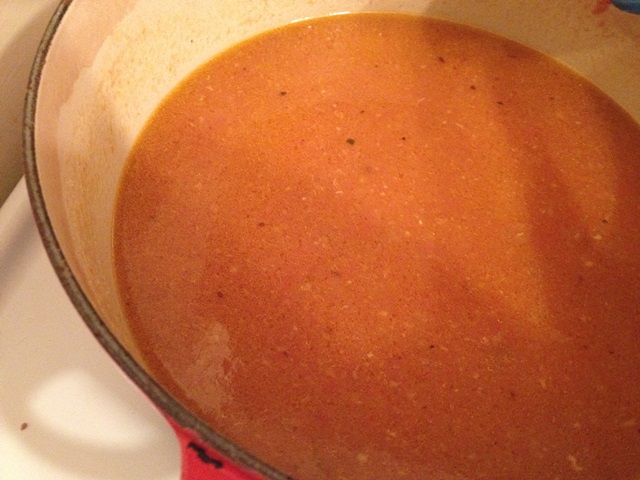
Stock.

Simmering stock

Happy Holidays! Did you celebrate? How was it? We have been busy, and apparently neglectful; the surest way to know we’ve not been home enough is the smell of cat pee on our bath towels and dirty laundry. And it’s not just the cat – our waistlines are suffering a noticeable neglect as well. We’ve eaten more food in the past week than I think we ate all year; definitely more calories. Definitely. I can feel my liver.

It’s not over yet. We have more dinners, more drinks, more friends and family and days filled with driving and negotiating with the car over how little we can get away with spending on gas. Our apartment is a hideous mess, but there’s almost no point in cleaning it. Why bother? We’re just going to have to do it again and again and again.

But the laundry’s going through its rotations, and I’ve found a quiet moment to process the leftovers. There is something meditative about picking meat off of bones; it requires focus, but it’s not strenuous work and the results mean future meals.

Even if we are just in the eye of this seasonal storm, I have found a moment of peace, and in it there is the warmth of bones and the produce that wilted in my crisper finding new life in a pot of stock that will nourish us back to health after December’s frantic gorging finally lets up.

You can’t even smell the cat pee anymore.

Make stock. It will warm your home and then when you’re too tired to do anything tonight or in a few days or next week, you’ll just bring some of it to a simmer with some veggies, a bit of meat and some noodles or grains or legumes and you’ll have an easy (and easily digestible) dinner that won’t take much more than 20 minutes to pull together.

There’s no real recipe. Most of the time I save my veggie scraps in a container in the freezer, and then when we eat a bird or a ham or a lot of bony beef, I put my scraps and bones in a stock pot with some herbs, some salt and pepper and a lemon. I fill the pot to about the 12-litre mark and simmer (never boil) for two hours or maybe more, depending on how the day goes. I usually end up with about eight litres of stock in the end, and that’s enough for eight pots of soup, or eight risottos, or 16 pots of Bolognese sauce or chili.

If you don’t have scraps in your freezer, use a couple of carrots, a few ribs of celery, an onion, the green tops of two leeks, and half a bunch of parsley and as many heads of garlic as you feel like (I always use two or three). For the bones, a carcass from Christmas dinner or a bag of chicken backs from your butcher will be perfectly fine; if you’re using raw backs to start, brown them in a bit of oil in the bottom of the pot with your veggies for extra flavour. But you don’t have to use meat; omit it and you’ll have yourself a perfectly lovely vegetable stock. Add some bay leaves, a handful of black peppercorns, and then just let it go. If anything scummy forms on the top, skim it off. There’s really nothing to it.

Strain it after a couple of hours, then put it back on the stove and simmer for longer to reduce it if you want, or don’t, but salt it at the end after you’ve tasted it. Cool it, then store it in large Mason jars or freezer bags in 4-cup portions.

Trust me on this – make stock. You’ll feel better knowing there’s nutritious, homemade soup in your future.

And enjoy the rest of the holiday season. There’s still fun to be had, and I hope you have it all.

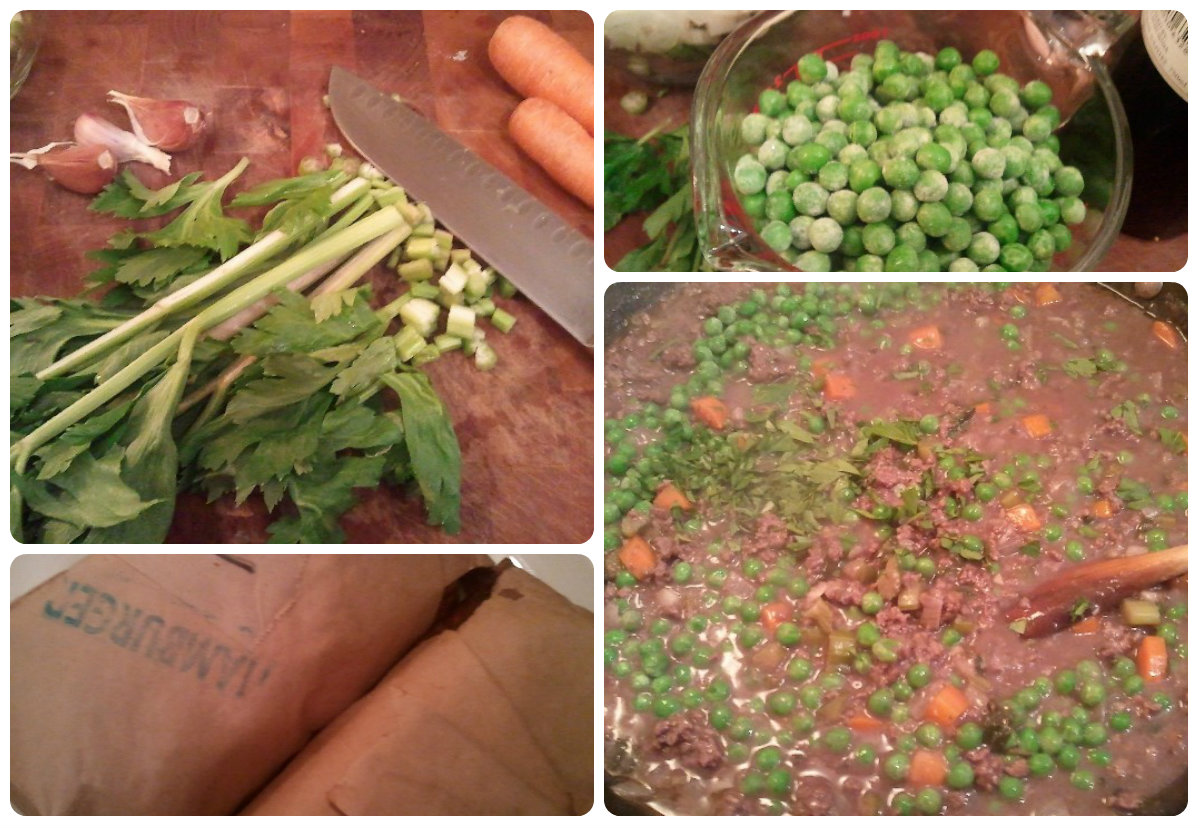
Cottage pie.

The makings.

A shepherd’s pie is supposed to be filled with lamb, which makes sense, but we’re working on a freezer full of meat Nick hunted and for probably legal reasons, he didn’t hunt a single sheep. So, let’s call this cottage pie, because I think that’s what you call a dish of meat topped with potatoes when the meat isn’t lamb. Here it’s filled with moose or venison, depending on what’s at the top of the pile in the deep freeze.

We are eating a lot of comfort food these days, as the weather has called for it and our lungs and noses have suggested it might be time for cold season and there are Christmas trees in store windows now. I don’t know where most of my days go, but the seasons are short and the years are passing so much more quickly than they used to. So occasionally, on evening I don’t have any plans, I’ll invite a friend or two over, and we’ll share a semi-responsible bit of wine and listen to whatever playlist I’m currently obsessing over and eat big plates of something hearty. Comfort food for comfortable evenings. The stuff elastic waistbands were invented for.

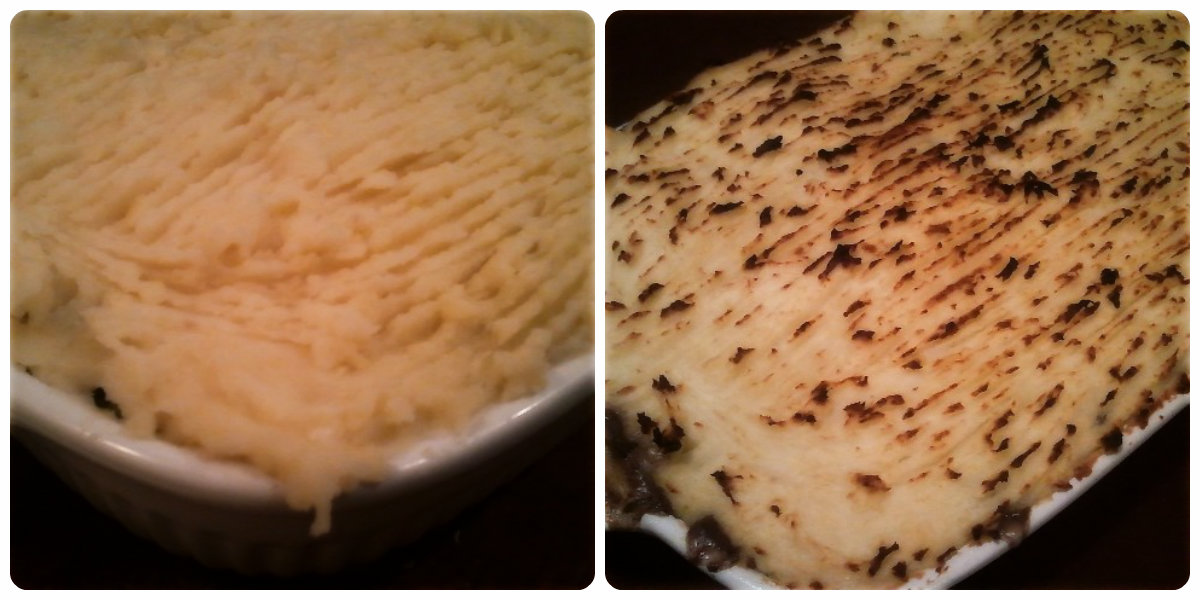
Before and after.

Pro tip: If you measure out the wine before you start cooking, you will be sure to have enough for both you and the recipe.

Also, I cannot emphasize enough how much you need a food mill. Ask for one for Christmas! It is the best tool for perfectly fluffy, lump-free mashed potatoes; I used one for the potato and rutabaga topping and there was nary a lump to be found in my mash. They also stir and spread more nicely if they’ve been milled. I am not tall enough to food-mill on my counter, so I sit on the floor to do it.

Sitting on the floor, milling some turnips and potatoes.

Cottage Pie

(Serves 8)

Topping:

  • 4 lbs. starchy potatoes such as Russets, peeled and diced
  • 2 lb. rutabaga, peeled and diced
  • 1/2 cup butter
  • 2 eggs, beaten
  • Salt to taste

Filling:

  • 1/4 cup olive oil
  • 1 onion, diced
  • 2 stalks celery, diced
  • 2 carrots, diced
  • 3 cloves of garlic, minced
  • 2 lbs. lean ground beef
  • 1 tbsp. chopped fresh rosemary
  • 1 tbsp. Worcestershire sauce
  • 2 tsp. Dijon mustard
  • 1 tsp. ground black pepper
  • 1/2 cup all-purpose flour
  • 1 1/2 cups dry red wine
  • 2 1/2 cups beef stock
  • 2 cups frozen peas
  • 1/2 cup chopped fresh parsley
  • Salt to taste

Preheat your oven to 375°. Lightly grease a 9″x13″ baking dish.

Put cubed potatoes and rutabaga into a large pot of salted water and bring it to a boil over high heat. Once it’s boiling, drop the heat to medium-high and continue to cook.

Meanwhile, heat olive oil in a large pan over medium-high heat. Add onion, celery and carrots, and cook for two to three minutes, until the veggies have brightened in colour. Add garlic, cook another minute, then add your meat, breaking it into pieces with your hands as you drop it into the pan. Stir, cooking until meat has browned. Add rosemary, Worcestershire sauce, mustard, and pepper. Stir. Add flour, and stir again until all the white disappears into the mix. Add wine, scraping the bottom of the pan with your spoon, and cook another minute or two. Add stock, and simmer until the sauce has thickened and reduced just slightly. Taste, adjusting seasonings as needed. Add peas and parsley. Stir. Remove from heat.

Pour your meat mixture into your prepared 9″x13″ baking dish.

Once your potatoes and turnips are cooked – they should pierce easily with a knife once they are done – then drain. Put pack into the pot and mash, or process them in your food mill. Add butter, stir to combine, then add eggs. Stir quickly. Taste, adjusting seasonings to your taste.

Dollop the potato mixture over the meat. Spread to coat the pan evenly, ensuring your potato mix reaches the edges whenever possible. Drag a fork over the topping.

Bake for about 25 minutes, until golden and the meat bubbles around the sides. Serve with salad, red wine, and country bread.

Cottage pie.