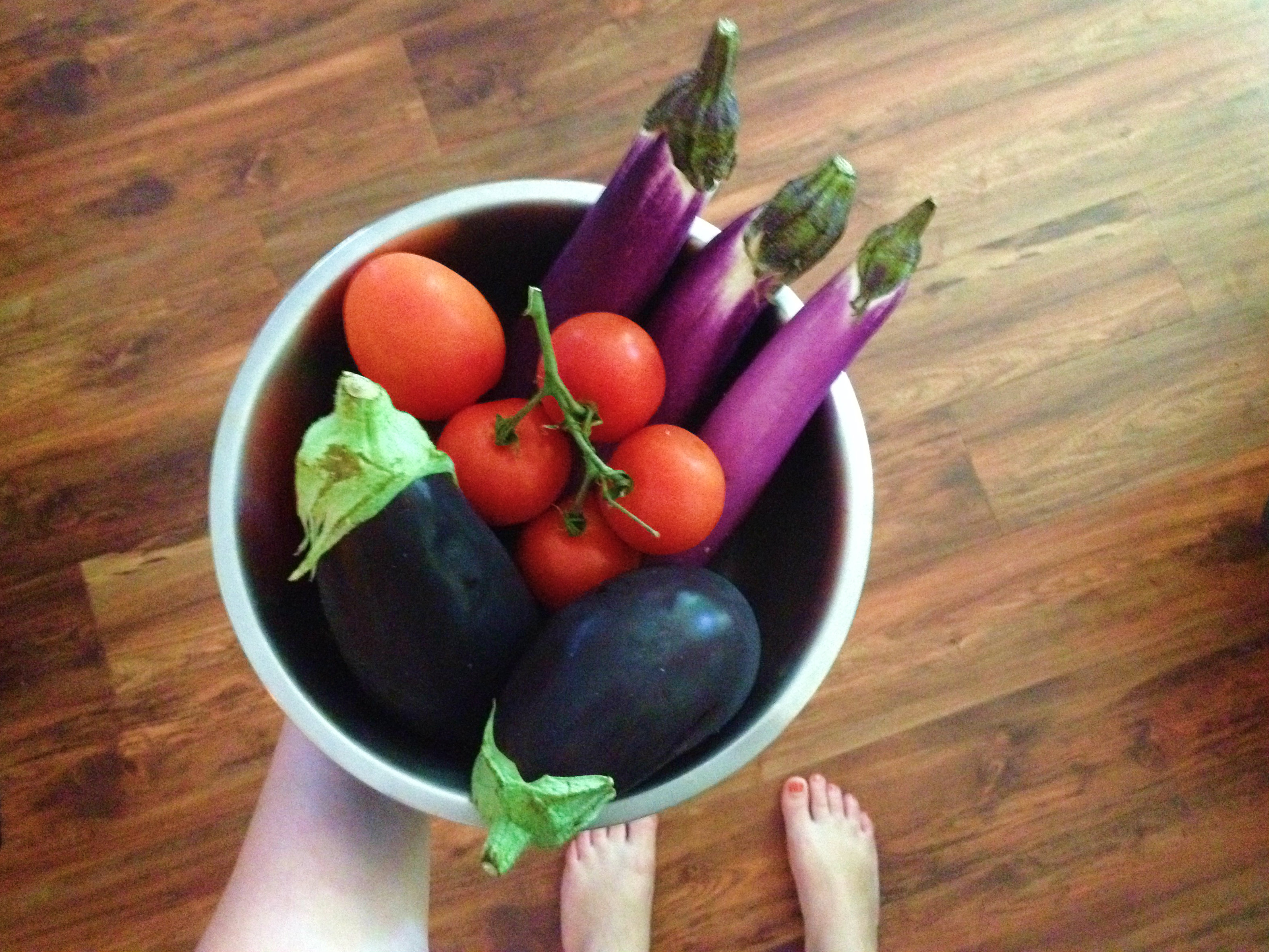
Mirza Ghasemi.

A few months ago a very sweet student in one of the labs at work phoned his grandmother in Iran to get me a recipe, which he then translated from Farsi but maybe not very well. I knew he could cook, and I had wondered if he ever made mirza ghasemi, a dish of grilled eggplant and tomatoes mashed together with olive oil and spices and garlic and topped with fried egg. I had recently fallen in love with the dish at a Persian restaurant, but wasn’t sure exactly what was in it – there was no description on the restaurant menu, and sometimes Google lies. He knew it, but he didn’t make it, so he asked if I could wait a few days and then called home.

It wasn’t eggplant season then, but it is now, so I pulled his recipe out of my inbox and realized there were a few things lost (or exaggerated) in translation – the ratio of eggs to eggplants was way off. A promising neuroscience student, he was hired away to Germany in the meantime so I can’t ask him my questions; this is a loose adaptation of his grandmother’s recipe, a dish from northern Iran that transforms bitter eggplant into a smoky dip for sangak or regular old white bread (toasted to within in an inch of its life for optimal sopping). The eggs make it a meal for two, or a hearty appetizer or snack for four.

I have given directions for this dish using the oven and stove, but please note that if it is a hot day and you have a side burner on your outdoor grill, you can make this entirely outside using roughly the same instructions and it will be that much better. Serve with bread and lemon quarters
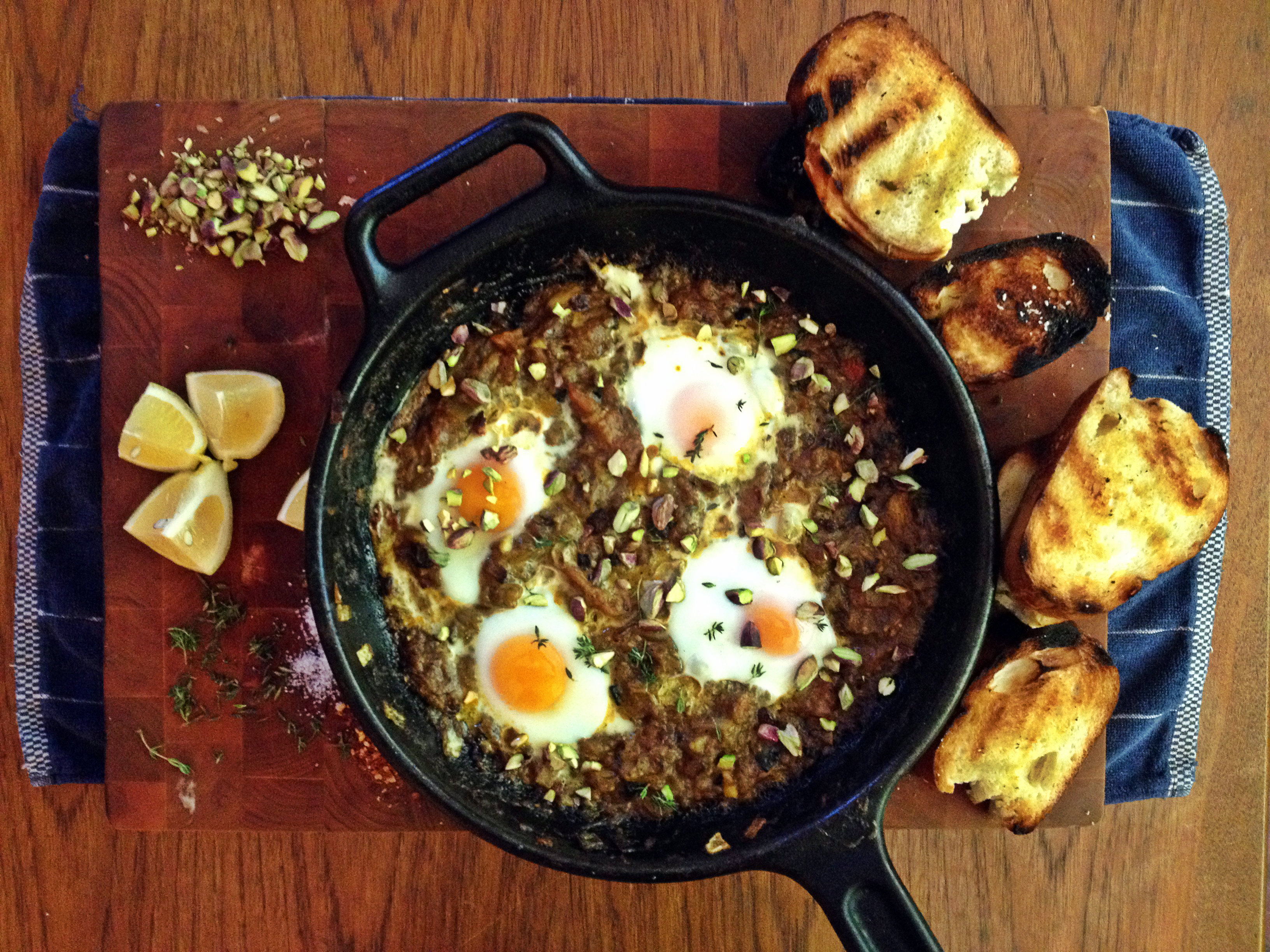
Mirza Ghasemi

(Makes 2 to 4 servings.)

  • 2 lbs eggplants
  • 1 lb tomatoes
  • 1 tbsp. + 1/4 cup olive oil, divided
  • 1 onion, finely chopped
  • 6 garlic cloves, minced
  • 2 tsp. ground cumin
  • 1 tsp. Kosher salt
  • 1 tsp. smoked paprika
  • 1/2 tsp. ground turmeric
  • 1/2 tsp. ground black pepper
  • 1/2 tsp. red pepper flakes
  • 1/2 lemon, juiced
  • 4 eggs
  • 2 tbsp. roasted shelled pistachios, roughly chopped
  • 2 tsp. fresh thyme, roughly chopped

Heat oven (or grill) to 400°F.

Using a fork or a toothpick, poke holes into eggplants and tomatoes all over. Drizzle one tablespoon of olive oil over whole eggplants and tomatoes.

Roast or grill eggplants and tomatoes for 20 minutes, until charred in places and softened – eggplants should appear to slump. Remove eggplants and tomatoes to a glass bowl, and cover with plastic wrap. Cool for at least 15 minutes, or until you can handle them comfortably with bare hands. Eggplants and tomatoes can be roasted or grilled up to 24 hours in advance – just store in the fridge until you’re ready.

If you roast your veggies ahead of time, return your grill or oven to 400°F before proceeding.

Gently remove skins from tomatoes and eggplants. If you like a smooth puree, you can use a food mill to slough off the skins and stuff. I prefer to mash the veggies’ innards with a fork or potato masher until they form a chunky mush. Reserve any liquids that have accumulated at the bottom of the bowl you cooled your veggies in.

Heat remaining olive oil in a 12″ skillet or cast iron pan over medium-high heat until shimmering. Add onion, and cook for about three minutes, until translucent but not browned. Add garlic, cumin, salt, paprika, turmeric, pepper, and pepper flakes, and cook for another minute, until the spices are fragrant.

Add eggplant-tomato mush, and any remaining liquids, and simmer for about six minutes, until the liquid has evaporated and the mixture looks a bit dry and sticky, like it would burn to the bottom of the pan if you’d let it. Add lemon juice, stir, and taste. Adjust seasonings as needed.

Using a spoon, create four little holes in the eggplant mixture, then crack an egg into each hole. Place the pan in the oven, and bake until the eggs have set to your liking, five to 10 minutes.

Sprinkle the finished dish with fresh thyme leaves and chopped pistachios.

Scotch eggs.

I wish I was in a place where we could talk warm yellow heirloom tomatoes, or crisp radishes drizzled with olive oil and speckled with flecks of ashy black salt, or fat red berries dipped in vanilla sugar. But I am in Vancouver, with wet socks because my galoshes both now have holes in the soles, half wondering what the hell I’m still doing here.

When we talk about our respective cultures, those muddled European backgrounds we cling tenuously to, what is important to Nick and I is less about the place – his heritage is roughly Dutch in the same way that mine is vaguely British – than it is about the food. When people talk about where they’re “from,” often they talk about a somewhere else, as if they really came from there, as if they identify more strongly with some other place than the place they are now. And maybe they do.

In the ongoing (and tedious) pursuit of a novel, I have been writing about the idea of reclaiming my culinary heritage. Mine, I guess, but to be honest the further I go with it the less sense it makes. Are the meals I grew up eating the only thing that counts? Are my grandmother’s recipes more significant than the dim sum I have eaten almost every weekend for more than half my life? Is the influence of Nick’s family recipes worth mentioning, or are they too new to count? I don’t know.

When I started writing about my grandmother’s shortbread, I had a direction in mind, but the further I go, the more I realize that culture is fluid, and I am Canadian which means nothing and everything all at once. Meatballs and maple syrup and smoked salmon and Szechuan green beans and Southern Barbeque are equally weighted here. And I loathe ketchup chips.

Being from the west coast of Canada, my food is everyone’s food – this is the meltiest melting pot I’ve ever seen. Way to add confusion, Emily. Never finish that culinary memoir, you feeb. So as much as I’d like to be able to write a simple book of recipes that speak to a simple culinary heritage, I can’t. My grandparents never ate tofu.

Do you claim a cultural heritage different from the one in the place you grew up? How do you self-identify, and is it more complicated than simply “the place you grew up is where you’re from?”

On days like these, after weeks of rain, the food that comforts Nick and I the most is the kind of food that goes with a lot of cold cheap beer. Food that is fried and rich and bad for us. Maybe the culture we most subscribe to is pub culture, as we are creatures of deep-fried habit. Tonight we ate a dish that has its origin in Scotland, where my grandmother’s family emigrated from. No relative of mine ever made it for me, but I make it whenever it’s rained too long, and whenever the pantry runs low and payday is still a long way off.

For Scotch eggs, I recommend starting with soft-boiled eggs. You will not overcook the yolks this way, but they will be set and cooked through by the time you’re done. Peel the eggs carefully.

Scotch eggs

  • 4 soft-boiled eggs*, shells removed
  • 1 lb. lean ground beef
  • 1 1/2 cups bread crumbs, divided
  • 1/2 medium onion, grated
  • 1/2 cup finely grated carrot
  • 1/4 cup fresh parsley, finely chopped
  • 3 cloves garlic, minced
  • 1 tbsp. vegetable oil
  • 1 tsp. Worcestershire sauce
  • 1 tsp. coarse salt
  • 1 tsp. ground yellow mustard
  • 1/2 tsp. dried oregano
  • 1/2 tsp. ground black pepper
  • 1 egg, beaten

Combine ground beef, 1/2 cup of bread crumbs, onion, carrot, parsley, garlic, oil, Worcestershire sauce, salt, ground mustard, oregano, and black pepper in a large bowl, and mix with your hands until thoroughly blended.

Divide meat mixture into four even portions. Spread meat across your palm – about twice the width of your egg – and press to an even thickness. Carefully wrap your egg in the meat mixture, pressing the meat to ensure the egg is completely sealed within.

Dip each meat-wrapped egg in the beaten egg, and dredge through bread crumbs until coated on all sides.

Fry in 1/2″ of oil over medium high heat, about four minutes per side, making quarter turns until each side is golden and meat is cooked through.

Remove to a plate lined with paper towel. Salt to taste.

Serve hot, with mustard as an accompaniment.


* I have never had any trouble using soft-boiled eggs, but my sister-in-law made these and found soft-boiled eggs hard to work with. Feel free to hard-boil the eggs; they might be easier to work with.