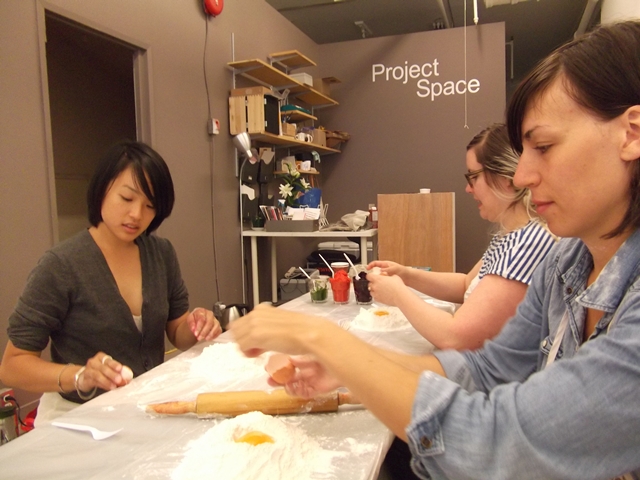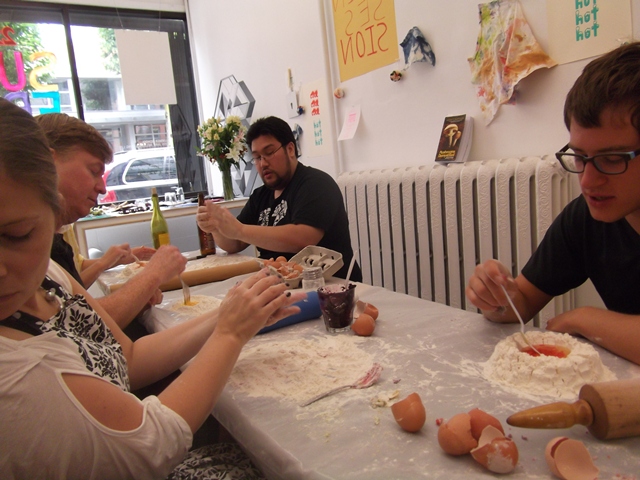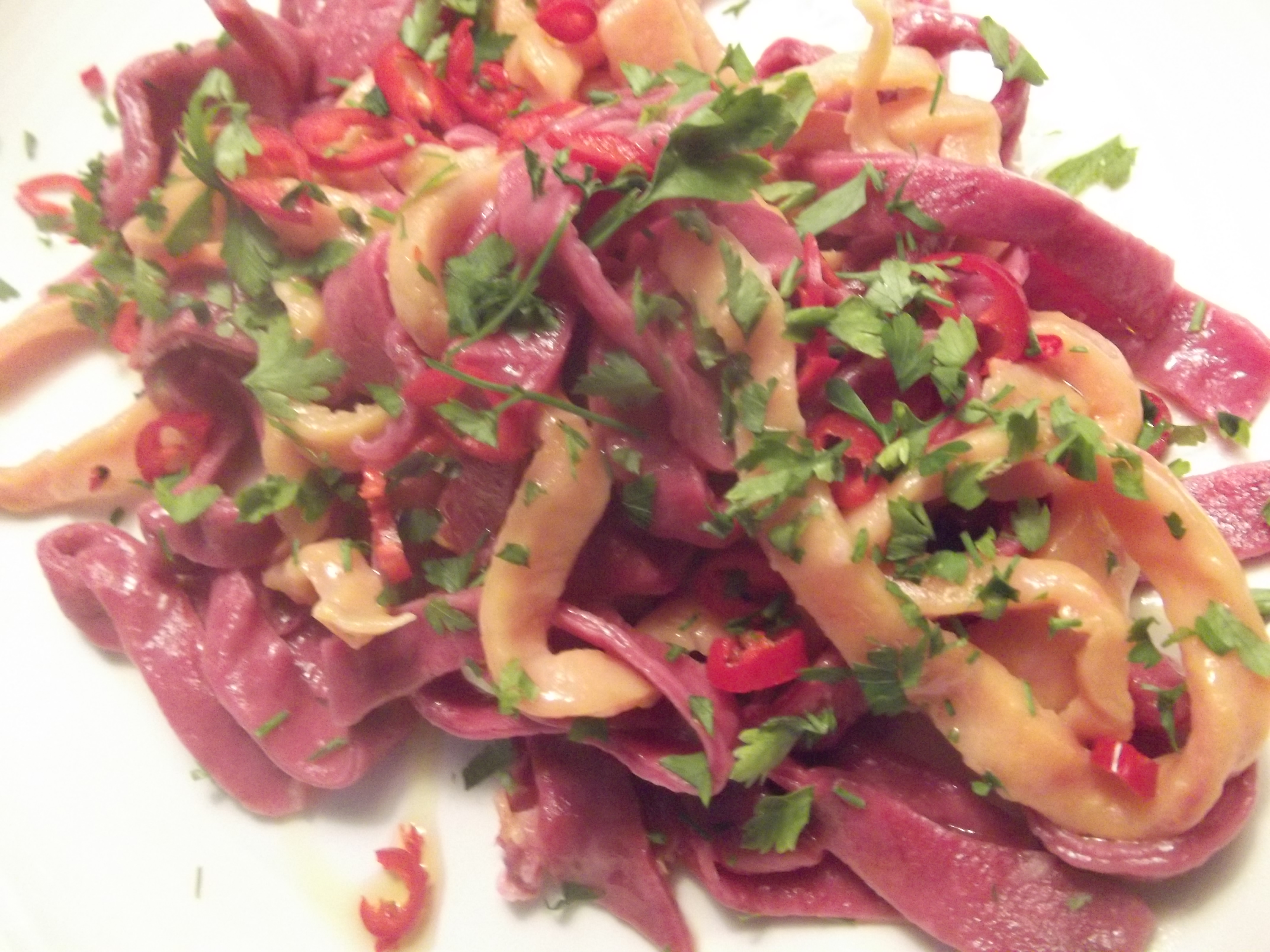
Making rainbow pasta at Project Space.

On East Georgia here in Vancouver, just up the block from Phnom Penh, a lot of little art spaces are starting to appear beside the lot of little restaurants I have long enjoyed. One of these is Project Space, a bookshop/art studio/everything-space run by the fabulous folks behind OCW Magazine, who have kindly published my words over the past five or six years.

For the past few days (and tomorrow), Project Space has been home to Summer School, a series of free classes hosted by artists Erin Jane Nelson and Ming Lin. So, because I’m there any time someone wants to combine art with something I can eat, today I went back to school.

The class was led by Ming Lin, who taught us to make rainbow pasta. Natural dyes are a passion of Lin’s, and food is an obvious medium for the exploration of these.

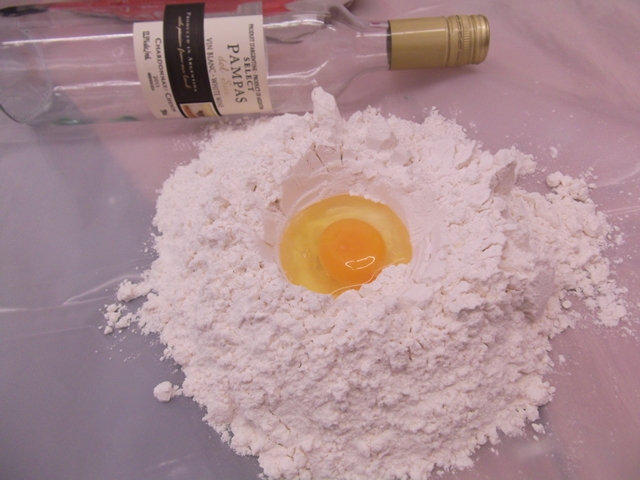
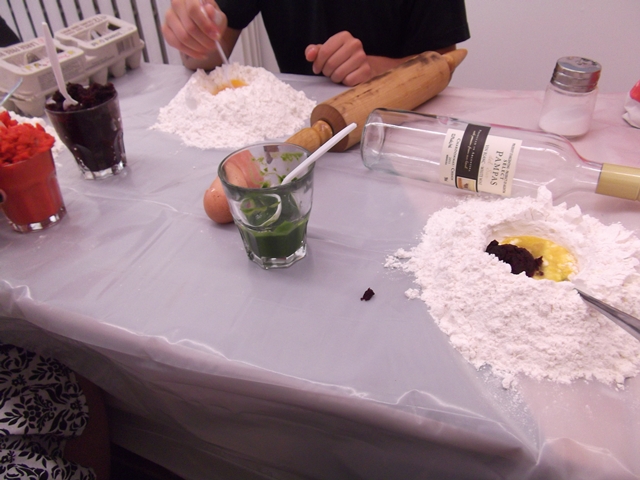
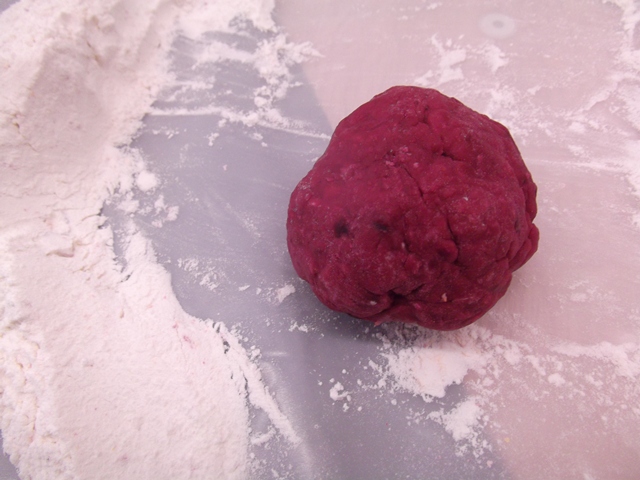
Making pasta is easy. For this class, we poured three cups of all-purpose flour into a pile on the table. We dug a well into the centre of the pile, and cracked an egg into it. We added salt, beat the egg gently in the well, then added about one tablespoon of puréed vegetables – either spinach, beet, or carrot. We’d then continue stirring, this time gradually folding flour into the the mix. When the dough began to form a ball, we’d pull it from the well and knead it, incorporating more flour until the dough was firm but pliable and no longer sticky. The dough went into the fridge for 15 to 20 minutes.

The same pile of flour lasted three rounds of this, and I ended up with three colourful balls of pasta dough, each time re-piling the flour, adding egg and salt, stirring, then adding a spoonful of purée.

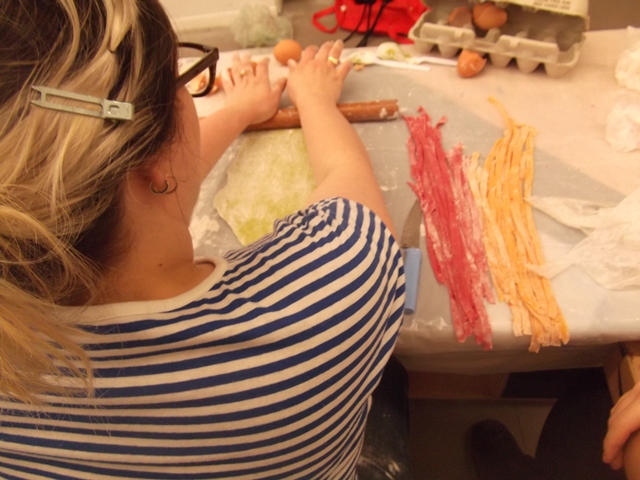
After resting in the fridge, the dough was ready to be rolled. At this point, I’d recommend the use of a pasta roller, unless you have the upper-body strength of someone over the age of eight. I do not, but no machine was available, so I rolled my pasta out with an empty wine bottle. Though the idea is to get your sheet of dough as thin as possible, mine was thicker than if I had run it through a pasta machine, which made the boiled noodles thicker and chewier than I prefer. But that’s okay.

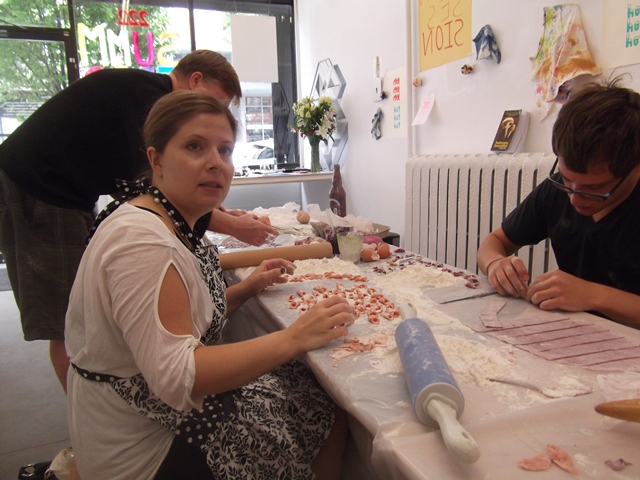
Some people trimmed their pasta into long strips. That’s how I did mine, as fresh strands of pasta tossed with browned butter and grated Grana Padano combine to form one of those perfect, simple dishes we ought to make more of. Others were more creative (and patient), and attempted to fold their pasta into bow-ties and penne.

Our teacher cut hers into tiny squares perfect for a pot of soup.

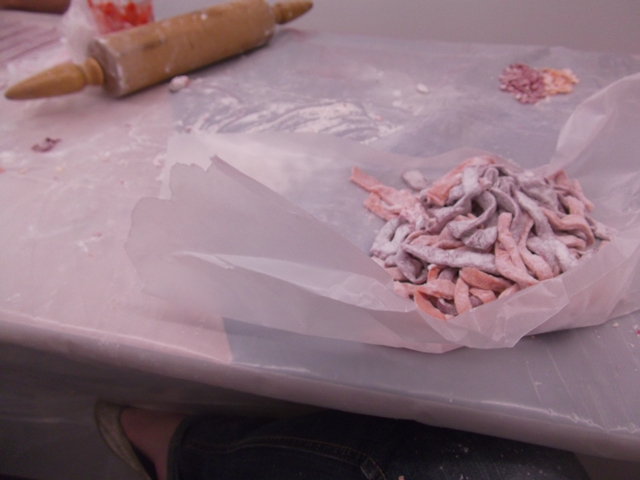
I ended up with a pile of purple and orange noodles, enough for two people to enjoy a small plate of pasta each. I boiled it for about three minutes, then tossed it in a pan with butter and cheese and chopped fresh chilies, and then scattered parsley over top.

Pasta-making was a pleasant diversion, and a reminder that a small amount of effort can yield delicious results. Why not dawdle over a bit of dough the next cloudy day and treat yourself to something simple and delicious? I hope it rains tomorrow, as I’d like to purée some chilies for a batch of dough and see what happens. What’s your perfect pasta? I’d love your tips and recipes. Bonus points for butter and cheese, obviously.

Strawberry lemon pancakes.


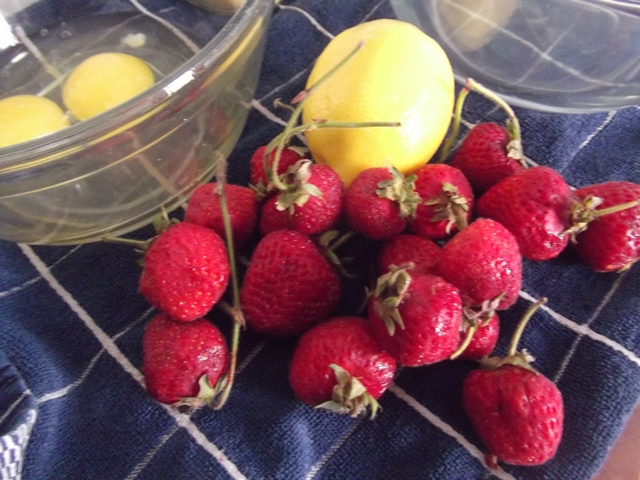
If last year’s strawberries – mouth-puckering and tannic – were the bitter embodiment of everything wrong with last summer’s weather, then this year’s fat, sweet berries have more than made amends. I can’t tell if I’m sunburned or turning into a red Violet Beauregard, I’ve eaten so many strawberries – handfuls and handfuls every time I’ve passed the fridge this past week. Berries dipped in sugar, berries sprinkled with cracked black pepper, berries melted into caramel and crushed into smoothies and boiled into jam.

I’m not tired of them, and raspberry season is already here. But we have to finish these before I can move on to a new berry – I am aware that this is the best problem a person can have.

So this morning we had pancakes.

There’s a breakfast place in New Westminster I liked to go to called The Jiffy Wiffy Waffle House. It’s changed, cleaned up, and isn’t the delightfully dodgy waffle purveyor it once was, but in its (my?) waffly prime, I would go there and order the waffle with peaches or berries baked right in. This was a novel idea, at the time – maybe it still is, because the last time I tried to do that here I burned frozen raspberries between the grooves of the waffle press and it took forever to scrub the thing clean. Don’t press fruit in your waffle iron unless you know what you’re doing, I guess.

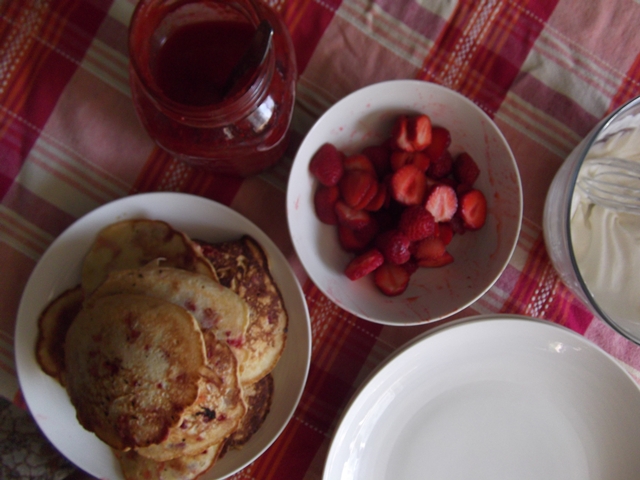
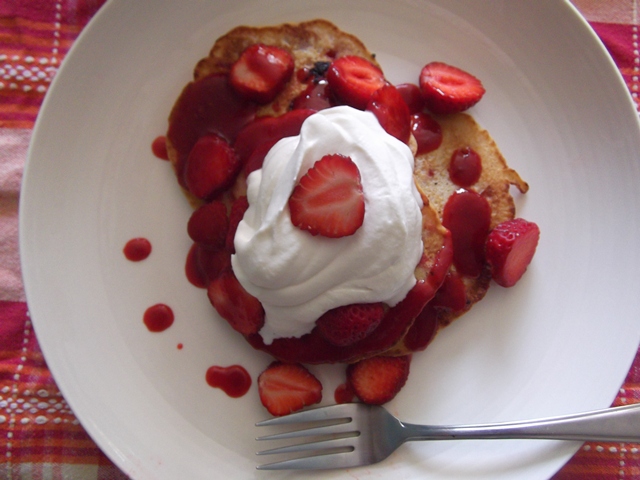
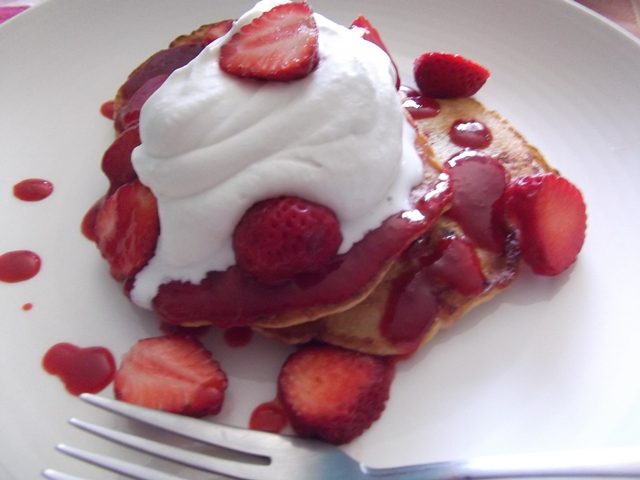
Anyway. I like fruit baked into carby things. Who wouldn’t? And these pancakes, thin and crisp and lemony, topped with sliced fresh berries, whipped cream, and this strawberry caramel? It’s like breakfast strawberry shortcake, which is the embodiment of everything right with this summer in Vancouver at this very moment.

Strawberry lemon pancakes

(Makes eight pancakes.)

  • 1 cup all-purpose flour
  • 1/2 cup cornmeal
  • 2 tbsp. sugar
  • 1/2 tsp. baking powder
  • 1/4 tsp. salt
  • 2 eggs, lightly beaten
  • 1 lemon, zest and juice
  • 2 cups milk
  • 3 tbsp. melted butter
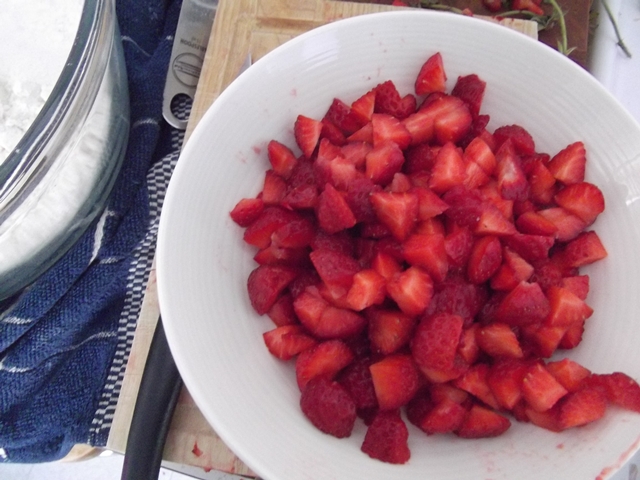
  • 1 lb. fresh strawberries, hulled and diced

In one bowl, stir together flour, cornmeal, sugar, baking powder, and salt. In another bowl, whisk together eggs, lemon zest and juice, milk, and one tablespoon of butter. Stir in diced strawberries.

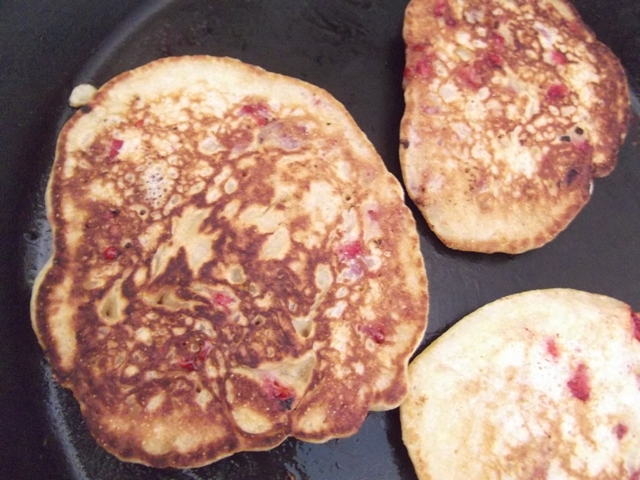
In a large skillet heated over medium heat, pour half of the remaining butter into the pan and turn to coat. When it begins to sizzle, pour in four equal portions of batter, turning once the edges of each pancake have started to look crisp and bubbles have formed on the surface of each cake. Turn, cook another one to two minutes, until golden on the bottom. Repeat until you’re out of batter.

Serve with fresh berries, whipped cream if you’re feeling indulgent, and this strawberry caramel I keep talking about if you feel like you’ve sweated away enough calories already this week and therefore deserve it.

If you end up with more pancakes than you can eat, simply cool them completely on a wire rack, and then stack them between sheets of wax paper, stick them in a bag, and freeze them. You can pop them in the toaster as you need them. They are way better than Eggos.

Picnics and bacon-wrapped garlic scapes.

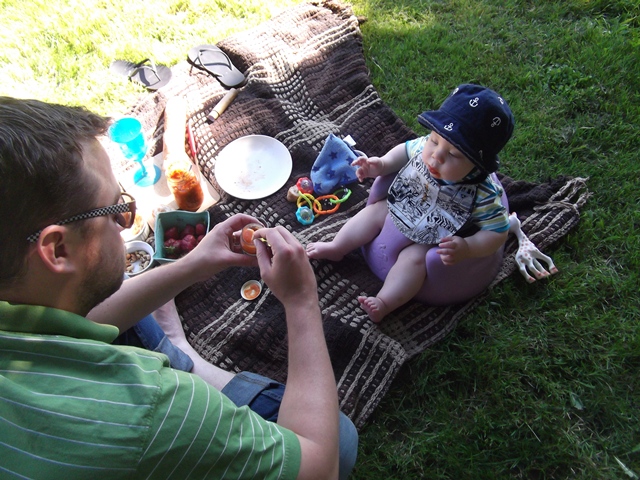
All of a sudden, two layers of clothes are too many layers of clothes, and my toes are naked and touching the grass, and I’m drinking wine in parks and getting dirty looks from the other mothers for all my drinking wine in parks. Summer finally landed in Vancouver yesterday, so picnic season began in earnest this afternoon.

I have written about the joy of picnics here before but I am getting older and with age has come a tendency to repeat myself, and also to assume that what I say bears repeating. Take yourself on a picnic. Bring a friend, and a bottle of wine, and something to nibble on, and whittle away the afternoon, or just languorously pass your lunch hour (bottle of wine optional in that instance, unless you work from home). All you need is a patch of grass and a bit of bread and cheese.

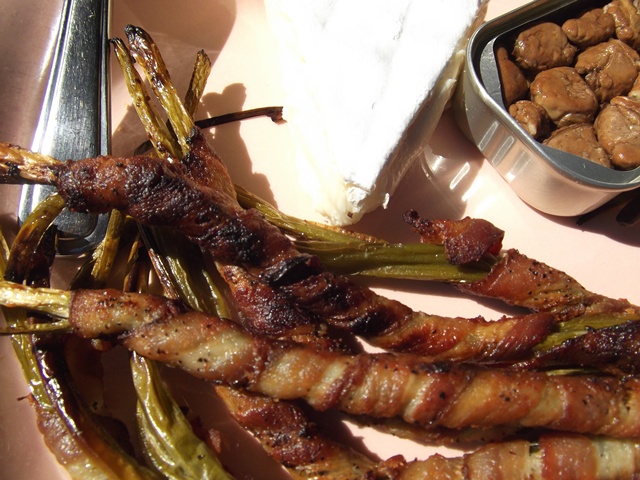
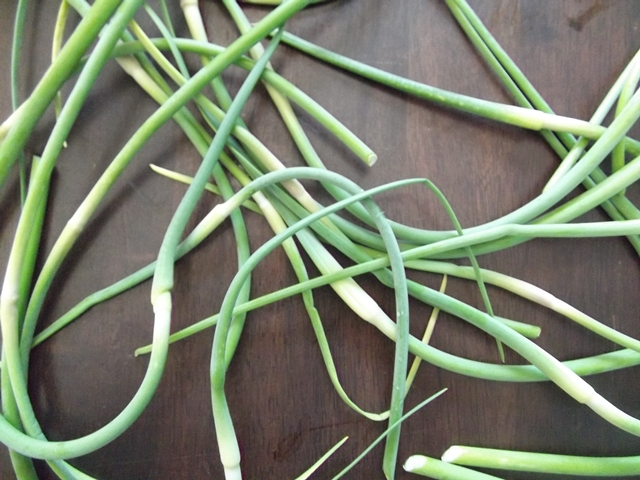
And garlic scapes, if you can find them. Even better if you can grow them. Wrap them in bacon, and eat them outside.

Bacon-wrapped garlic scapes

  • 24 garlic scapes
  • 8 strips bacon
  • Coarse salt
  • Pepper

Preheat your oven to 425°F. Lightly grease a rimmed baking sheet.

Trim scapes at the bud, leaving eight to 10 inches of the stalk. (I left the buds on some of the shorter scapes, and the flowers inside were a little fluffy, but not unbearable if you’re used to finding cat hair in everything.) Bundle scapes in threes, wrapping each as tightly as possible with the bacon.

Sprinkle each bundle with a few flecks of coarse salt, then with freshly ground pepper.

Bake for 25 minutes, until the bacon is brown and looks crisp. Flip the bundles halfway through. Delicious served hot, but also pretty nice eaten cold, in the shade, on the grass.


Potatoes with chorizo, scallops, and gremolata.

Full disclosure: I didn’t pay for any part of this dish. It’s technically a sponsored post, I guess, which I agreed to do because the product is potatoes – whole potatoes, which I was allowed to do anything I wanted with. Some of them I cooked simply and slathered in butter, because potatoes in butter taste so much better than skinny could ever feel. (This is the point at which I am sure the nice potato people are wondering whose idea it was to contact me.)

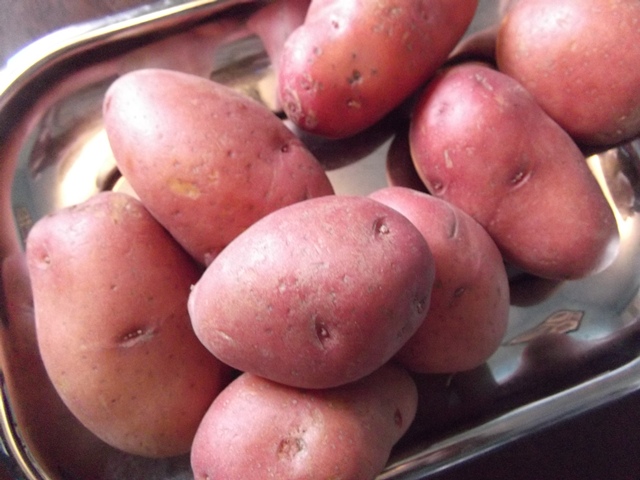
I was asked by a company called EarthFresh, a Canadian potato company, to create a recipe for these pink and gold potatoes, and for it I got the groceries paid for. Which perhaps will become obvious to you when you see that I’ve created a recipe that uses a pound of scallops even though I am still unemployed. Maybe disclosure is redundant then? Anyway, the recipe will go into a contest and if I win I get a second gift card for even more groceries, which will come in handy should the search for work drag on.

As a main dish, I’ll admit this one’s a little weird. But bear with me – the sweetness of the potatoes is matched by the sweetness of the roasted garlic and the scallops, and balanced by the lemon juice and the spiciness of the pepper flakes, paprika, and chorizo.

While here they act almost like pasta, sopping up the dish’s flavourful juices, often potatoes are a secondary ingredient, a thing that rounds out a meatier dinner. I don’t know why that is, as on more than one occasion while I was a student I would eat a plate of buttery, cheesy mashed potatoes for supper and they were more than satisfying, but most often potatoes suffer silently at the side, relegated to the role of “lead starch.” We are told to enjoy them in moderation, and advised to eat them deep-fried less often.

Waxier potatoes, and in particular the golden varieties of potatoes, are not so bad for you. They score lower on the glycemic index, which means that Nick with his diabetes can eat more of them than the fluffy Russet kind as they aren’t so quick to spike his blood sugar levels. Even if he couldn’t eat a whole plate of them, golden potatoes also make for a more interesting mash.

Anyway.

Some notes on this recipe:

  • I used larger scallops for this, about 15 to 20 to a pound. If all you can get is the cute little baby scallops, cook them for less time – I’d guess 10 minutes.
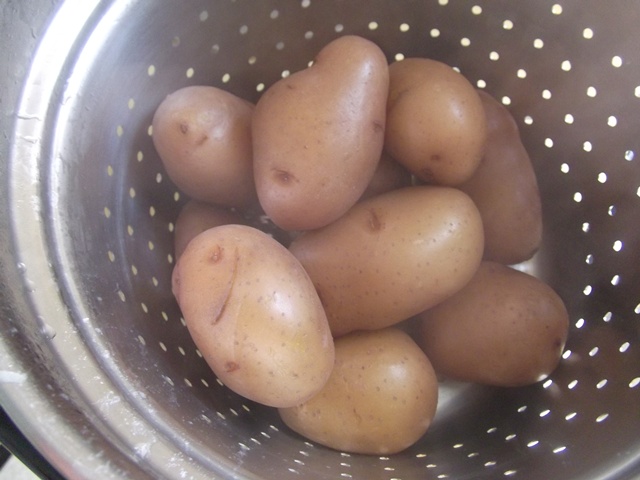
  • I used two pounds of potatoes, about four potatoes to a pound which parboiled in about 15 minutes – if you have larger or smaller potatoes, adjust your cooking time.
  • If you decide not to use scallops, cubes of a firm-fleshed white fish, whole button mushrooms, or diced zucchini would work well instead.
  • When I tested this recipe I used a 9″x13″ baking dish, which worked fine, but the next time I make this I am going to use a roasting pan as I felt the potatoes could sop up even more flavour if they weren’t as densely packed. Use what you’ve got, though – a 9″x13″ baking dish won’t ruin dinner.

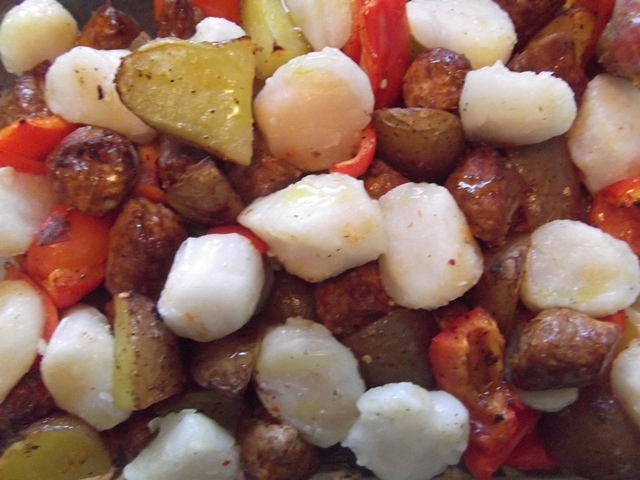
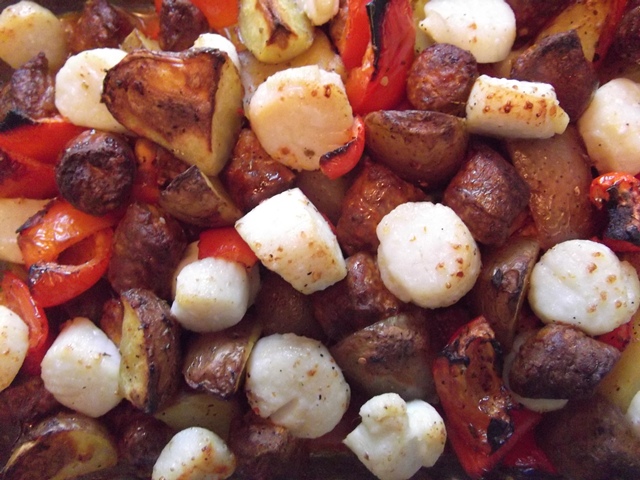
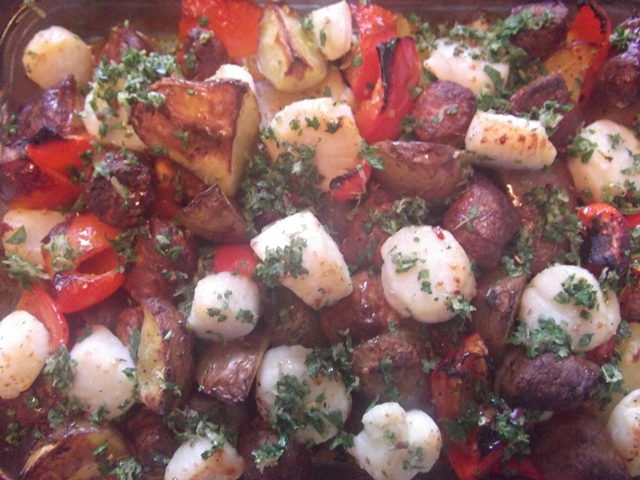
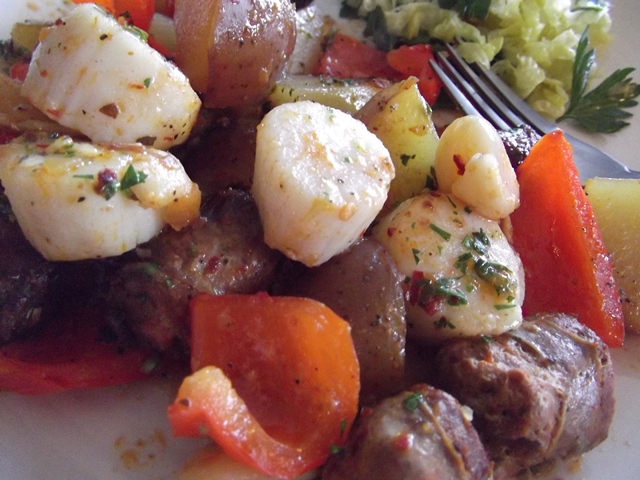
Potatoes with chorizo, scallops, and gremolata

  • 2 lbs. yellow-fleshed potatoes (such as Klondike Rose)
  • 1 lb. raw Spanish chorizo, cut into inch-thick pieces
  • 2 red bell peppers, cut into bite-size pieces
  • 2 heads garlic, cloves separated and peeled
  • 3 tbsp. extra virgin olive oil
  • 2 tbsp. lemon juice (from about one large lemon)
  • 1 1/2 tsp. coarse salt, divided
  • 1 tsp. red pepper flakes
  • 1/2 tsp. smoked paprika
  • 1/2 tsp. ground black pepper
  • 1/2 tsp. dried oregano
  • 1 lb. scallops (thawed if frozen)

Gremolata:

  • 1/4 cup parsley, firmly packed
  • Zest of one lemon
  • 2 cloves garlic
  • 1/2 tsp. coarse salt
  • 1/2 tsp. red pepper flakes
  • Extra virgin olive oil

Preheat oven to 425°F.

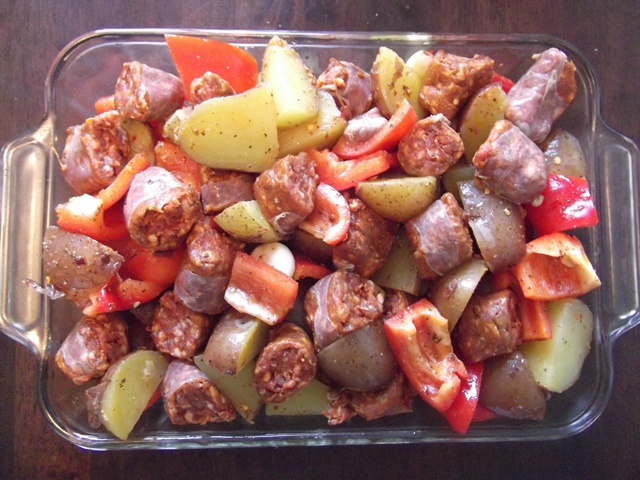
Parboil whole potatoes until just fork-tender, about 15 minutes. Drain and chop into quarters or eighths, to about an inch thick. Toss into a bowl with raw chopped chorizo, bell peppers, and garlic cloves.

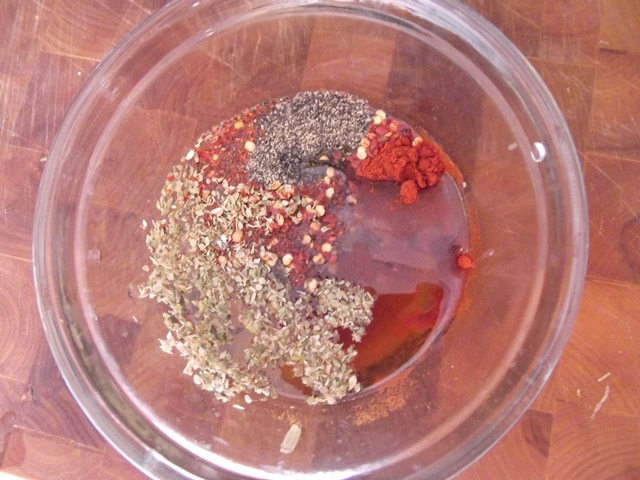
In a smaller bowl, whisk olive oil, lemon juice, one teaspoon of salt, pepper flakes, smoked paprika, black pepper, and oregano. Pour over potato mixture and toss to coat.

Pour the dressed potato mixture into a baking dish or roasting pan and bake for 20 minutes.

Using the same bowl you tossed your potatoes in (don’t rinse it!), toss your scallops with the remaining 1/2 teaspoon of salt. After 20 minutes, pull the dish out of the oven and carefully nestle the scallops in with the potatoes and sausage.

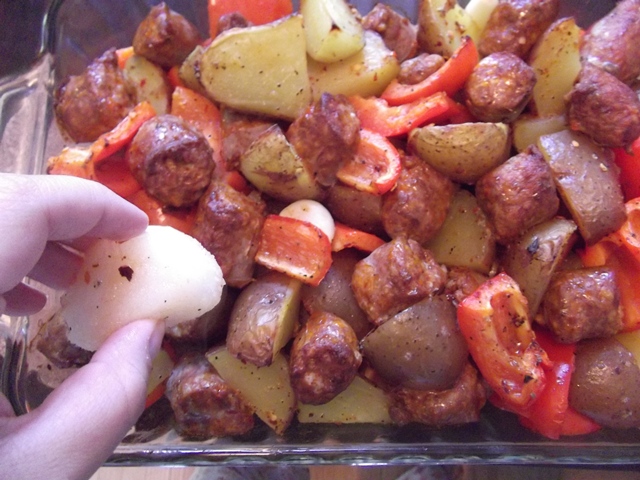
Cook for an additional 20 to 25 minutes, until potatoes have browned and scallops have turned lightly golden.

Meanwhile, place parlsey, garlic, lemon zest, and salt in a pile on your cutting board and chop everything finely. Really mince the hell out of it. Throw it into a bowl and mix with the red pepper flakes.

When your dish has finished baking, pull it out and sprinkle with the parsley mixture. Drizzle with a bit of extra virgin olive oil and serve hot, with crusty bread for sopping and a salad to make you feel virtuous.


Scotch eggs.

I wish I was in a place where we could talk warm yellow heirloom tomatoes, or crisp radishes drizzled with olive oil and speckled with flecks of ashy black salt, or fat red berries dipped in vanilla sugar. But I am in Vancouver, with wet socks because my galoshes both now have holes in the soles, half wondering what the hell I’m still doing here.

When we talk about our respective cultures, those muddled European backgrounds we cling tenuously to, what is important to Nick and I is less about the place – his heritage is roughly Dutch in the same way that mine is vaguely British – than it is about the food. When people talk about where they’re “from,” often they talk about a somewhere else, as if they really came from there, as if they identify more strongly with some other place than the place they are now. And maybe they do.

In the ongoing (and tedious) pursuit of a novel, I have been writing about the idea of reclaiming my culinary heritage. Mine, I guess, but to be honest the further I go with it the less sense it makes. Are the meals I grew up eating the only thing that counts? Are my grandmother’s recipes more significant than the dim sum I have eaten almost every weekend for more than half my life? Is the influence of Nick’s family recipes worth mentioning, or are they too new to count? I don’t know.

When I started writing about my grandmother’s shortbread, I had a direction in mind, but the further I go, the more I realize that culture is fluid, and I am Canadian which means nothing and everything all at once. Meatballs and maple syrup and smoked salmon and Szechuan green beans and Southern Barbeque are equally weighted here. And I loathe ketchup chips.

Being from the west coast of Canada, my food is everyone’s food – this is the meltiest melting pot I’ve ever seen. Way to add confusion, Emily. Never finish that culinary memoir, you feeb. So as much as I’d like to be able to write a simple book of recipes that speak to a simple culinary heritage, I can’t. My grandparents never ate tofu.

Do you claim a cultural heritage different from the one in the place you grew up? How do you self-identify, and is it more complicated than simply “the place you grew up is where you’re from?”

On days like these, after weeks of rain, the food that comforts Nick and I the most is the kind of food that goes with a lot of cold cheap beer. Food that is fried and rich and bad for us. Maybe the culture we most subscribe to is pub culture, as we are creatures of deep-fried habit. Tonight we ate a dish that has its origin in Scotland, where my grandmother’s family emigrated from. No relative of mine ever made it for me, but I make it whenever it’s rained too long, and whenever the pantry runs low and payday is still a long way off.

For Scotch eggs, I recommend starting with soft-boiled eggs. You will not overcook the yolks this way, but they will be set and cooked through by the time you’re done. Peel the eggs carefully.

Scotch eggs

  • 4 soft-boiled eggs*, shells removed
  • 1 lb. lean ground beef
  • 1 1/2 cups bread crumbs, divided
  • 1/2 medium onion, grated
  • 1/2 cup finely grated carrot
  • 1/4 cup fresh parsley, finely chopped
  • 3 cloves garlic, minced
  • 1 tbsp. vegetable oil
  • 1 tsp. Worcestershire sauce
  • 1 tsp. coarse salt
  • 1 tsp. ground yellow mustard
  • 1/2 tsp. dried oregano
  • 1/2 tsp. ground black pepper
  • 1 egg, beaten

Combine ground beef, 1/2 cup of bread crumbs, onion, carrot, parsley, garlic, oil, Worcestershire sauce, salt, ground mustard, oregano, and black pepper in a large bowl, and mix with your hands until thoroughly blended.

Divide meat mixture into four even portions. Spread meat across your palm – about twice the width of your egg – and press to an even thickness. Carefully wrap your egg in the meat mixture, pressing the meat to ensure the egg is completely sealed within.

Dip each meat-wrapped egg in the beaten egg, and dredge through bread crumbs until coated on all sides.

Fry in 1/2″ of oil over medium high heat, about four minutes per side, making quarter turns until each side is golden and meat is cooked through.

Remove to a plate lined with paper towel. Salt to taste.

Serve hot, with mustard as an accompaniment.


* I have never had any trouble using soft-boiled eggs, but my sister-in-law made these and found soft-boiled eggs hard to work with. Feel free to hard-boil the eggs; they might be easier to work with.

Yellow curry braised beef.

I spent the last half of my teens and the first half of my twenties playing field hockey for the Vancouver Rowing Club, and every Victoria Day long weekend I would dig through the piles of laundry I always left unfolded to find my jersey, skirt, and Dutch-soccer orange knee socks and then head out to the pitch to play in the Vancouver Invitational Tournament. Except for one weekend when it was so hot I spent the afternoons in the beer garden in my sports bra, it rained. In nine of ten years I spent the weekend soaked, my toes wrinkling in my turf shoes, my skin slick with a layer of moisture that never seemed to dry.

I was awful at field hockey. I am too competitive and would get aggressive at all the wrong times, but I never had the skill to back it up. And I don’t run very fast. In the wild, I could be taken down by the oldest, most arthritic bear or mountain lion. Nevertheless, in all the years since I played, I miss it most in the weeks before the May long weekend. And then the weekend arrives, and it rains, and I remember peeling my polyester jersey off my damp, sticky body, and I still miss it. There were always cute Australians to look at, and the beer was cheap and plentiful.

For half the time I played, I was dating one of the goalies on the premier men’s team. When that ended badly (oh so badly!) I had already been subtly trying to trick Nick into spending time with me, and when he finally relented, I found other things to do on the long weekend. I couldn’t go back to hockey, but at that point, I didn’t want to. The possibility of an awkward run-in was enough to keep me from trying to dig up those socks again.

But, you know … Facebook. I am still friends on Facebook with a few of the women I played with, and I see that they’re playing this weekend and I miss it all. I liked playing field hockey, and the interesting characters that comprised the teams I liked to play on. I am starting to wonder if I can have all that, and still avoid the awkward run-ins, and somehow convince Nick to come watch and cheer me on. Maybe not on the May long weekend, of course. It’s always so rainy.

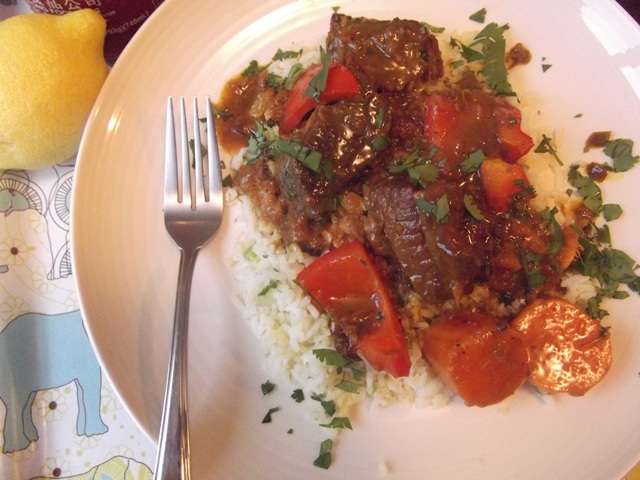
This May long weekend has been fairly quiet, and it has been raining steadily since yesterday. So today has been a day for laundry and long hours spent braising meat in fragrant coconut milk and warm spices, and for remembering fondly how it feels to be so damp from the vantage point of my warm apartment, in my pajama pants fresh out of the dryer.

Yellow curry braised beef

  • 2 tbsp. coconut oil (or vegetable oil)
  • 3 to 4 lbs. cubed beef brisket or boneless chuck (sometimes sold as stew meat) – short ribs would also work well here
  • 1 tsp. salt
  • 1 onion, diced
  • 2 tbsp. minced ginger
  • 2 tbsp. minced fresh lemongrass
  • 2 tbsp. minced fresh cilantro stems (leaves reserved)
  • 6 cloves garlic, minced
  • 2 jalapeño peppers, minced (to minimize the spice, you can remove the seeds and the membranes before chopping)
  • 2 tsp. ground turmeric
  • 2 tsp. ground cumin
  • 1 1/2 tsp. ground coriander
  • 1 tsp. ground black pepper
  • 1/2 tsp. ground cardamom
  • 1/4 tsp. ground cinnamon
  • 3 tbsp. fish sauce
  • 3 tbsp. brown sugar
  • 2 14 oz./398 ml cans coconut milk
  • Zest and juice of one lime
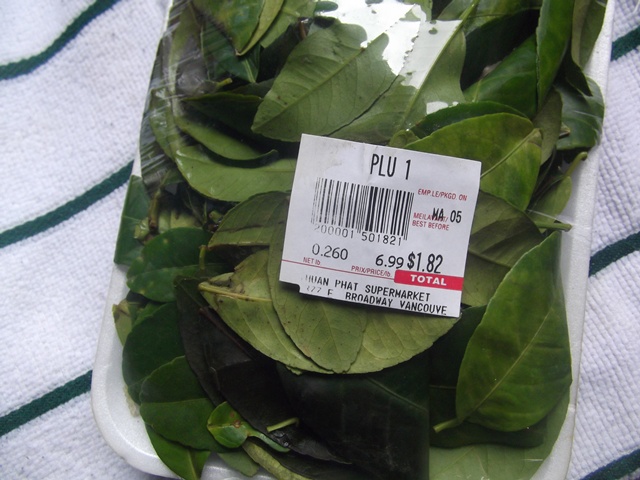
  • 3 to 4 kaffir lime leaves (optional)*
  • 2 red Thai bird chilies (optional)
  • 1 lb. cubed sweet potato
  • 1 medium red bell pepper, chopped

Preheat your oven to 325°F.

In a pot you can use on the stove and in the oven, melt coconut oil over medium-high heat. Add beef pieces, and season with salt. Brown beef deeply on all sides, about three minutes. You want to get good colour on the beef, but you don’t want to burn it. When beef is browned, remove it and set it aside.

To the same pot, add onion, ginger, lemongrass, cilantro stems, garlic, and jalapeño peppers. Sauté until fragrant, two to three minutes. Add turmeric, cumin, coriander, black pepper, cardamom, and cinnamon, and cook another two to three minutes, until the bottom of the pan looks dry.

Add sugar, fish sauce, coconut milk, and lime. If you have kaffir lime leaves and Thai chilies, add these to the pot as well – I leave my chilies whole. Add beef back to the pot, with any meat juices that have collected in the meantime – there’s good stuff in there. Cover, and put on the middle rack of your preheated oven. Braise for 3 to 3 1/2 hours, stirring occasionally.

In the last 45 minutes of cooking, add your sweet potatoes to the pot, and re-cover.

Remove the pot from the oven, uncover it, and return it to the stove over medium heat. Add bell peppers, cooking an additional 10 minutes until peppers are tender and the sauce has reduced slightly. Serve over rice, with a sprinkling of fresh cilantro.

*You can buy kaffir lime leaves at most Asian markets. They are very inexpensive, so if you end up with a lot of them, stick them in a baggie and store them in the freezer – they’ll keep a few months if well sealed, and you can use them to liven up curries of all kinds.

Nasi goreng.

For the past six months, with one of us being off work and on parental leave, after the rent and car insurance come out there isn’t much left for the first two weeks of the month. I spent what little was leftover on clothes to wear to job interviews and a cute outfit for the baby, and why can’t I stop buying cute outfits for the baby? He’s like a damp, squirmy doll. One that never stops eating. The kid lives for food – convulses for it, even – so maybe the outfits are a kind of reward for fitting in with the rest of us around here?

Anyway, we’re in for a week or two of pantry meals.

One that we eat frequently during times like these is nasi goreng, a spicy Dutch/Indonesian fried rice dish I learned about the first time I went to meet Nick’s family. There’s a Dutch breakfast restaurant near us that serves nasi goreng wrapped in a pannekoek. The Dutch are into it.

It was Nick’s and his sister’s birthday when he first brought me over, and he’d requested nasi goreng with beef for their special birthday meal. I wasn’t eating red meat at that point, so his mom made me a separate meal (Relationship tip: start out high-maintenance, especially with your in-laws!). I was grateful – “nasi,” as they called it, looked semi-unappealing due to the unusual and disgusting (to me) addition of fried bananas.

Nasi goreng is one of Nick’s favourite dishes, so fortunately I would encounter it again later after I had re-embraced red meat and understood that bananas aren’t mandatory. Side note: I am living proof that there is someone for everyone, even if he probably did something awful in a past life to deserve this. He doesn’t like bananas either.

There are no actual unappealing parts to this dish, which I would come to learn (bananas aside). It’s salty and spicy and meaty, and there is so much garlic in it (I use nine cloves, but you can use less if garlic isn’t its own food group at your house). It’s especially good after Christmas or Easter dinner when you end up with a lot of leftover ham – a little diced ham goes a long way in this. If you have a lot of leftover chicken, dice that up instead of the ground meat. Add shrimp if you’ve got it. Make it vegetarian with smoked tofu and a few handfuls of frozen peas.

This is best if you have a lot of leftover rice, but more often than not I end up making rice fresh due to my having forgotten to plan ahead. We use brown rice, but you can use whatever you want – three to four cups of cooked rice is about what you’ll need. And if you don’t have the ingredients I have listed below, substitute freely – soy sauce and sugar for the ketjap manis, sriracha for the sambal oelek.

Nasi goreng

(Serves four to six as a main course.)

  • 2 cups long-grain brown rice
  • 3 cups vegetable stock
  • 3 tbsp. vegetable oil
  • 6 to 9 cloves of garlic, sliced
  • 1 shallot, roughly chopped
  • 2 tbsp. sambal oelek*
  • 2 tbsp. ketjap manis (sweet Indonesian soy sauce) **
  • 2 tbsp. fish sauce
  • 1 tbsp. sesame oil
  • 2 tsp. lime juice
  • 3/4 tsp. ground cumin
  • 1 lb. lean ground beef
  • 2 cups grated carrot
  • 1 cup finely sliced cabbage, packed
  • Salt and pepper

Accompaniments

  • One fried egg per serving
  • Cilantro, for garnish
  • Chopped scallions
  • Additional sambal oelek

In a medium heavy-bottomed pan with a tight-fitting lid, over medium-high heat, bring rice and vegetable stock to a boil. Reduce heat to low, cover, and cook for 45 to 50 minutes. Set aside and allow to cool completely, which will take between two and four hours.

In a large pan over medium-high heat, sauté garlic in oil until it is golden and crispy but not burned (two to three minutes – any longer and it will become too bitter). Remove garlic from pan with a slotted spoon, and drain garlic on a plate lined with paper towel. Set aside.

In a blender or food processor, purée the shallot with the sambal oelek, ketjap manis, fish sauce, sesame oil, lime juice, and cumin. Set aside.

Add ground beef to the now garlic-infused cooking oil in your hot pan. Continue cooking over medium-high heat until meat has browned and is cooked through. Add cooked rice, shredded carrot, and cabbage. Pour shallot mixture over pan contents and stir to coat. Cook an additional three to five minutes.

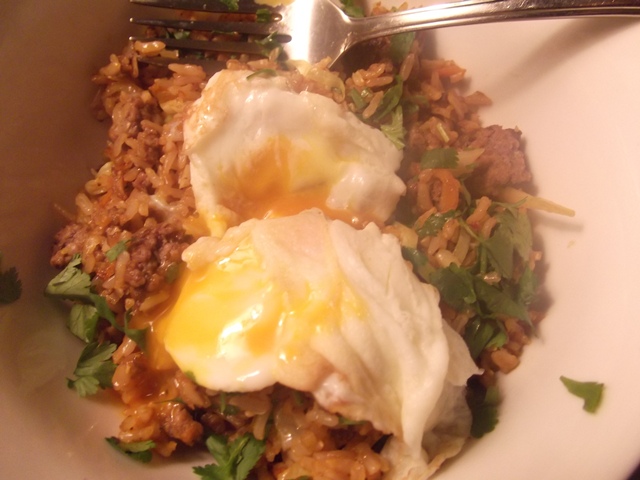
Stir the crispy garlic into the rice. Taste, adjusting seasonings with salt and pepper to taste. Serve hot, topped with a sprinkle of cilantro, some scallions, and an egg fried over-easy, so that the yolk is still runny. Nick always adds more sambal oelek, and then apologizes as he douses the whole thing in Maggi sauce.

*I find sambal oelek hotter than our usual hot sauces, so tread lightly if you’re spice-sensitive. If you don’t have sambal oelek, Chinese chili garlic paste will work, and so will Sriracha (which goes with everything).

**If you don’t have or can’t find ketjap manis (also called kecap manis), use two tablespoons soy sauce with one tablespoon brown sugar. You can find ketjap manis as Asian grocers or Southeast Asian specialty markets – I got a huge bottle for  less than three dollars at Thuan Phat Supermarket on Broadway and Prince Edward in Vancouver (though I hadn’t had much luck finding it at T&T). You can also find it online.

Sugar sandwiches.

If you read a lot of parenting blogs or websites (and oh, for the love of all the things please don’t), one of the myths you might encounter is the one about how if you do everything right, in your fourth month post-partum the pounds will literally melt off of you and you will suddenly weigh what you did in high school. It’s almost month five, and I did everything according to the literature but noticed this morning that my top is more muffin-like than it ought to be and my chins are more numerous than I remember. So you know what? Screw it. Sugar sandwiches.

By this point it’s well established that most of my happiest memories involve food, so it makes sense that some of my earliest recollections of my grandparents involve treats. My Dad’s mother died when I was very young and I don’t recall very much about her but I do remember sitting at her kitchen table, and the way my skin felt beneath my thin cotton undershirt against the cold vinyl of her kitchen chair, and the way my spoon scritched on the bottom of my bowl of Rice Krispies. I remember scraping brown sugar off the bottom of the bowl, my spoon holding more sugar than cereal, and how much better these Rice Krispies tasted than any I had eaten before.

More than 25 years later there is no more unhealthy breakfast cereal for me than puffed rice, because I can’t have it without adding too many heaping tablespoons of brown sugar – there is more sugar in my Rice Krispies than in five bowls of anyone else’s Cap’n Crunch. There can be no breakfast cereal in my cupboards.

My Mom’s Dad had as much to teach me. His penchant for sweets remains unrivaled by anyone I’ve ever met. Around my grandparents’ house there were always dozens of boxes of chocolate, some stashed in his usual spots – the kitchen, the living room, other parts of the living room, every container or drawer on his side of the bedroom – and some stored in the freezer for when his reserves ran low. At the end of every visit he would send me home with a sandwich bag full of the better flavours – hedgehogs, caramels, and never the gross orange cremes.

It was watching my grandfather that I learned about sugar sandwiches.

To make a sugar sandwich, you need good whole-grain bread (the whole-grainier, the better), non-fancy peanut butter, and brown sugar. After admitting on Twitter that I really don’t like natural peanut butter, I was comforted to discover that most people have strong feelings about, or at least have considered, what makes good peanut butter, and most of the time one remains loyal to the peanut butter of her childhood. And while natural peanut butter makes a good ingredient in other things, in sugar sandwiches we do not mess around. Use the kind of peanut butter you are faithful to.

You must smear a tasty amount of peanut butter evenly upon one entire side of each of two pieces of bread. Then add the sugar to one of the pieces of bread, spreading evenly over the peanut butter, even to the edges of the slice. How much sugar you use depends on you, but I have the kind of weak character that compels me to unapologetically don footed pajamas for company, so I use a little more than a rounded tablespoon.

At that point, you can slap your bread together and shove the whole thing in your mouth, or you can get a little bit fancy. You can add a few flecks of fleur de sel which will make your sandwich quite lovely if your peanut butter isn’t salty. You can jump back in time and toast each slice before peanut-buttering them up. You can shove the whole deal in a panini press, or you can put the sandwich under the broiler. I like the last option, because the effect of a crunchy exterior giving way to a soft interior is a sensation I enjoy. Warm, a sugar sandwich tastes very similar to fresh peanut butter cookies but it only takes two minutes to make.

Eat your sugar sandwich on the couch, with your feet jammed between the cushions and your legs covered by a blanket. You may want to have a book handy. A glass of milk or a cup of tea will complement the sandwich nicely. Linger long over your snack, drink, and book, and then indulge in a nap afterward. Calorie-counters and diabetics will take issue with this luxury, but the important thing is that Grandpa would heartily approve.

Kasha varnishkes.

I like clutter. I like my visual field to be jam-packed with stuff that sparkles or is brightly coloured or that I can look at and instantly conjure some memory of some time or place, whether real or fictional – I’m beginning to wonder how many of the things I remember actually happened and how many I invented or just read. In the recklessly unencumbered pre-baby era, Nick and I would spend many of our weekends flitting from brunch to thrift stores and flea markets, picking through piles of junk to find what we believed to be treasures. I once joked to my friend Dan that it wouldn’t be a big deal for us to move cross-country, as everything we own could be replaced in thrift stores when we got there. He agreed, which should probably be kind of insulting. I mean, some of our stuff is from Ikea, so it’s not all junk … right?

Among the beer steins and vintage “art,” one of my favourite things to discover among the rubble was cookbooks, especially the kind from the 70s and 80s with their deliciously terrible food styling and orange-tinged photography. One of my biggest regrets is that I didn’t buy the 1987 edition of Vogue Entertaining when I saw it at the VGH Thrift Shop for $13 – the jellied salads! The all-brown buffet of “Indian food!” The palm fronds in crystal vases! (Side note: That this is one of my biggest regrets speaks either to a total lack of ambition or a history of unapologetically not giving a shit. I can’t decide which is worse.)

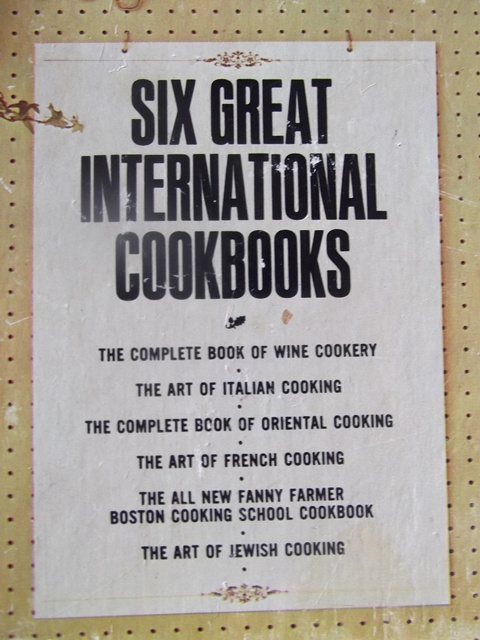
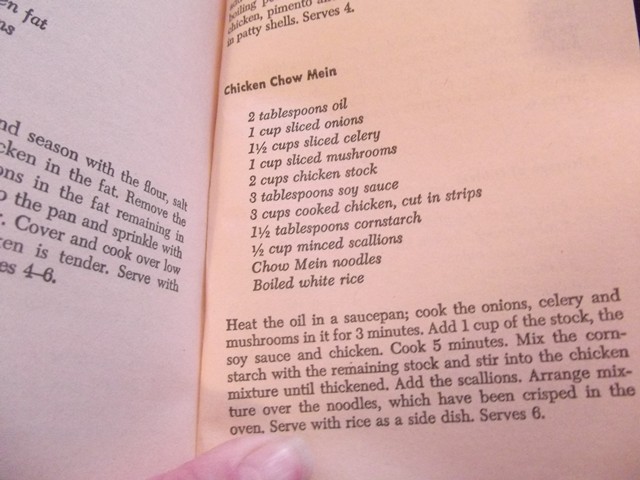
One of my favourite cookbook finds to date came from the Cloverdale Flea Market, where we spent one sunny afternoon searching for more beer steins, kitten art, and light-up statues of Jesus. In a pile in the back of one man’s trailer, I found a collection of six paperback books on “international cuisine,” which continues to delight all these years later. My favourite is the book on Jewish cookery, which does not contain a recipe for matzo ball soup, but which boasts recipes for both Cantonese Chicken and Chicken Chow Mein.

Not knowing a lot about Jewish food, this book has been my introduction to a cuisine that only seems to get airtime in December and April. And while I have yet to follow a recipe to the letter, a few recipes have been jumping-off points. One of these, for kasha varnishkes, is an excellent (if not beautiful) dish (“delicious and nourishing beige noodle mush” is a pretty accurate description) that uses pantry staples for a cheap starch alternative.

Buckwheat is one of those super-healthy things you’re supposed to eat to lower cholesterol. It’s high in fibre, it’s cheap, and it’s quite tasty. And it has diverse applications – Food52 has a compiled a pretty thorough list. You can find roasted buckwheat groats, also known as kasha, at natural foods stores and Eastern European delis and groceries. Kasha varnishkes are lightly sweet, thanks to the onion and apple, and are best served alongside sausages or roast meats and pickles, or with veggies for a full and hearty meal. You can use vegetable stock to make it vegetarian-friendly.

Kasha varnishkes

(Serves four as a side-dish.)

  • 6 tbsp. butter, divided
  • 1/2 cup roasted buckwheat groats
  • 1 egg
  • 2 cloves garlic
  • 2 cups chicken or vegetable stock
  • 1/4 lb. small egg noodles, such as spaetzle
  • 2 cups chopped apple, diced to about 1/2″
  • 1 medium onion, diced
  • 2 tbsp. chopped fresh parsley
  • Salt and pepper, to taste

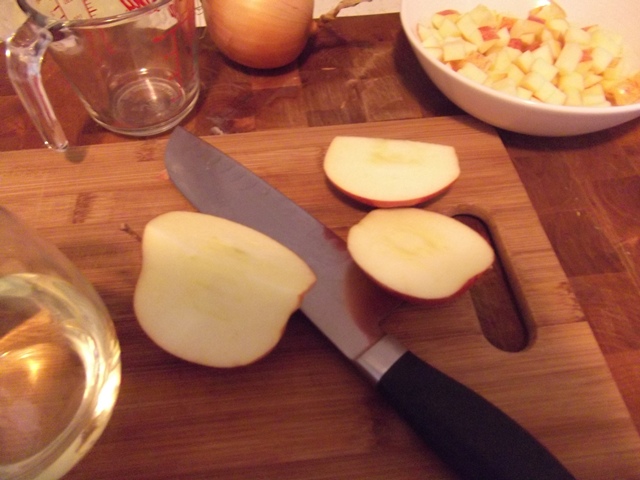
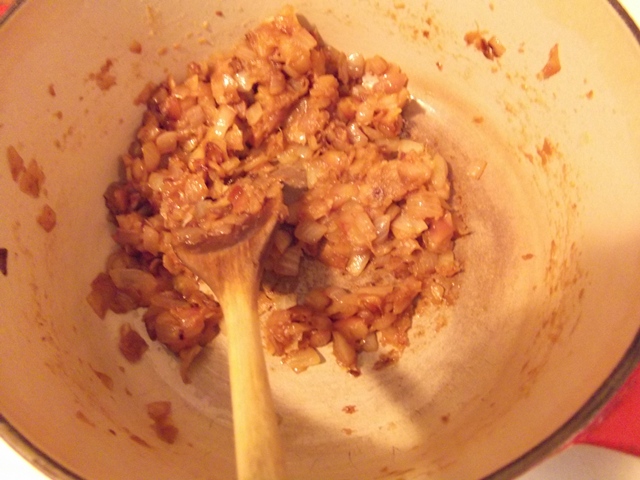
In a large, heavy-bottomed pot over medium-high heat, melt two tablespoons of butter and stir in apples and onions. Cover, cook ten minutes, then remove lid and reduce heat to medium. Stir frequently for 20 to 30 minutes, until apples and onions have caramelized and shrunk down considerably.

Meanwhile, heat three tablespoons of butter in a pot over medium-high heat. In a bowl, stir buckwheat and egg until thoroughly combined. Pour into pot, stirring to keep groats from sticking together. Keep stirring until egg is cooked and appears dry. Add garlic, then chicken stock. Reduce heat to medium and simmer until liquid is absorbed and groats are fluffy, about 15 minutes.

In another pot, bring 2 1/2 cups of water to a rolling boil. Add noodles, and cook until just al denté (refer to cook time on package). Drain.

Stir cooked groats and drained pasta into the apple and onion mixture, add an additional tablespoon of butter, stirring to coat. Taste, adjusting seasonings as needed. Stir in parsley, and serve immediately.

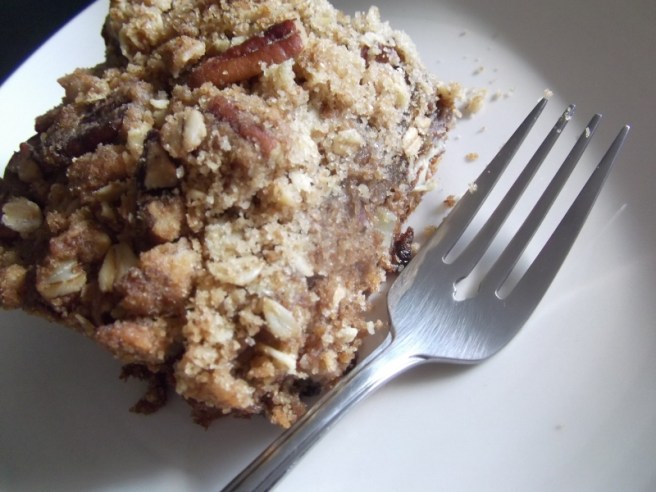
A recipe for apple cake.

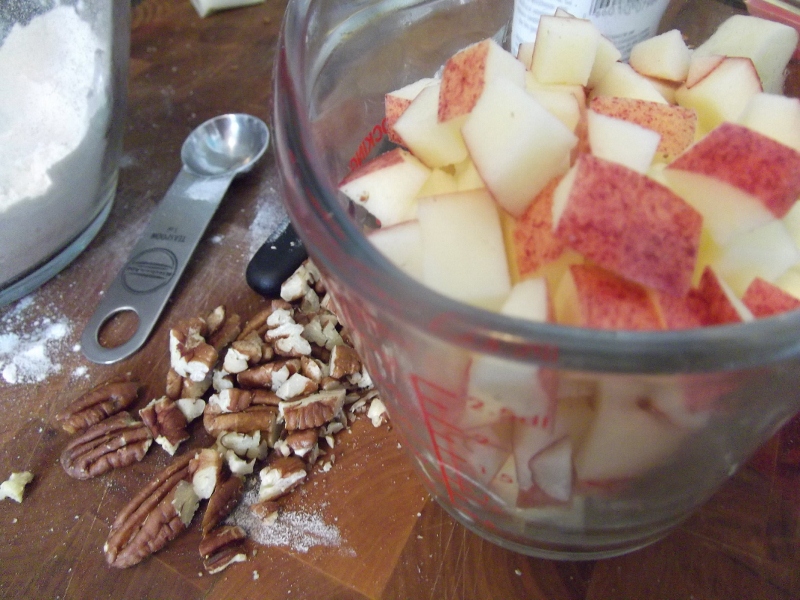
My mom sent me home with big bag of apples last Sunday, and though I eat a lot of fruit and put apples in Nick’s lunch bag each morning this week, I still have quite a few left over. I also had the last of a bag of oatmeal in my cupboard, and a few handfuls of pecans left in my freezer. I have currants, and they’re drying out. And Nick’s dad called to ask if he could come see the little pork chop this afternoon, as it’d been awhile and he was headed out of town so it would be a while longer before we’d see Nick’s parents again. Last night some friends came over for fried chicken, and this morning my apartment smelled like fried grease and dirty dishes.

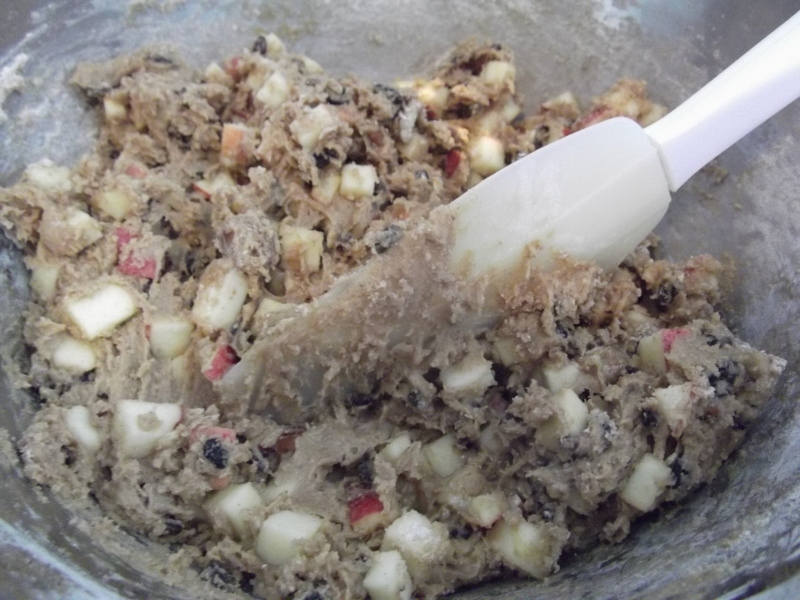
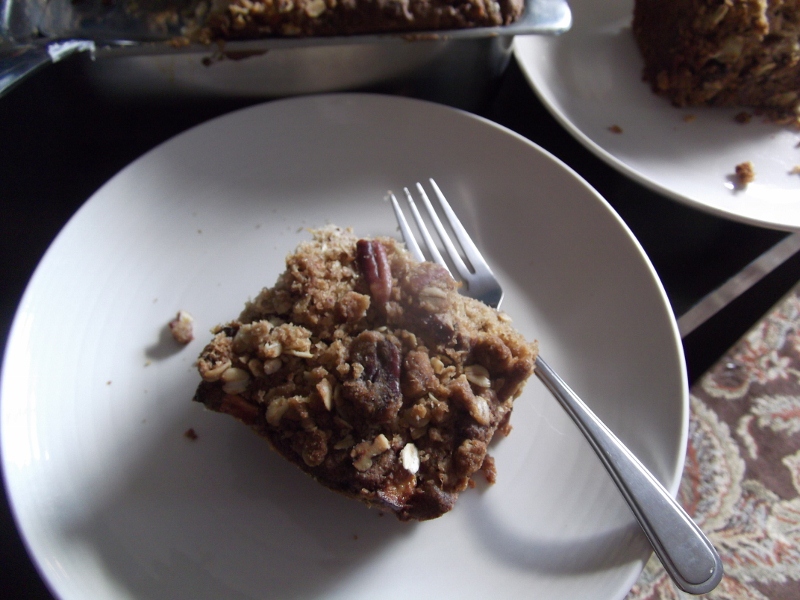
The situation was ripe for cake-baking, and oh, I thought I was clever. I would whip up a quick cake batter, toss in a couple of those apples and nuts and maybe the currants, and maybe throw an oaty, streusely topping on the whole thing so when Nick’s dad arrived at least there would be something to go with a cup of tea, and maybe it would seem like Nick and I have our shit together a little more than we actually do. I shoved most of the dishes into the sink and covered them with soapy water and got to baking.

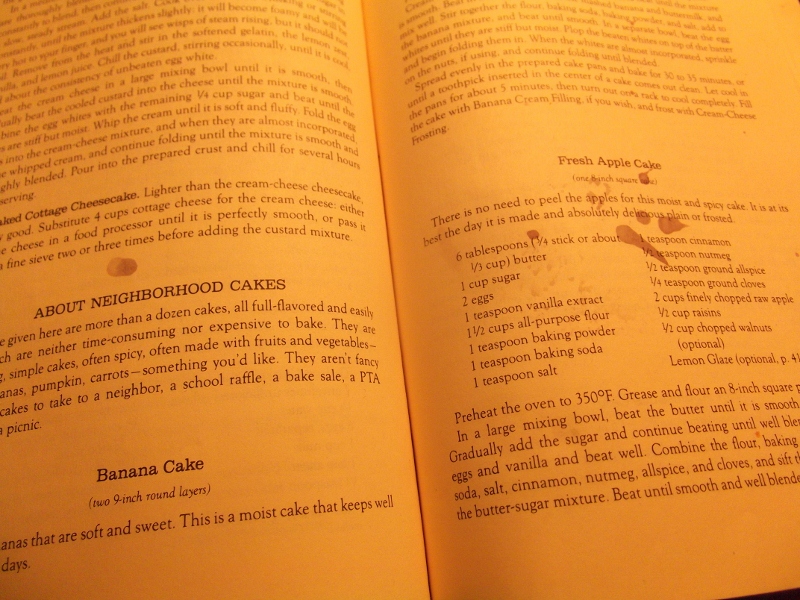
And then I pulled my well-worn copy of Fannie Farmer off the bookshelf to check one little thing, and the book flipped open to a spot I use quite a bit, to a recipe for an apple cake with raisins and walnuts, one so close to what I was doing that I am certain I didn’t invent it after all. I make the sour cream spice cake on page 344 quite often, and there was the apple cake, just the other side of the page on 343 where it’s been all this time, where I must have seen it a million times but never thought about it.
In high school, Hunter S. Thompson was my favourite writer. I bought every single one of his books, including an exorbitantly priced used copy of Curse of Lono – illustrated by Ralph Steadman, it cost a little more than I made in four weekends working the cash register at Farmer Ken’s. Every night I would fall asleep watching Fear and Loathing in Las Vegas. I replaced my VHS copy three times, and the DVD twice. I own a copy of the not-popular Where the Buffalo Roam, and even if it isn’t brilliant, it’s still important to me.

It was reading Hunter S. Thompson that I began to understand how a literary voice could be distinct, and I poured myself so deeply into his writing that when I typed my own words, they were accented with his. Without practice and spending the time to figure out my own voice, I emulated his (poorly). I became editor of my high school paper as part of my journalism class in Grade 12, and though it started as a respectable publication, I was unjustly handed a C+ at mid-term for my efforts by a teacher who graded on personality. I stopped caring about journalistic integrity and by the end it was my own personal tabloid and rant rag, a tribute to my misunderstanding of Gonzo Journalism. The school’s administration refused to approve publication the last issue due to the amount of questionable content, which I thought meant I was totally badass. In hindsight, I was probably just a jackass.
By the time I finished university, I had fallen under the sway of Kerouac and Vonnegut and Whitman and Ginsberg, as one does, and went through phases of trying to be more like each of them, with predictably little success. The hardest thing about learning to write is learning to write simply and honestly, and to learn to distinguish the difference between being influenced and copying outright.

Like a lot of people, until 2008 I was pretty certain the Internet was for nerds (forgetting how big a nerd I have always been). I didn’t know what blogging was, but it sounded lame. And then I discovered The Bloggess, and I related again to a weird person doing awesome things with words, and it was like I was 17 again – “I can do that!” I thought. And so I started this blog, and again couldn’t help but copy another writer’s tone, her syntax, her delicious use of profanity and run-on sentences and sentence fragments. I am a little embarrassed about the whole first year or so of this site, because I was trying so hard to write in a way that I thought sounded good and that I thought people would like.

I feel like I have grown with this little blog, and now the words you read are written the way I would speak them. If in three years this embarrasses me, I’ll let you know.
Learning to cook is a lot like learning to write. You find recipes that suit you and what you have in the fridge, and you practice them, and eventually you think you have what it takes to ditch recipes and go it alone. And maybe you do. But if you are passionate about something you immerse yourself in the culture of the thing and soon you are using what you’ve learned, applying other people’s ideas and techniques and style to your work.

Every day I learn something new about food by eating in restaurants and watching the Food Network and reading food writing in magazines and books and on blogs. I cook almost every day, and I often write about it, but I would be lying if I said that every dish I’ve ever posted here is a complete original. Maybe there was no recipe in front of me, and maybe I wasn’t even thinking of a specific thing I’d seen or read about or tasted, but the influences are there. I’ve used thousands of recipes, and I don’t know the point at which the ones I’ve memorized and remade hundreds of times and tweaked and recreated become mine. Any recipe I’ve written myself has likely been touched by something I experienced somewhere else, or something I saw but thought I could do better.
Maybe you own a recipe the first time you change the recipe. Maybe a recipe is just a list of ingredients, and the ownership comes with the instructions and the presentation and the story you tell alongside the dish. Recipe ownership has been a topic of discussion on Twitter and at Dianne Jacob’s website (here, here, and here) about this, and I don’t know what’s right. There are only so many recipes for any one thing (for example, lemon bars), and chances are that if you search the ingredients for the thing you invented or that you make all the time without a recipe, Google will produce a match. Cooking is derivative. Writing can be too. And if you knowingly reproduce a recipe on your blog, you have a responsibility to give credit and link back to the original (or to where you can buy the book online) the same way that if you use prose that someone else has written, you would place the text in quotation marks and provide a reference.
Every English teacher I ever had claimed that there are only seven plots. In spite of this, people keep telling stories. So maybe there are no original recipes, and maybe every dish is just a creative re-telling. Maybe all cooks and all artists steal and the magic is not in making it look like you have created something when you haven’t, but in showing the way in which you’ve made something old new.
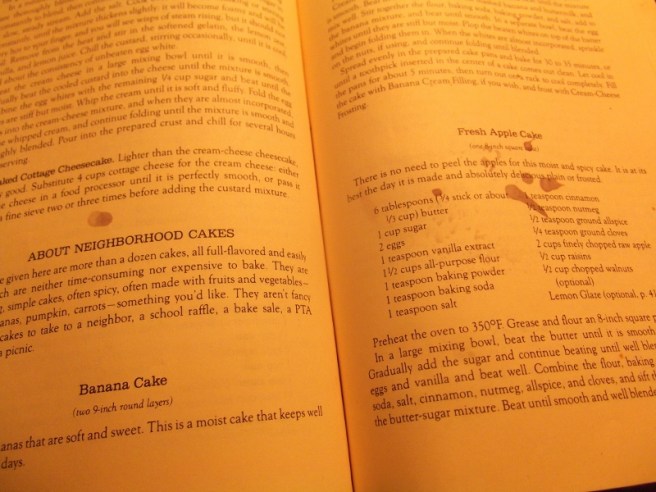
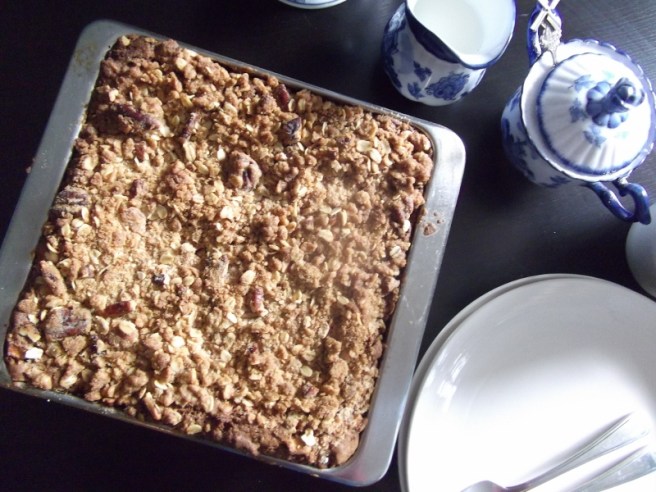
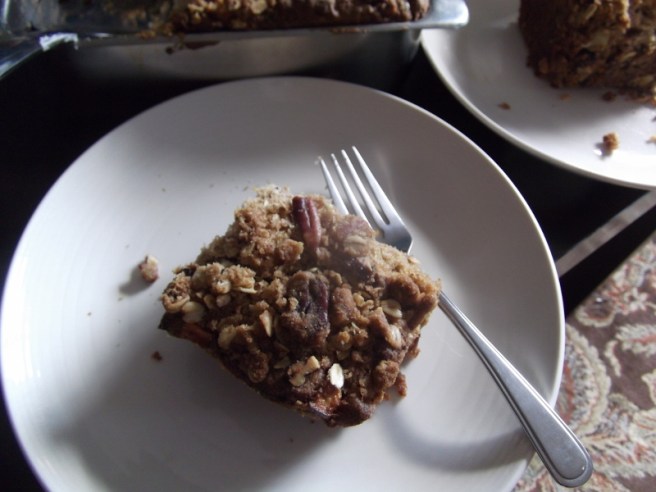
Anyway, here’s a recipe for apple cake. It’s kind of like this other apple cake I know. If you’ve got the Fannie Farmer Baking Book, it’s on page 343.

Apple Cake

Adapted from the Fannie Farmer Baking Book

Cake

  • 1/2 cup butter, at room temperature
  • 1 cup brown sugar
  • 2 eggs
  • 1 tsp. maple extract (no maple? Vanilla’s fine)
  • 1 cup all-purpose flour
  • 1/2 cup whole wheat flour
  • 1 tsp. baking powder
  • 1 tsp. baking soda
  • 1 tsp. salt
  • 1 tsp. cinnamon
  • 1/2 tsp. ground ginger
  • 1/4 tsp. nutmeg
  • 1/4 tsp. ground cloves
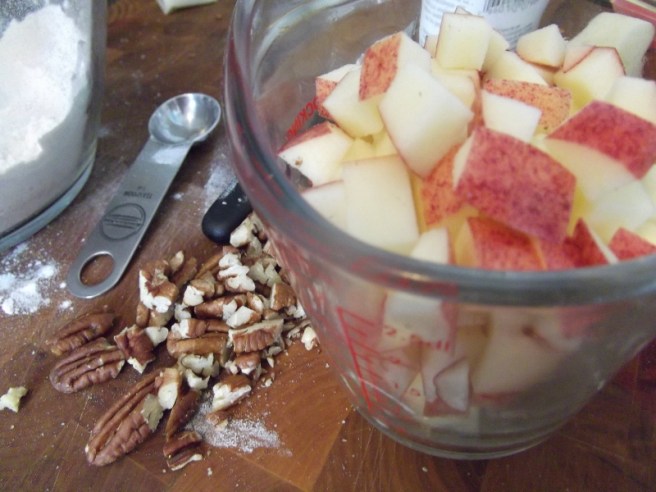
  • 2 medium firm-fleshed apples (such as Gala, Granny Smith, or Red Delicious), diced to 1/4″
  • 1 cup whole pecans, toasted and roughly chopped (divided)
  • 1/2 cup dried currants

Streusel:

  • 1/2 cup whole wheat flour
  • 1/2 cup brown sugar
  • 1/2 cup rolled oats
  • 1/4 cup butter, at room temperature

Preheat oven to 350°F. Butter an 8″x 8″ cake pan.

In a medium bowl, combine butter, sugar, oats, and half of the pecans. Mix with your hands until the mixture resembles coarse crumbs. Set aside.
In a large bowl, beat butter and sugar until creamy. Add eggs, one at a time, beating continuously until batter is smooth. Add maple extract.
In yet another bowl, add both types of flour, baking powder, baking soda, cinnamon, ginger, nutmeg, and cloves. Whisk to combine.

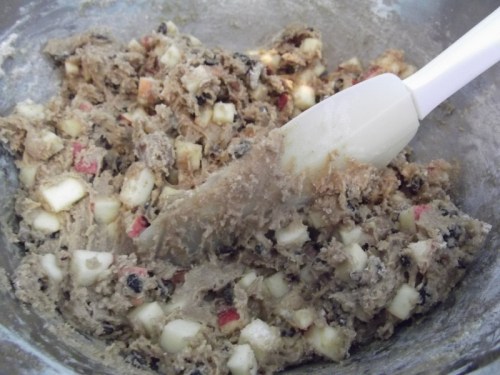
Stir flour mixture into wet ingredients until just moistened. Fold in apples, remaining pecans, and currants.

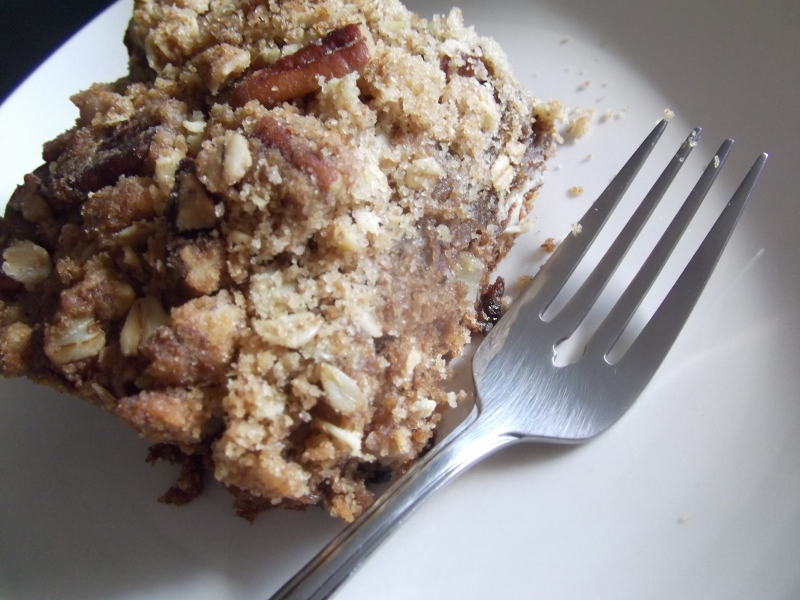
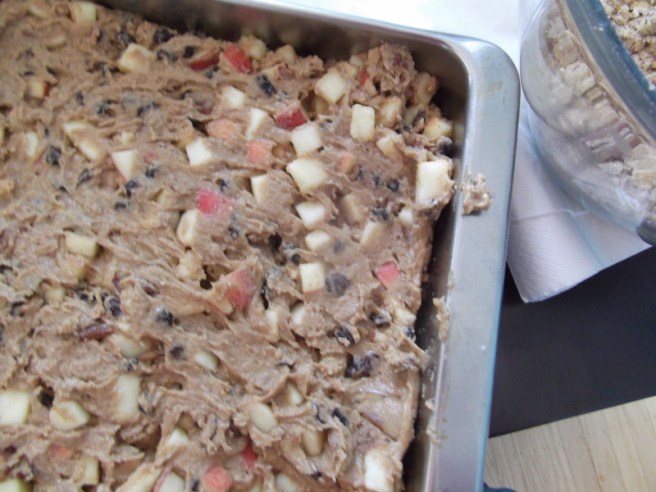
Pour into the prepared baking dish. Sprinkle oat mixture over top of the batter, and then bake for 40 to 45 minutes, or until a toothpick inserted into the centre of the cake comes out clean. Serve warm, with tea or coffee. You can say you invented it, if you like.